Ultra-processed foods, such as packaged snacks, cookies, chips, and many ready-to-eat products, make up a large part of the modern diet. Some researchers argue that these foods should be treated more like tobacco because of their links to poor health and the ways companies have used additives and marketing to make them more appealing.
In this lesson, we examine the comparison between tobacco and ultra-processed foods and consider whether stronger regulation may be needed. Researchers point to the influence of former tobacco companies in the food industry, while public health experts say growing scientific evidence and public support could lead to new policies, lawsuits, and restrictions.
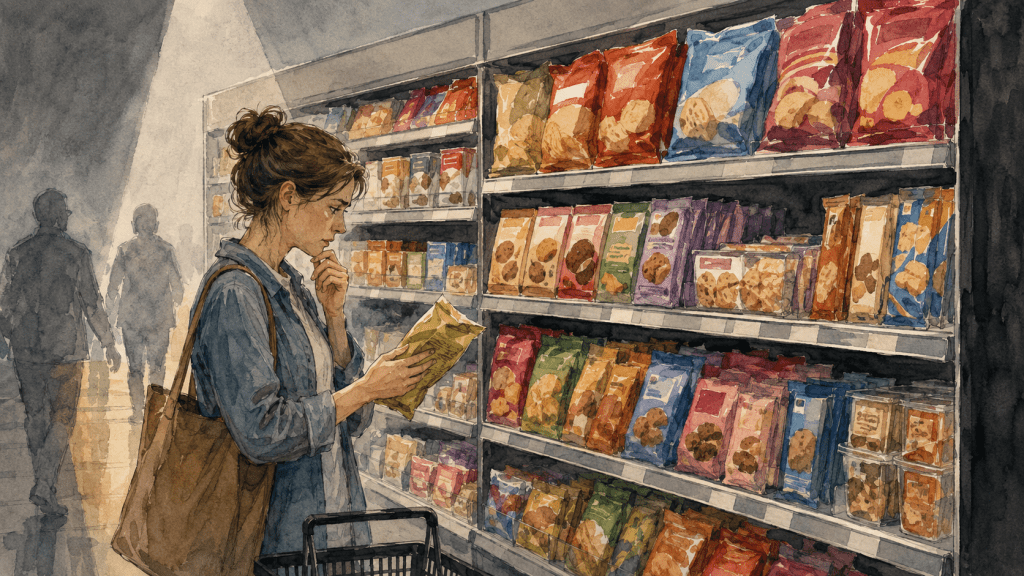
| Ultraprocessed foods are the new Tobacco War |
Warm-up question: Do you think governments should regulate unhealthy foods more strictly, or should people be free to make their own choices?
Listen: Link to audio [HERE]
Read:
Elsa: Should ultra-processed foods be considered the new war on tobacco? That’s the argument that dozens of researchers are making in a series of papers published today in the American Journal of Public Health. They say that these foods—things like packaged chips, snacks, and cookies, which dominate the American diet—have become major drivers of poor health, and the time to act is now. Here to tell us more is NPR health correspondent, Maria Godoy. Hi, Maria.
Maria: Hi, Elsa.
Elsa: Okay, so explain, what is the connection between tobacco and ultra-processed foods here?
Maria: Well, you know, back in the 1980s, tobacco giants bought up some of the biggest food firms. So, for example, Philip Morris used to own General Foods and Kraft, and R.J. Reynolds owned Nabisco. And then this was the era when ultra-processed food production really ramped up in the U.S.
Maria: Laura Schmidt is a researcher at UCSF, and she’s been studying old tobacco company archives. She says tobacco firms had amassed a lot of research on how to make cigarettes more pleasurable and addictive with chemical additives, and records show they deliberately applied this knowledge to food.
Maria: The very technologies that were used to figure out how to optimize the addictive properties of nicotine using added sugar and artificial flavorants, that core technology was transferred from the tobacco industry to ultra-processed food development.
Maria: Schmidt says these kinds of additives have now become one of the defining characteristics of what makes a food ultra-processed.
Elsa: That’s fascinating. Are there other similarities between, like, the tobacco playbook and the ultra-processed foods playbook?
Maria: Yeah, marketing strategies. So, for example, take the concept of king-size candies—you know, we’ve all seen these. That term “king-size” actually originated as a way to market longer cigarettes. Or, you know, for consumers worried about health, tobacco companies used to sell so-called light cigarettes. Well, they made light versions of foods, too.
Maria: Schmidt found a quote from a former Philip Morris CEO who said that ultra-processed foods and cigarettes were really similar businesses. He said they were both low-cost, consumer-packaged goods with a huge market.
Elsa: Okay, so that’s marketing. But ultimately, we are talking about people’s health here. And we know that cigarettes are linked to cancer, right? So, what does this research say about ultra-processed foods and health?
Maria: Well, there’s already a lot of research linking high consumption of ultra-processed foods to poor health outcomes—so, from obesity to diabetes to all-cause mortality. Several of the new papers here add to this body of evidence. For instance, one study followed more than 5,000 older Americans over 10 years, and it found that higher consumption of ultra-processed foods was linked to an increased risk of cognitive impairment and dementia.
Maria: Another study surveyed a nationally representative group of 2,000 adults about ultra-processed foods, and it found that across party lines, the majority of people who responded said they want the government to regulate them.
Maria: Here’s Lindsay Smith—she’s a professor of nutrition at the University of North Carolina and an author of one of these papers.
Lindsay Smith: It feels like we’ve reached a tipping point between the strength of the science, the public support, and then also political will. And those three factors combined, to me, suggest that we might be at a place where we start to see real policy action on this topic, the way that we did in tobacco.
Maria: You know, many policy experts say we are likely to see change at the state level first. We’ve already seen states pass bans on synthetic dyes in foods, for instance. And some experts say litigation may be next. In other words, state attorneys general filing suit against food companies alleging damage to the public health, sort of like the lawsuits we saw against tobacco companies in the 1990s.
Vocabulary and Phrases:
- driver of: a major cause or force behind something
- amassed: collected or gathered a large amount of something over time
- deliberately: intentionally; done on purpose
- optimize: to make something as effective or successful as possible
- playbook: a set of strategies or methods used to achieve a goal
- mortality: death, especially when discussed as a health statistic
- regulate: to control something through rules or laws
- political will: the willingness of government leaders to take action on an issue
- litigation: legal action or lawsuits
Fill in the Blank Use the correct word or phrase from the vocabulary list.
- Researchers studied the relationship between diet and long-term __________.
- The company faced major __________ after consumers claimed its products harmed their health.
- The company __________ years of customer data before launching its new product.
- Food companies often try to __________ flavor, texture, and convenience.
- The company used the same marketing __________ in several different industries.
- Even when public support is strong, change may not happen without __________.
- Some lawmakers want to __________ the sale of certain food additives.
- Poor diet is a major __________ chronic disease in many countries.
- The advertisement was __________ designed to appeal to children.
Comprehension Questions:
- Why are some researchers comparing ultra-processed foods to tobacco?
- What role did tobacco companies play in the development of some major food companies?
- How did tobacco companies use their research when developing ultra-processed foods?
- What health problems have been linked to high consumption of ultra-processed foods?
- What kinds of policy actions or legal actions might happen in the future?
Discussion Questions:
- Why are some researchers comparing ultra-processed foods to tobacco?
- What role did tobacco companies play in the development of some major food companies?
- How did tobacco companies use their research when developing ultra-processed foods?
- What health problems have been linked to high consumption of ultra-processed foods?
- What kinds of policy actions or legal actions might happen in the future?
 LanguageLeap