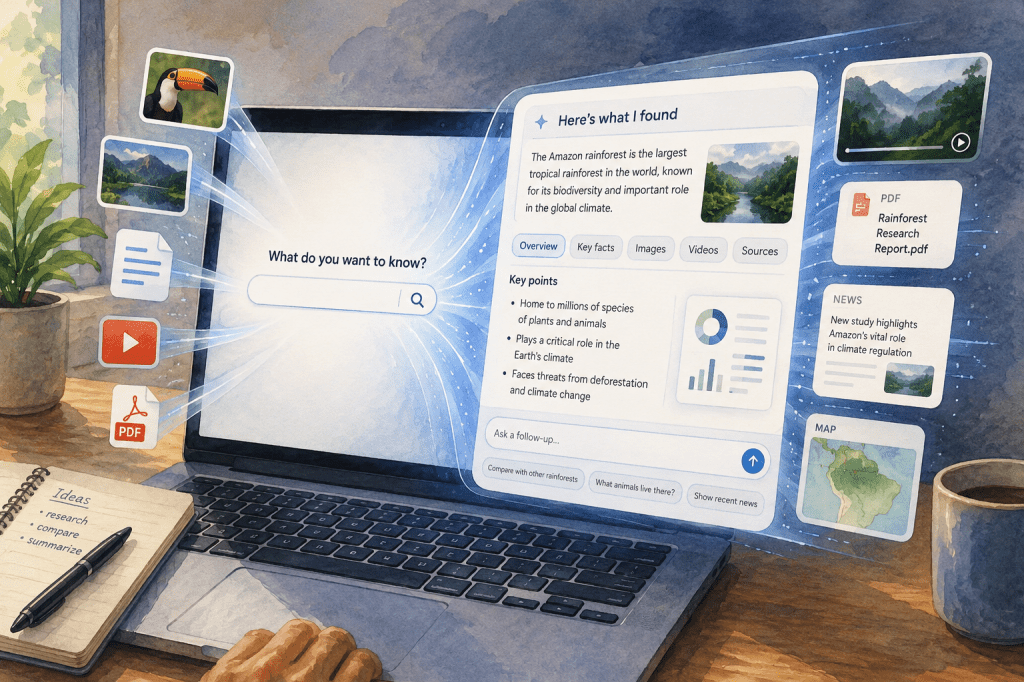
For decades, Google Search was built around a simple box where users typed a few words and received a list of links. Now, that familiar search experience is becoming more interactive and AI-driven, allowing people to ask longer questions, upload files or images, and even ask Google to monitor information for them over time.
In this lesson, we examine how AI is changing internet search and consider what this shift means for users, businesses, and websites that depend on search traffic. While AI-powered search may make information easier to access, critics worry that it could make the process less transparent and reduce the number of choices users see.
| Ask AI or just Google it? Google makes a big change to a little search box |
Warm-up question: When you search for information online, do you usually trust the first answer you see? Why or why not?
Listen: Link to audio [HERE]
Read:
JUANA SUMMERS, HOST: OK, Mary Louise, pop quiz time. What do most people on Earth do if they want to find something on the internet?
MARY LOUISE KELLY, HOST: I hesitate to speak for most people on Earth, but I’m guessing they Google it.
SUMMERS: Exactly. Google dominates internet search, and it has done so for 2 1/2 decades with a no-frills search box. Well, that search box is changing, and NPR tech correspondent John Ruwitch is here to tell us why that little box is actually a big deal. Hi, John.
John, help me out here. What exactly is changing?
RUWITCH: Yeah, Google’s trying to make search more like an AI chatbot in some ways. So it’s going from that little box where people generally typed in a few words to a more dynamic space where you can make more complex requests. You can put in longer strings of texts. That box is going to expand. You can add pictures, videos. You can upload PDFs. And then it can analyze them and, for instance, maybe find similar things online.
SUMMERS: Interesting. What is Google trying to do here?
RUWITCH: Well, they say they’re making search more helpful with AI. So the company’s been putting these AI overviews at the top of many of its searches for about a year, and now they’re deepening that relationship with their chatbot, Gemini. They’re adding what’s known as agentic – excuse me – agentic functionality to search, and that’s sort of a fancy way of saying you can program it to do things for you, like watch out for sales or do deep-dive research.
Liz Reid is in charge of search at Google. I caught up with her at the company’s annual developer meeting this week. She says it can now solve problems that aren’t as simple as a keyword search.
LIZ REID: So what we see is that people come to search when they have a question in the moment, but there’s lots of things they would like to keep up to date with that they don’t have time for.
RUWITCH: So as an example, she says, you might not have time to check what’s going on in your hometown every weekend, and you miss stuff. Well, now you can ask Google to keep an eye on it for you and let you know if there’s an event or maybe a festival coming up.
SUMMERS: Interesting. I mean, is there a downside to making search more AI-centric?
RUWITCH: Critics say that Google has always been something of a black box. You don’t really know how the company ranks the search results that you get, and they think AI is going to make it even more opaque. Sarah T. Roberts is the director of the Center for Critical Internet Inquiry at UCLA. She says it’s worrying not to know where information is coming from or really how trustworthy it is.
SARAH T ROBERTS: It’s like being served something and having no idea what the ingredients are and just hoping for the best.
RUWITCH: Independent tech analyst Carolina Milanesi says AI, in this context, could end up giving consumers fewer choices.
CAROLINA MILANESI: You know, right now if, I ask a question, I get a bunch of answers, and I feel that I’m in control as to which answer I take or, you know, if I’m looking for something, which product I’m going to end up buying. That is going to be less so going forward.
SUMMERS: And, John, quickly, what are the business implications of this change?
RUWITCH: Yeah, the old model on the internet has been like this. You search for something, web links pop up, you click on those links and then the store with those links gets your business. When AI provides answers, links aren’t really always front and center, so there’s less clicking going on. And that’s created an issue that some people are worried about known as Google Zero. That’s the idea that eventually, web traffic from search is going to die. That will have huge repercussions for everything from online shops to web advertising to even news organizations. Google seems to be trying to thread a needle here. Reid says they’re bridging the best of the web and the best of the AI – best of AI together because people want both.
SUMMERS: That is NPR’s John Ruwitch. Thanks so much.
RUWITCH: You bet, Juana.
Vocabulary and Phrases:
- pop quiz: a quick, unexpected question or test
- no-frills: simple and basic, without extra features or decoration
- dynamic: active, changing, or able to respond in different ways
- overview: a short summary of the main points
- agentic functionality: AI features that allow a system to take actions or complete tasks for a user, not just answer questions
- black box: a system whose inner process is hidden or difficult to understand
- opaque: not clear or transparent; difficult to understand
- front and center: in the most noticeable or important position
- repercussions: serious effects or consequences that happen because of an action or change
- thread a needle: to carefully balance two difficult or competing goals
Fill in the Blank Use the correct word or phrase from the vocabulary list.
- The teacher started class with a quick __________ about yesterday’s reading.
- The website has a __________ design with only a search box and a few buttons.
- Modern search tools are becoming more __________ and interactive.
- The report gives a useful __________ of the company’s new strategy.
- The new assistant has __________, so it can book meetings and monitor updates for users.
- Many people see the recommendation algorithm as a __________ because they do not know how it works.
- The company’s decision-making process is too __________ for customers to fully trust.
- In traditional search results, links to websites were usually __________.
- A major drop in search traffic could have serious __________ for online businesses.
- Google is trying to __________ by combining AI answers with the open web.
Comprehension Questions:
- How is Google’s traditional search box changing?
- What are AI overviews, and where do they appear?
- What kind of tasks might Google’s new AI search features be able to do?
- Why do critics worry that AI search could become more opaque?
- What is “Google Zero,” and why are businesses concerned about it?
Discussion Questions:
- Do you prefer getting a direct AI answer or choosing from several website links? Why?
- What are the risks of relying on AI to summarize information for us?
- How might AI search affect small businesses, news sites, or online shops?
- Should search engines clearly show where their AI answers come from?
- Can Google balance AI convenience with the openness of the web, or are those goals in conflict?
 LanguageLeap