Delivery robots are becoming a normal part of life on some college campuses, but their impact goes beyond bringing food to students. At schools like Oregon State University, companies such as Starship are also creating hands-on jobs for students who help maintain, monitor, and improve robot fleets.
In this lesson, we examine how campus delivery robots are giving students real-world experience with robotics and influencing their career paths. While working with existing robots is not the same as learning to build them from scratch, these jobs can help students understand how technology performs outside the classroom.
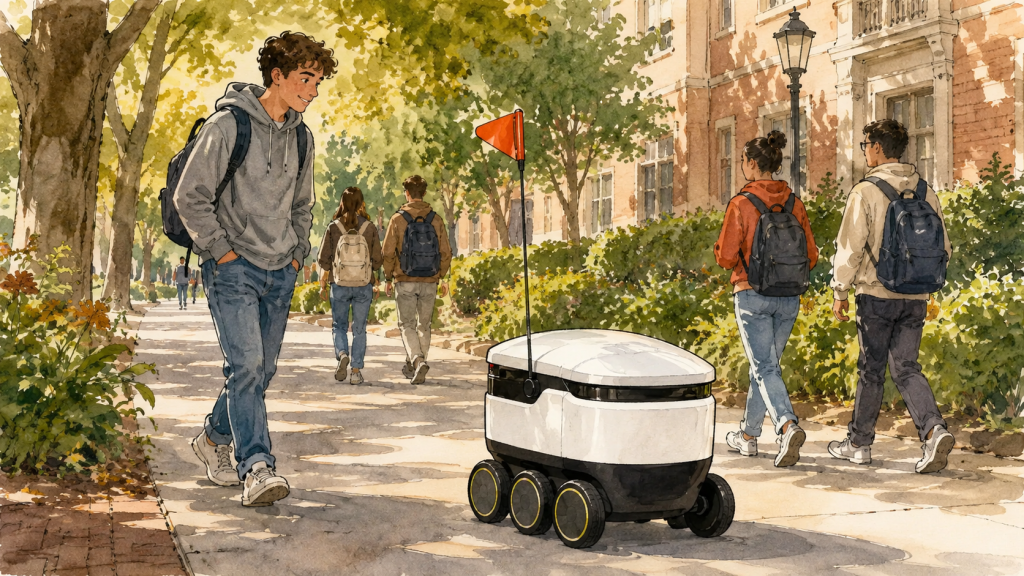
| Campus delivery robots are becoming a robotics workforce pipeline |
Warm-up question: Would you rather learn about technology in a classroom or through hands-on work with real machines? Why?
Listen: Link to audio [HERE]
Read:
Kai Ryssdal: My colleague David Brancaccio did a series a number of years ago called “Robots Ate My Job.” And then a couple of years later, he did a series called “Robot-Proof Jobs.”
This next story is kind of a hybrid. Forget artificial intelligence for a second, and what it is and will do to the labor market. On some college campuses, actual robots are—metaphorically, anyway—hiring students, teaching those students, and in some cases, rerouting their careers. Julia Piccar has the story.
Julia Piccar: Five years ago, robotics company Starship rolled out 20 food delivery robots at Oregon State University in Corvallis. Today, close to 80 of the bots do 1,000 deliveries a day. They look like motorized storage bins on six wheels with a bright orange flag sticking out of the top, making them easy to spot on campus. I’m on the trail of one of them.
Robot: Hello, I’m Sunshine, and I’m delighted to be here with your delivery.
Julia Piccar: Where some students might have once delivered for DoorDash and Grubhub, they now work as attendants and technicians for the robot fleet.
Julia Piccar: Scott McCrutty was studying business management at Northern Arizona University when his roommate told him about Starship.
Scott McCrutty: But he kind of approached me and said, “Hey, um, there’s a new robotics company um coming to campus focusing on food delivery.”
Julia Piccar: The opportunity proved to be so valuable, it changed the entire course of his education. McCrutty, a self-avowed hands-on learner, left college after sophomore year to join Starship.
Scott McCrutty: They allowed me to go on launch uh trips where I launched Oregon State University, Arizona State University and assisted with some of the mapping that goes around campuses as well.
Julia Piccar: Starship and other robotics companies like Robot.com and Austin-based Avy Ride are quietly turning campuses into real-world training grounds. According to Starship, about 2/3 of its student hires are pursuing engineering or computer science degrees. Jacob Olsen is one of them. The nuclear engineering student says his experience working hands-on as a fleet attendant gave him insight for his work with a professor studying robots to detect radiation.
Jacob Olsen: I was basically integrating a robot with a radiation detector and being able to model a room and detect the radiation around it.
Julia Piccar: Five years ago, Starship product engineer Marcus Hall was majoring in computer and electrical engineering at Oregon State. He was designing an autonomous delivery platform when COVID hit. While classes were paused, Hall noticed a robot technician job for Starship on campus.
Marcus Hall: This is a perfect fit ’cause, you know, I was interested in robotics, I’ve always worked with that sort of space.
Julia Piccar: Hall got the job and quickly found that even though class had taught him design principles, he was now seeing how they are stress-tested in the real world.
Marcus Hall: If you get to build it to a full fruition, you would see, you know, your machine driving around and how it interacts with the foliage, with the roads, with the people.
Julia Piccar: Oregon State robotics professor Ross Hatton says the more hands-on time engineering students get with robots, the better. But he cautions that learning how an existing robot operates isn’t the same as having the knowledge to build one yourself.
Ross Hatton: It very much speaks to the idea of being someone who has done something versus someone who is doing something.
Julia Piccar: Hatton says that the base layer of learning for students who might one day build their own robots is still tinkering—in labs, robotics clubs, and internships. Still, he finds it beneficial for students to witness a viable robotics company in action.
Ross Hatton: It’s still a very young field, and so seeing a successful company able to go through and deal with the whole monetization tree of building out from there is something that’s really exciting to see.
Julia Piccar: Starship now operates in more than 60 colleges, where students are learning to fix robots and, maybe, launch their careers. In Corvallis, Oregon, I’m Julia Piccar for Marketplace.
Vocabulary and Phrases:
- hybrid: a combination of two different things
- metaphorically: in a symbolic or non-literal way
- on the trail of: following or tracking someone or something
- fleet: a group of vehicles, robots, ships, or aircraft operated together
- self-avowed: openly describing oneself in a certain way
- sophomore year: the second year of high school or college
- give insight: to provide a deeper understanding of something
- autonomous: able to operate or move without direct human control
- stress tested: tested under difficult or realistic conditions to see how well something works
- foliage: leaves, plants, and greenery
- speaks to the idea of: supports or connects to a particular idea
- tinkering: experimenting with or adjusting things in a hands-on way
- viable: able to work successfully or survive in real conditions
Fill in the Blank Use the correct word or phrase from the vocabulary list.
- The company manages a __________ of robots at several universities.
- He is a __________ hands-on learner who prefers building things himself.
- The machine was __________ before being released to customers.
- Many engineering students enjoy __________ with machines in labs and clubs.
- The speaker used the phrase __________, not literally.
- An __________ vehicle can drive without a human driver.
- She changed her major during her __________ of college.
- The program is a __________ of classroom learning and real-world experience.
- Working in the lab helped __________ into how robots behave in real environments.
- This example __________ learning by doing.
- The reporter was __________ a delivery robot across campus.
- The robot had trouble moving through thick __________ near the sidewalk.
- The company proved that its business model was __________.
Comprehension Questions:
- What kind of robots are being used at Oregon State University?
- How have student jobs changed because of campus delivery robots?
- Why did Scott McCrutty leave college to join Starship?
- How did Jacob Olsen’s work with robot delivery help his academic research?
- What warning does Professor Ross Hatton give about working with existing robots?
Discussion Questions:
- Do you think hands-on experience is more valuable than classroom study for engineering students?
- Should universities encourage companies to use campuses as testing grounds for new technology?
- What kinds of jobs might robots create, even as they replace other jobs?
- Would you be comfortable having autonomous robots operate regularly on a school campus?
- What is the difference between using a technology and truly understanding how to build it?
 LanguageLeap