The World Cup is returning to North America for the first time in more than 30 years, and excitement around the tournament is growing. But for many fans, the biggest story so far is not only the soccer—it is the rising cost of attending matches, traveling between cities, and finding hotels during the event.
In this lesson, we examine why the World Cup has become so expensive for fans and consider how ticket prices, travel costs, and corporate pricing strategies are changing the experience of major sporting events. While organizers say they are trying to provide fair access, many longtime fans are facing sticker shock as they decide how much they are willing to spend.
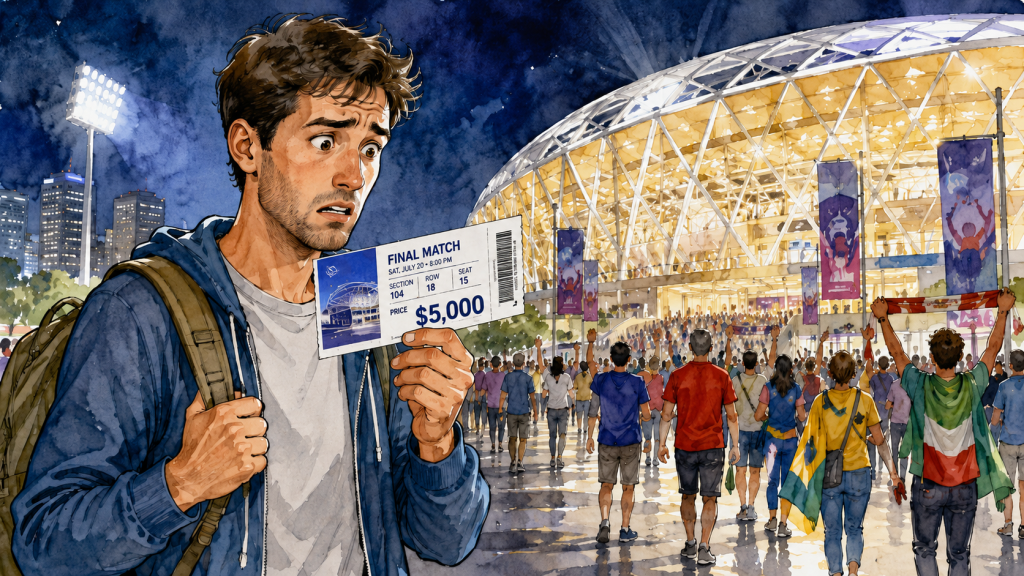
| From tickets to airfare to lodging, fans prepare for a pricey World Cup |
Warm-up question: Would you travel to another city or country to watch a major sporting event? Why or why not?
Listen: Link to audio [HERE]
Read:
Nova Safo: For Marketplace, I’m Nova Safo. Good morning. We are less than a month away from the start of soccer’s World Cup. It takes place here in North America for the first time in 32 years. So far, the buzz around the world’s most popular sporting event has been about its high costs. Tickets can run anywhere from hundreds to thousands of dollars. Public transit fares to some matches will cost $50 or more. Marketplace’s Henry Epp has the details.
Henry Epp: “Manuel Rueda of Bogota, Colombia, has been to every World Cup since 1994 with his dad. They typically go to at least nine matches each time. Sometimes they catch Colombia in the group stage, and they’ve often gone to some of the big games towards the end of the tournament, including the final. The total cost of those trips?”
Manuel Rueda: “It’s usually a minimum like 10,000 per person. It’s not cheap, okay? It’s not cheap even if it’s in Qatar or in Russia or in Brazil”.
Henry Epp: “But this year in the U.S., he expects they’ll pay almost twice that much for hotels, flights, and especially tickets, even though they’re not splurging on the big game.”
Manuel Rueda: “This time we’re not going to the final. Too much. Yeah, whatever, Cristiano Ronaldo is in the game, but it’s not worth it”.
Henry Epp: “At least Rueda says he bought their plane tickets to the six different cities they’ll visit when they were still around $200 each. With rising fuel prices, airfares are climbing fast. Kevin Baxter had some sticker shock as he booked his flights.”
Kevin Baxter: “You know, the tickets that I had priced a couple of months ago for U.S. group play games, now that I’m actually buying the tickets, they’re three and four times more expensive than they were just four or five months ago.”
Henry Epp: “Baxter has an expense account that’ll cover the costs. He’s a sports reporter for the LA Times who’s covered seven men’s and women’s World Cups, including a couple with long distances between cities. And when he booked his travel and lodging across Russia eight years ago, for instance,”
Kevin Baxter: “the prices that we paid seemed reasonable to me. I didn’t feel like, you know, we were getting gouged. This one just feels different.”
Henry Epp: “At least in terms of tickets to the matches, it has been different from past Cups. Sports economist Victor Matheson of the College of the Holy Cross has receipts from 1994, the last time the Cup was in the U.S. Back then, he saw Romania take on Switzerland in Detroit.”
Victor Matheson: “So that’s a second tier game and a second tier city. No insult to Detroit. Uh I paid $50 for those tickets. So we’re talking about a gigantic increase in one generation of the World Cup.”
Henry Epp: “One reason for the jump in price, Matheson says, when FIFA brought the World Cup to the U.S. 32 years ago, soccer wasn’t nearly as popular here.”
Victor Matheson: “You might argue back in ’94, they were willing to give tickets away a little cheaper than they might have trying to invest in the United States so that they could make money later. But they’re certainly taking in their profits this time.”
Henry Epp: “In a written statement, FIFA said it’s ‘quote’ focused on ensuring fair access to our game for existing but also prospective fans, and said that it released at least a thousand tickets priced at $60 for each match. FIFA also noted that it reinvests revenue from the Cup in soccer development programs around the world. I’m Henry Epp for Marketplace.”
Vocabulary and Phrases:
- buzz: excitement, attention, or public conversation around something popular or important
- splurging: spending a lot of money on something special or unnecessary
- sticker shock: surprise or shock caused by seeing a much higher price than expected
- expense account: money provided by an employer to pay for work-related costs, such as travel, meals, or hotels
- gouge: to charge unfairly high prices, especially when people have few other options
- second tier: not the highest level, but still good or important; below the top level
- prospective: possible or likely in the future
Fill in the Blank Use the correct word or phrase from the vocabulary list.
- There is a lot of __________ around the upcoming tournament.
- We are going on vacation, but we are not __________ on luxury hotels.
- I had serious __________ when I saw the price of the concert tickets.
- Since the trip was for work, the reporter used his __________ to cover the costs.
- Some customers felt the company was trying to __________ them during the busy season.
- It was a __________ match, but the tickets were still very expensive.
- The company is trying to attract both current and __________ customers.
Comprehension Questions:
- Why has much of the recent buzz around the World Cup focused on cost?
- How much does Manuel Rueda expect this World Cup trip to cost compared with previous ones?
- Why did Kevin Baxter experience sticker shock when booking flights?
- Why does Victor Matheson compare current ticket prices with the 1994 World Cup?
- What does FIFA say it is doing to support fair access to matches?
Discussion Questions:
- Do you think major sporting events have become too expensive for ordinary fans?
- Is it fair for organizers to charge very high prices when demand is strong?
- Would you rather attend one expensive major event or several cheaper local events?
- How do high prices change the atmosphere of a sporting event?
- Should global events like the World Cup prioritize profit or accessibility? Why?
 LanguageLeap