Some of the world’s biggest artificial intelligence and technology companies are preparing to enter the public stock market with enormous valuations. Unlike earlier tech startups that often went public while still unproven, companies like SpaceX, OpenAI, and Anthropic are waiting much longer before offering shares to public investors.
In this lesson, we examine how the IPO market has changed and explore the opportunities and risks surrounding large AI companies going public. While many investors are eager to participate in these offerings, critics argue that waiting so long to go public allows most early profits to stay concentrated among private investors and venture capital firms.
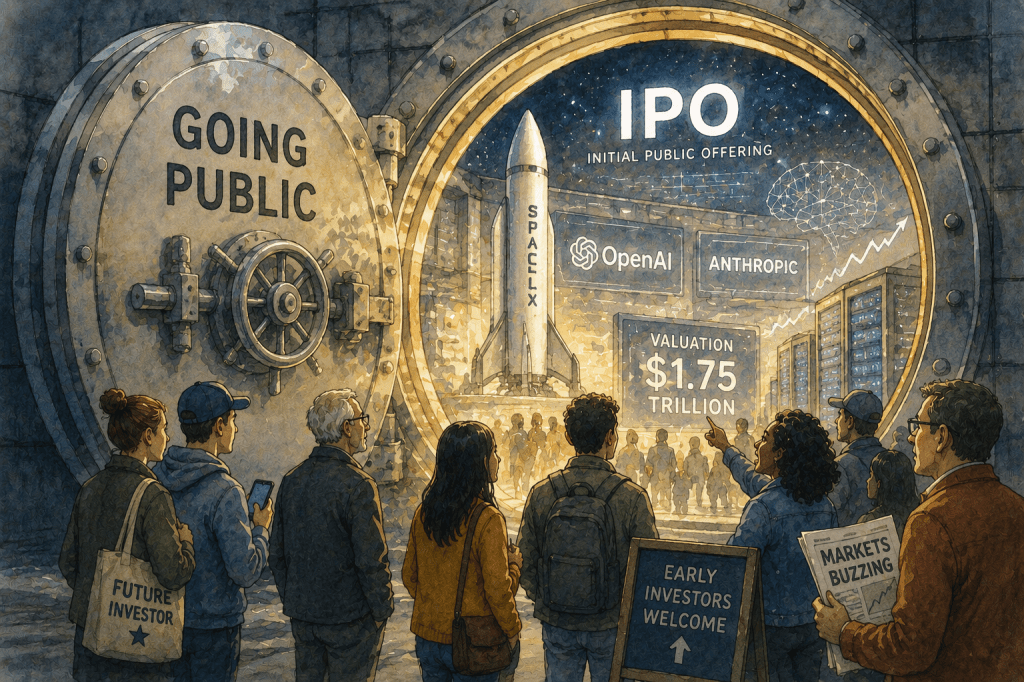
| Mega-IPO season is upon us |
Warm-up question: If you had the chance to invest early in a major AI company, would you do it? Why or why not?
Listen:
Read:
Kai Ryssdal: I am just going to read from the SpaceX S-1 that came out last night. That’s the first form that companies have to file with the Securities and Exchange Commission to start the process of going public. “Our mission,” it says, “is to build the systems and technologies necessary to make life multi-planetary, to understand the true nature of the universe, and to extend the light of consciousness to the stars.” So, Elon Musk and the gang are taking a big swing indeed. This is the first look under the financial hood of the rocket company, which also owns the social media platform X, as well as XAI. It’s coming before its expected IPO next month, which could wind up with a 1.75 trillion with a T dollar valuation. This is the first in a string of mega IPOs that are lined up. OpenAI as soon as this fall, perhaps Anthropic after that. Point is, this hasn’t happened before—companies hitting the public markets for the first time with such enormous valuations. Marketplace’s Megan McCarty Carino starts us off.
Megan McCarty Carino: When the web browser Netscape went public in 1995, it was barely a year old.
Host: At 11:00 a.m. this morning, the company’s stock went public and Wall Street went bonkers.
Megan McCarty Carino: That kicked off the dot-com boom, says Jay Ritter, an economist at the University of Florida.
Jay Ritter: There were lots of startups that went public at a very early stage where it wasn’t at all clear who the survivors were going to be.
Megan McCarty Carino: That created a risk for retail investors, but also opportunity to get in on the ground floor of tech companies that would build unimaginable fortunes like Google and Amazon.
Jay Ritter: In that the last few decades, they’ve been delaying going public.
Megan McCarty Carino: SpaceX is 24 years old. OpenAI is 10. Anthropic is only five, but all have mature businesses generating billions in revenue. It means gains have accrued to a smaller group of private investors and venture capital firms, and that important details about these companies’ business models have been less transparent, says Minmo Gang, a professor of finance at Cornell.
Minmo Gang: Once you go public, companies can no longer cherry-pick what pieces of information they want to disclose.
Megan McCarty Carino: While these companies have booming revenue, Gang says they’re not likely to be profitable in the near future because they’re spending so much on hardware. But there’s a lot of pent-up demand to invest in the technology people are increasingly using every day, says analyst Daniel Newman at Futurum Group.
Daniel Newman: These are companies that could legitimately take almost all of the market’s liquidity, for a short period of time because there’s going to be so many funds, institutions and retail investors that are all going to want to participate, all be part of this.
Megan McCarty Carino: A lot of individual investors have already been trying to scoop up shares ahead of the IPO on the secondary market. Not always through official means, when an investment banker offered his Bay Area home for sale in exchange for Anthropic shares. I’m Megan McCarty Carino for Marketplace.
Vocabulary and Phrases:
- go public: for a private company to begin selling shares on the stock market
- take a big swing: to make a very ambitious or risky attempt
- IPO: Initial Public Offering; the first time a company sells stock to the public
- bonkers: crazy, wild, or completely irrational; behaving in an extreme or unbelievable way
- retail investors: ordinary individual investors, not large institutions
- get in on the ground floor: to join or invest at an early stage before major growth happens
- accrued: accumulated or gradually built up over time
- cherry pick: to selectively choose only the best or most favorable things
- pent-up demand: strong demand that has been building for a long time without being fulfilled
Fill in the Blank Use the correct word or phrase from the vocabulary list.
- Interest and profits gradually __________ over several years.
- The company plans to __________ next year to raise additional funding.
- Many __________ began buying shares through trading apps.
- There is strong __________ for new AI investment opportunities.
- Early employees were excited to __________ before the company became successful.
- Launching reusable rockets was considered __________ by many experts.
- Investors are closely watching the company’s upcoming __________.
- Critics say some companies __________ information before releasing reports publicly.
Comprehension Questions:
- Why is the SpaceX IPO receiving so much attention?
- How are today’s AI companies different from many tech companies during the dot-com era?
- Why do some experts think delayed IPOs are a problem for retail investors?
- What happens when companies become publicly traded?
- Why are many investors eager to buy shares in AI companies?
Discussion Questions:
- Do you think ordinary investors should have earlier access to fast-growing companies?
- Why might companies delay going public for many years?
- What are the risks of investing in highly valued AI companies?
- Should companies be required to share more information before an IPO?
- Do you think the current excitement around AI resembles the dot-com boom? Why or why not?
 LanguageLeap