For years, Tesla CEO Elon Musk has promised a future filled with fully self-driving robotaxis. While those predictions suggested rapid expansion across the United States, the actual rollout has been much slower and more limited than many expected. Competitors like Waymo currently have a much larger presence in the autonomous vehicle market.
In this lesson, we examine why robotaxi adoption has progressed more slowly than expected and explore the technical and regulatory challenges facing autonomous vehicle companies. As businesses continue developing self-driving technology, questions remain about safety, public trust, and whether robotaxis will eventually become common in everyday life.
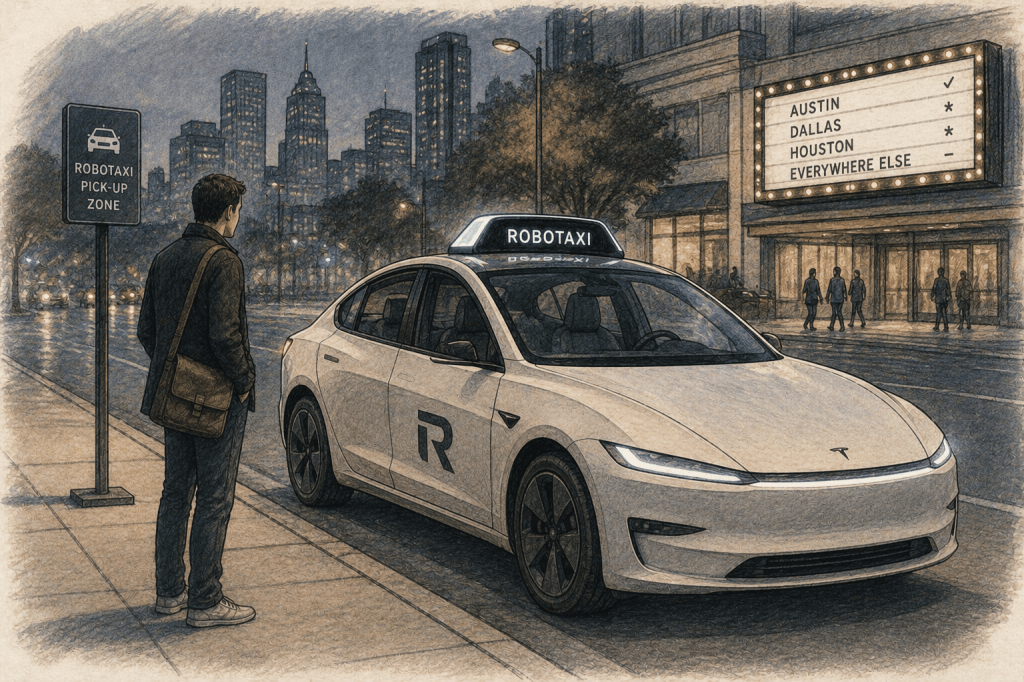
Is the robotaxi revolution ever coming? |
Warm-up question: Would you feel comfortable riding alone in a fully self-driving taxi? Why or why not?
Listen: Link to audio [HERE]
Read:
Sabri Ben-Achour: From Marketplace, I’m Sabri Ben-Achour. Tesla, specifically Tesla’s CEO Elon Musk, has long made big promises about robotaxis. These are the fully self-driving taxis. At one point, Musk said half the population of the US would have access to them by the end of last year. In Tesla’s earnings call last week, that ambition was whittled down to just a dozen or so states by the end of this year. And the reality right now is even more modest. You’re much more likely to see a robotaxi from competitor Waymo. Joining us to talk about Tesla’s elusive robotaxi rollout is Kirsten Korosec, transportation editor at TechCrunch. Good morning.
Kirsten Korosec: Morning.
Sabri Ben-Achour: How widespread are Tesla’s driverless vehicles right now?
Kirsten Korosec: Not widespread at all. They are in Austin, and there are a little bit more than a dozen that are considered to be actively in service. And they did just roll out in Dallas and Houston, but those two you really need to put a little asterisk next to because, as far as I can see on my end, it’s incredibly limited—just a couple of vehicles in both of these cities.
Sabri Ben-Achour: What has made the general rollout of driverless taxis slower than some people might have expected or hoped?
Kirsten Korosec: There’s a number of reasons why. There’s the technical reasons, right? And then there’s the regulatory hoops that all of these companies have had to jump through. And then there’s the hard part of just operating these things.
Sabri Ben-Achour: What is the biggest technical hurdle still remaining, do you think?
Kirsten Korosec: When I’ve talked to engineers, they sort of sum it up as, you know, we’ve solved 99.999% of “quote-unquote” full self-driving, and it’s that very last fraction in which sometimes the vehicle doesn’t operate as it should. There’s also, I think, just this interesting phenomenon about how, you know, we accept as a society people dying in car crashes, around 45,000 or so a year. But I think that the level of acceptance of a single autonomous vehicle potentially, you know, killing someone or being involved in a fatal car crash or even injuring someone is very, very low. And so the bar is high.
Sabri Ben-Achour: How big is the regulatory hurdle facing these companies?
Kirsten Korosec: It’s dependent on the state. So if you’re in the state of California and you want to operate a robotaxi service, you have to go through two agencies and have multiple different permits. You want to do that in Arizona, it’s a very different process and much faster. If we get a federal framework, I think that could be very helpful and actually encourage the disbursement of this technology in a more clear way. But right now you see these pockets or heavy hubs of activity.
Sabri Ben-Achour: Do you see a future where autonomous vehicles are commonplace and everywhere?
Kirsten Korosec: I think that in certain cities, it will absolutely be everywhere. But are we going to see robotaxis in Middle America or in smaller towns? I don’t think so—certainly not anytime soon.
Sabri Ben-Achour: Kirsten Korosec, transportation editor at TechCrunch. Thank you so much.
Kirsten Korosec: Thank you.
Vocabulary and Phrases:
- earnings call: a meeting where company executives discuss financial results with investors and analysts
- whittled down: reduced gradually to a smaller number or amount
- modest: relatively small, limited, or not extreme
- elusive: difficult to achieve, find, or obtain
- roll out: to officially introduce or launch something new
- put an asterisk next to: to add an important condition, exception, or warning
- jump through (regulatory) hoops: to complete complicated official requirements or procedures
- high bar: a very demanding standard or expectation
- regulatory hurdle: a legal or government-related obstacle that must be overcome
Fill in the Blank Use the correct word or phrase from the vocabulary list.
- Early sales of the product have been fairly __________ so far.
- Fully autonomous driving technology remains somewhat __________.
- Customers have a __________ when it comes to safety in autonomous vehicles.
- During the company’s __________, executives discussed future expansion plans.
- The company plans to __________ its new service later this year.
- I would __________ that claim because there are still many limitations.
- Strict licensing requirements became a major __________ for the business.
- The original list of locations was eventually __________ to only a few cities.
- Startups often need to __________ before entering new markets.
Comprehension Questions:
- How widespread are Tesla’s robotaxis currently?
- Why does the interview guest say Tesla’s rollout is still very limited?
- What are the two main categories of challenges facing robotaxi companies?
- Why is the final stage of autonomous driving development so difficult?
- Why are regulations different depending on the state?
Discussion Questions:
- Would you trust a fully autonomous taxi more or less than a human driver?
- Why do you think society may judge autonomous vehicle accidents differently from human-caused crashes?
- Should governments slow down or accelerate approval for self-driving vehicles?
- Which companies do you think are most likely to lead the robotaxi industry in the future?
- Do you think robotaxis will eventually become common in smaller cities and towns? Why or why not?
 LanguageLeap