After 15 years as CEO of Apple, Tim Cook is stepping down and handing leadership to longtime executive John Ternus. Cook took over after Steve Jobs and led the company through a long stretch of growth, focusing on operations, efficiency, and expanding Apple’s services business.
In this lesson, we examine leadership change at Apple and consider how Cook’s tenure shaped the company’s strategy and long-term direction. As Ternus takes the helm, Apple faces new challenges, including pressure to innovate and growing competition in artificial intelligence, raising the question of whether the company will continue refining its existing products or shift toward more breakthrough innovation.
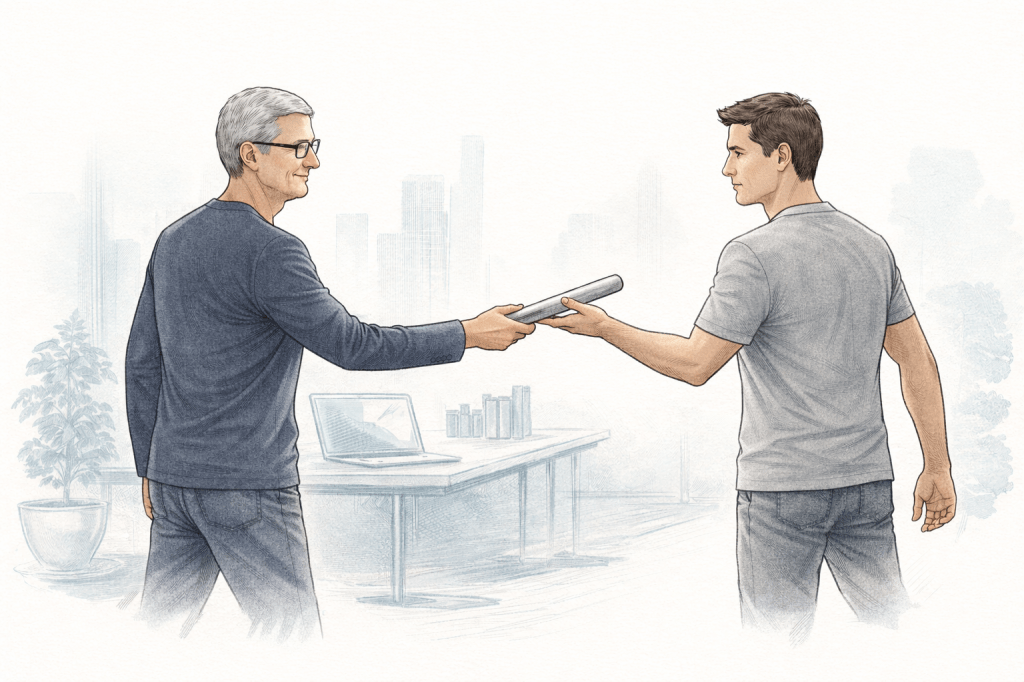
| Tim Cook to step down as Apple CEO. In letter, describes 15 years of emails |
Warm-up question: Do you think it’s harder to lead a company after a legendary founder leaves? Why or why not?
Listen: Link to audio [HERE]
Read:
SCOTT DETROW, HOST:
Tim Cook, the CEO of Apple, is stepping down. Cook posted the announcement on Apple’s website this afternoon. He ran the company for a 15-year stretch of extraordinary growth, and in September, he will be passing the baton. To tell us more, NPR tech correspondent John Ruwitch joins us. Hey, John.
JOHN RUWITCH, BYLINE: Hi, Scott.
DETROW: So I keep thinking back to when Cook first got the job and thinking, how can anybody replace Steve Jobs at Apple? And yet he quickly becomes one of the most high-profile CEOs in corporate America. What does his departure now mean for Apple?
RUWITCH: Yeah, it’s interesting. You know, in his message, one of the things that really shined through was a sense of continuity. Tim Cook himself is an Apple lifer. He was with the company for years and years before becoming CEO. In the announcement, he said, quote, “this is not goodbye.” And that’s ’cause he’s going to be taking up the role of Apple’s executive chairman, and he’s going to be handing the reins to another Apple lifer, a guy named John Ternus, who’s been with the company for a quarter century. Ternus has been in charge of product engineering, so basically overseeing the production of all of Apple’s iconic devices. Jo-Ellen Pozner is an associate professor at Santa Clara University’s business school, and I asked her what this shift in leadership means.
JO-ELLEN POZNER: I think this is definitely a signal that we’re doubling down on hardware. And frankly, the hardware unit has been incredibly successful.
RUWITCH: Yeah, hardware has been Apple’s strong suit, right? The iPhone is the iconic flagship of the company. Under Cook, also, they introduced the Apple Watch and AirPods.
DETROW: Yeah. So what do you think – other than the fact that a good chunk of Americans have one of these devices on them at all times, like, what do you think Tim Cook’s legacy is from his time at Apple’s helm?
RUWITCH: Yeah. Well, when he became CEO in 2011, as you say, he had huge shoes to fill following legendary founder Steve Jobs’ death. But the thing is that he didn’t try to be Steve Jobs. Apple watchers say he’s an operations guy, not a visionary product creator, and he’s gotten a lot of praise over the years for kind of playing to his strengths, focusing on efficiency, supply chains, manufacturing. Cook also expanded Apple’s portfolio from hardware and software into services, so things you might use like Apple Music, Apple News, Apple Pay – those came under him. They’re huge revenue streams for the company, and the company has grown a lot. You know, during Cook’s tenure, it went from having a market cap of around $350 billion to the $4 trillion behemoth that it is today. By the way, also, he was the first Fortune 500 CEO to come out as gay. That was hailed as a pretty important moment for the LGBTQ community when that happened in 2014.
DETROW: So those are all the positives. What are some of the downsides or the ongoing challenges that the new CEO is going to have to deal with?
RUWITCH: Yeah. One area of criticism has been around product innovation. You know, Apple has always been known for revolutionary products, but under Tim Cook’s tenure, it was more about iterations and updates than wow factor. Cook’s focus on efficiency and supply chain optimization has had a big upside, but there’s been a downside. You know, Apple basically produces everything overseas now and largely in China, which makes them susceptible to tariffs. Here’s Jason Snell who writes about Apple at sixcolors.com and Macworld.
JASON SNELL: They have spent so long getting so focused on China that it is taking them a very long time and will take them probably decades to not be completely reliant on China.
RUWITCH: Yeah, so that is a big risk. Artificial intelligence, that’s another thing Ternus is going to have to deal with on Day 1 when he takes over in September.
DETROW: Fair to say, Apple has not been leading the pack when it comes to AI, right?
RUWITCH: It is not. They’ve been lagging, according to analysts. They’ve also had trouble delivering on some promises, you know, in particular, AI upgrades to Siri. They’ve promised them. They’ve been delayed. And so the new CEO will have a lot on his plate.
DETROW: NPR’s John Ruwitch, thanks so much.
Vocabulary and Phrases:
- stretch: a continuous period of time
- shined through: became clearly visible or noticeable
- handing the reins to: giving control or leadership to someone else
- doubling down: increasing effort or commitment to a particular strategy
- strong suit: an area where someone or something performs very well
- a good chunk: a large portion or significant amount
- at the helm: in a position of leadership or control
- huge shoes to fill: a difficult role to take over from someone very successful
- market cap: the total value of a company based on its stock price multiplied by shares
- hailed as: publicly praised or celebrated as
- tenure: the period of time someone holds a position
- iterations: repeated improvements or updated versions of something
- susceptible: easily affected or influenced by something
- lagging: falling behind or not keeping up
- have a lot on one’s plate: to have many responsibilities or tasks to deal with
Fill in the Blank Use the correct word or phrase from the vocabulary list.
- The innovation was __________ a breakthrough in the industry.
- The company is __________ on its investment in AI technology.
- Communication has always been her __________.
- The new manager has __________ after the previous leader’s success.
- The new CEO will __________ as the company faces multiple challenges.
- A __________ of the budget is spent on research and development.
- He has been __________ of the organization for over a decade.
- His leadership style __________ during the crisis.
- The company’s __________ reached an all-time high this year.
- During her __________, the company expanded internationally.
Comprehension Questions:
- What was the main focus of Tim Cook’s leadership style at Apple?
- How did Apple grow during Cook’s tenure?
- What criticism has Apple faced regarding product innovation?
- Why is Apple considered vulnerable due to its supply chain?
- What major challenge will the new CEO face immediately?
Discussion Questions:
- Is it better for a leader to focus on innovation or efficiency? Why?
- What are the risks of relying heavily on one country for manufacturing?
- Do you think Apple has done enough to stay competitive in AI?
- How should a new CEO approach taking over from a successful leader?
- What qualities are most important for leading a global company today?
 LanguageLeap