Oil prices often rise during global conflicts, and many people assume that oil companies simply make huge profits whenever that happens. But the reality is more complicated. While higher prices can create enormous short-term gains, they can also create long-term risks for producers, investors, and the broader economy.
This lesson explores how oil companies benefit from price spikes, why some profits are limited by business decisions like hedging, and how too much price volatility can eventually hurt the entire sector.
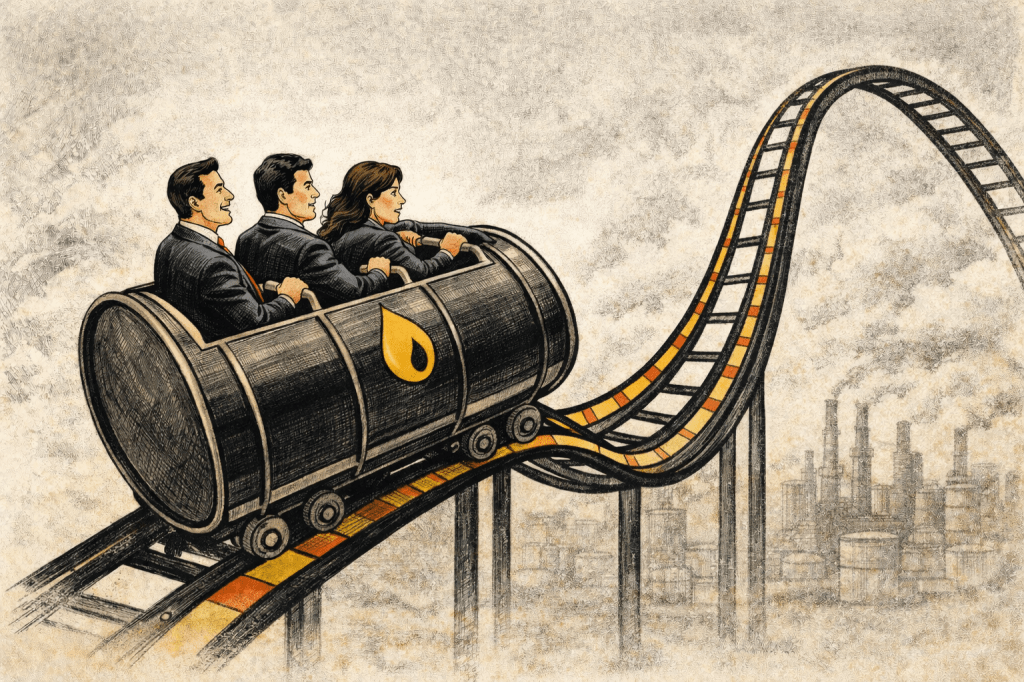
| Why high oil prices are good for oil companies — until they aren’t |
Warm-up question: Have you ever seen a company or industry benefit from a crisis in the short term, but suffer in the long term? What happened?
Listen: Link to audio [HERE]
Read:
JUANA SUMMERS, HOST: Crude oil prices have fallen sharply as a fragile ceasefire takes hold in the Middle East, but prices are still way up from before the war. Higher prices are a big boost to oil industry profits, but as NPR’s Camila Domonoske reports, they also carry some risks for producers.
CAMILA DOMONOSKE, BYLINE: Let’s start with a straightforward bit. When oil prices go up, companies that sell oil make more money – like, a lot more money. In 2022, prices soared after Russia launched its full-scale invasion of Ukraine, and the global oil industry brought in some $916 billion in profits.
ISABELLA WEBER: I mean, literally record, right?
DOMONOSKE: Isabella Weber is a professor of economics at UMass Amherst. She was part of a team that calculated, those profits were roughly seven times the industry’s pre-COVID average. U.S. oil companies and American investors were the biggest beneficiaries, and the very rich benefited the most.
This time around – well, Exxon Mobil just estimated that higher prices boosted its revenue by more than $2 billion, partially offset by lost production in the Middle East. Overall, energy stock prices suggest the war has been very good to the sector. Weber is keeping an eye on an index tracking fossil fuel company stocks, and as of last week…
WEBER: It looks pretty similar to the oil price, so it’s really, shooting through the roof.
DOMONOSKE: Now, that said, there are a few reasons why companies might not benefit as much as you’d think from the recent price spike. First, let’s talk about hedging. That’s where a company locks in a price for their oil months in advance to get a little certainty. And many producers had been doing this before the war because there was too much oil production, and they were worried prices might go down. Jai Singh is with the consultancy Rystad Energy.
JAI SINGH: They had hedged, you know, a meaningful amount of their production coming into this year at kind of $55.
DOMONOSKE: In March, prices surged to double that. Singh estimates companies hedged about a third of their production at a lower price.
SINGH: So there were some limits to how much of this windfall they could enjoy.
DOMONOSKE: Second, producing more oil would seem an obvious way to rake in more cash, but it’s not as easy as you might think to drill, baby, drill. Like, there are parts of Texas where the wells produce both oil and natural gas and where the gas pipelines are pretty well full. If you want to add more wells right now, good luck finding space in a pipeline to get your gas out. And drilling for new wells isn’t cheap. Investors want to be sure wells will be profitable in the long term.
And that brings us to challenge three, volatility. Prices have been on a roller coaster. Several oil producers declined to comment for this story, but Dustin Meyer, of the American Petroleum Institute, speaks for the industry. He says this volatility isn’t good for anyone.
DUSTIN MEYER: Well, our industry is fundamentally predicated on making long-term investments, and it’s very hard to do that when market prices are so volatile and so unstable.
DOMONOSKE: But what if prices were stable and they stayed high? Well, it depends how high. There’s a clip that recently went viral from the TV show “Landman,” starring Billy Bob Thornton as longtime oilman Tommy Norris.
BILLY BOB THORNTON: (As Tommy Norris) You want oil to live above 60 but below 90.
DOMONOSKE: Dollars a barrel, that is. And look, NPR doesn’t usually go to TV dramas for our economic analysis. But I was chatting with an energy expert who brought up this clip unprompted and said, that price range – Billy Bob Thornton is exactly right.
THORNTON: (As Tommy Norris) And don’t get me wrong. We’re still printing money at 90. But gas gets up over 3.50 a gallon, it starts to pinch.
DOMONOSKE: It starts to pinch everyone, the whole economy. And when that pinch gets bad enough, it leads to less driving, flying, building, buying stuff, even a recession. And all that means less demand for oil. Ed Crooks, from the research group Wood Mackenzie, is the analyst who sent me to that clip.
ED CROOKS: And the economy suffers, and inflation rises. Growth falls. People in the wider economy lose their jobs. People also start thinking about alternatives to oil.
DOMONOSKE: Like electric vehicles. So depending on exactly where oil prices settle, they could be really good for producers or, Crooks says, they could weaken the oil industry for decades. Camila Domonoske, NPR News.
Vocabulary and Phrases:
- straightforward: simple and easy to understand without complications
- beneficiaries: people or groups that receive advantages, profits, or benefits from something
- index: a measurement that tracks the performance of a group of stocks, prices, or economic data
- shooting through the roof: rising extremely quickly to a very high level
- hedging: reducing financial risk by locking in prices or protecting against market changes
- surged: increased suddenly and strongly
- windfall: a sudden unexpected gain, especially financial profit
- rake in: to earn or collect a large amount of money
- volatility: frequent and unpredictable price changes
- predicated: based on or built upon a certain condition or assumption
- unprompted: said or done without being asked
- pinch: financial pressure or economic pain caused by rising costs
Fill in the Blank Use the correct word or phrase from the vocabulary list.
- Our investment strategy is __________ on long-term market stability.
- The company decided to use __________ to protect itself from currency fluctuations.
- Tech stocks __________ after the new AI product launch.
- Rising rent prices are starting to __________ middle-class families.
- The CEO mentioned the competitor completely __________ millions during the demand spike.
- The market __________ shows how energy companies performed this quarter.
- The manager gave an __________ explanation that everyone understood.
- Lottery winners often describe the money as a __________.
- Price __________ makes it difficult for companies to plan ahead.
- Several major exporters were the biggest __________ of the policy change.
- The speaker brought up inflation __________ during the meeting.
- Housing prices are __________ in major cities.
Comprehension Questions:
- Why do oil companies usually make more money when oil prices rise?
- Why did hedging reduce some companies’ profits during the recent price increase?
- Why can’t producers simply increase drilling immediately?
- Why is volatility difficult for oil companies?
- According to the report, what oil price range is considered ideal?
- What happens when gasoline prices become too expensive for consumers?
Discussion Questions:
- Do you think industries should be allowed to profit heavily during wars or global crises? Why or why not?
- Is hedging a smart business strategy, even if it limits profits during a boom?
- Which industries besides oil are highly affected by volatility?
- At what point do rising prices stop helping companies and start hurting demand?
- How do high fuel prices affect consumer behavior in your country?
- Could prolonged high oil prices accelerate the transition to clean energy?
 LanguageLeap