As NASA’s Artemis II astronauts return from the farthest human journey ever made, the mission is already being seen as a major step toward the future of space exploration. Beyond breaking distance records, the crew successfully tested critical spacecraft systems, gathered valuable lunar data, and even witnessed a rare eclipse from space. In this lesson, you’ll explore how this historic mission is helping scientists prepare for future lunar landings, deep-space travel, and the next era of human exploration.
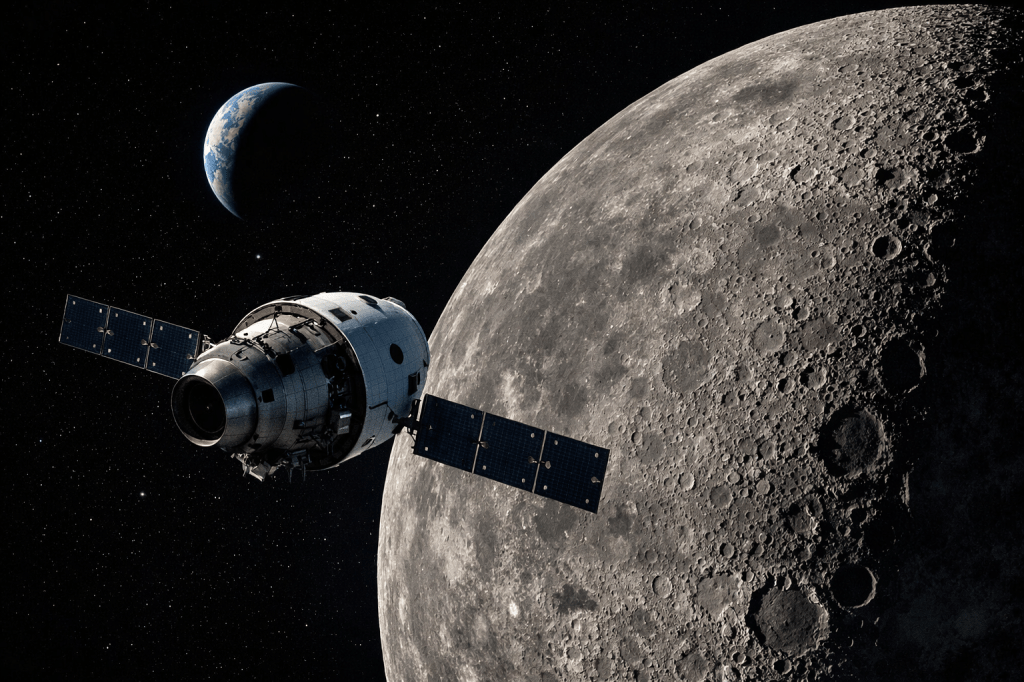
| Artemis II astronauts swung by the moon, broke an Apollo record, and saw an eclipse |
Warm-up question: If humans return to the moon regularly in the future, what do you think the most important goal should be: science, business, exploration, or something else?
Listen:
Read:
LEILA FADEL, HOST: The four-astronaut crew of NASA’s Artemis II mission is now on their way back to Earth.
A MARTÍNEZ, HOST: They have traveled farther than any humans have before after a trip around the moon. The mission is giving scientists here on Earth important new data that will help future space flights.
FADEL: Central Florida Public Media’s Brendan Byrne has been following the mission and joins us now. Good morning, Brendan.
BRENDAN BYRNE, BYLINE: Good morning.
FADEL: So walk us through this trip home.
BYRNE: Sure. So the Orion spacecraft whipped around the back side of the moon yesterday, and for about 40 minutes, the Earth was out of sight and the crew was unable to communicate to mission control. This was expected. And during this communication blackout, according to NASA, the crew reached the mission’s maximum distance from Earth at 252,756 miles, beating the previous record set by the Apollo 13 mission. And as the spacecraft emerged from the blackout, it began its journey back home with these words from mission specialist Christina Koch.
CHRISTINA KOCH: We will explore. We will build. We will build ships. We will visit again. We will construct science outposts. We will drive rovers. We will do radio astronomy. We will found companies. We will bolster industry. We will inspire. But ultimately, we will always choose Earth. We will always choose each other.
BYRNE: And with that, Koch and her fellow crewmates were on their way home, a quarter-million-mile journey that will come to an end on Friday.
FADEL: How has this mission gone so far?
BYRNE: All signs point to it being a success. The Orion spacecraft conducted key test flights of its control and life-support system. The crew took thousands of photos of the far side of the moon and made their own geological observations for lunar scientists to better understand just what the moon is made of and how it came to be. And on the way home last night, the crew even saw an eclipse from space. The moon was in a location where it blocked the light of the sun, allowing them to see things like the solar corona, which is the atmosphere of the sun. Here’s mission pilot Victor Glover explaining just what he saw.
VICTOR GLOVER: This is – we just went sci-fi. This has – it just looks unreal.
BYRNE: Now, those remarks come from Glover after he and his crewmates spent hours viewing areas of the moon never before seen by human eyes, so really, that eclipse must have been impressive. And they – last night they got a call from President Trump to congratulate them on their accomplishments, and he even asked for their autographs.
FADEL: OK, so what happens next? Do these astronauts just get to hang out, coast back home?
BYRNE: Oh, no. There’s plenty of work to still do.
BYRNE: This is first and foremost a test flight of Orion with its first human passengers. The crew will demonstrate the radiation shielding of the spacecraft, manually control it once more to see how it moves. But one of the most critical tests will come during reentry on Friday, as the Orion space capsule punches through Earth’s atmosphere at 25,000 miles per hour, enduring temperatures of up to 5,000 degrees Fahrenheit. That reentry will test the heat shield and parachutes that will slow the crew down so their capsule can gently splash down in the Pacific Ocean off the coast of San Diego.
FADEL: I’ve got to ask, since it’s gotten so much attention, how’s the space toilet?
BYRNE: It’s certainly been a bit of a rocky road for Orion’s bathroom. It worked, it didn’t, it worked again. But remember, the crew’s testing new hardware. This is the first toilet to fly to the moon.
BYRNE: So what they learn will help future human missions in the vehicle, and hopefully, that next crew won’t have any issues flushing their toilet.
FADEL: Brendan Byrne is with Central Florida Public Media and is the host of the space podcast Are We There Yet? Brendan, thank you for joining us again.
BYRNE: Anytime.
Vocabulary and Phrases:
- Walk us through this: explain something step by step in a clear way.
- Whipped around: moved very quickly around something.
- Blackout: a period when communication or power is temporarily lost.
- Eclipse: an event when one object in space blocks the light from another.
- Autograph: a person’s signature, usually requested from someone famous.
- First and foremost: most importantly; before anything else.
- Splash down: when a spacecraft lands in water.
- Rocky road: a difficult process with problems or challenges.
Fill in the Blank Use the correct word or phrase from the vocabulary list.
- During the communication __________, the astronauts could not contact mission control.
- The spacecraft __________ the far side of the moon before beginning its trip home.
- Can you __________ the process of preparing for a moon mission?
- The crew saw an amazing solar __________ from space.
- Safety is __________ the most important part of space travel.
- The president even asked the astronauts for their __________.
- After reentry, the capsule will __________ in the Pacific Ocean.
- Testing new technology is often a __________ before everything works smoothly.
Comprehension Questions:
- What record did the Artemis II crew break during the mission?
- Why was there a 40-minute communication blackout?
- What scientific observations did the astronauts make during the trip?
- What major test will happen during reentry on Friday?
- Why is the spacecraft’s toilet considered part of the mission test?
Discussion Questions:
- Would you volunteer for a mission around the moon? Why or why not?
- Which part of this mission sounds the most dangerous to you?
- Why do you think space missions still capture so much public attention?
- Do you think private companies should help build future moon bases?
- What technologies developed for space travel could improve life on Earth?
 LanguageLeap