This lesson focuses on how oil markets react to uncertainty during geopolitical conflict, even when the physical supply situation has not changed significantly. You will learn vocabulary related to market psychology, real-world conditions, and cause-and-effect relationships, while improving your ability to follow complex explanations about pricing and risk. The material highlights the gap between physical energy supply and financial trading, and gives you practice understanding how expectations, political messaging, and market reactions can create powerful feedback loops.
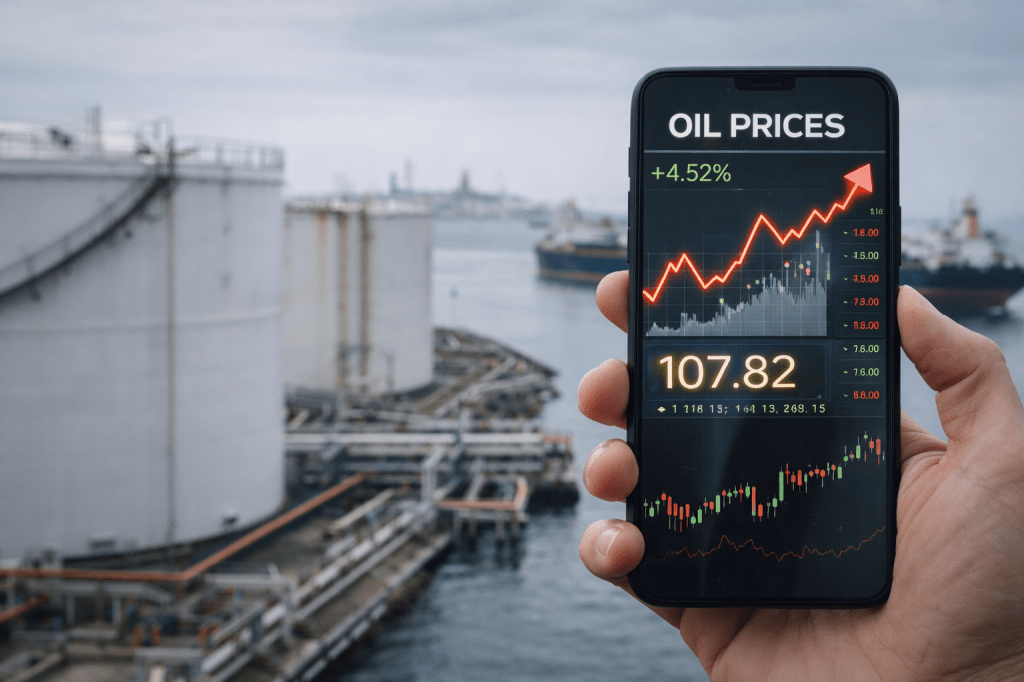
| How long will the war last? No one knows, and it’s making oil prices weird |
Warm-up question: Why do markets sometimes react more strongly to uncertainty about the future than to what is happening right now?
Listen:
Read:
SCOTT DETROW, HOST:
Since the start of the war with Iran, crude prices – oil crude prices – have been on a roller coaster, and that’s been happening even though the situation in the Strait of Hormuz has barely changed. Oil tanker traffic has slowed to a crawl. So what gives? NPR’s Camila Domonoske takes a look at the psychology of oil markets.
CAMILA DOMONOSKE, BYLINE: Rory Johnston, an oil markets researcher, sums up the recent situation like this.
RORY JOHNSTON: The oil market right now is in the midst of this almost, like, Schrodinger’s cat of the largest oil supply shock in the history of the oil market.
DOMONOSKE: Schrodinger’s cat, as in the famous thought experiment where there’s a cat in a box, and it’s either alive or dead. The reason – the box also contains a vial of poison and some radioactive material. If a single atom of it decays, the vial breaks, and the cat dies. But you don’t know the outcome until you open the box. So until you know, the cat’s kind of alive and dead at once – quantum mechanics, man. The oil version is that we are either in the worst oil crisis ever, or things are basically fine. The cat’s-dead scenario is a long war.
JOHNSTON: If this persists, it will be bigger than the oil shocks of the 1970s.
DOMONOSKE: The cat’s alive if the war ends, say, tomorrow.
JOHNSTON: Theoretically, if Trump were to pull back right now, the oil market could begin to heal itself.
DOMONOSKE: The two potential realities are profoundly different, and that’s why markets are in such chaos. The near-complete halt of ships through the Strait of Hormuz has cut off nearly 20% of the world’s oil and gas from markets. For oil markets, a dead cat scenario where that closure lasts for months is their nightmare. If that’s the case, prices should go sky high, whereas, if the cat’s alive and the war is about to end soon, Johnston says…
JOHNSTON: We would look back at this as a deeply, deeply jarring scare, but that’s probably about it in terms of the lasting economic consequences.
DOMONOSKE: The world had a lot of spare oil before this started, so a short closure is not a crisis. If the strait is reopening soon and oil fields in the Gulf will restart production, then prices shouldn’t go crazy. And markets had a reason to expect this. Other recent crises resolved quickly. Markets recovered. Anyone who bought too high lost money, so that’s fresh in traders’ memories. So what’s in the box – a long war or a peace deal? The market has been getting mixed signals. Ellen Wald is the author of “Saudi, Inc.”
ELLEN WALD: There keeps being this idea that, oh, we’re going to have, you know, naval escorts, or we’ve taken out all of their ballistic missiles, and yet the situation on the ground is that drones are still flying. Missiles are still flying across the Strait.
DOMONOSKE: Oil is both a tangible physical good and a paper market – prices moving on a screen. And right now, there is a disconnect between the two. In the real physical world, jet fuel prices have doubled. Countries like Pakistan and Bangladesh are closing schools and rationing fuel to conserve energy. But in the commodity markets where traders bet on future prices, prices get yanked back down every time, say, the president posts on social media that talks are going well.
WALD: Because there is always this assumption that the hostilities could be stopped very soon.
DOMONOSKE: But see, unlike in the original Schrodinger’s cat, it’s not random chance which way things go. President Trump plays a huge role. Trump’s messages move the market, but the market also influences Trump. He watches oil prices and stocks very closely, and he’s reversed policies before when markets signaled they would crash the global economy. Dan Pickering is the chief investment officer at Pickering Energy Partners.
DAN PICKERING: There is a feedback loop here where high prices create more anxiety for the administration, which could either create an end to the conflict or an increase in intensity.
DOMONOSKE: If oil were $200 right now instead of 100, would Trump feel more pressure to change course? It’s a hypothetical question for now until markets find out what’s in the box – a short war or a long one.
Camila Domonoske, NPR News.
Vocabulary and Phrases:
- Slowed to a crawl: became extremely slow, almost stopping.
- What gives?: an informal way to ask what is causing a confusing situation.
- Sums up: expresses the main idea clearly and briefly.
- Profoundly: deeply or extremely.
- Situation on the ground: the real, actual conditions in the real world.
- Tangible: real and physical; something you can touch or directly observe.
- A feedback loop: a cycle where one result influences the next action, which then affects the original situation again.
Fill in the Blank Use the correct word or phrase from the vocabulary list.
- Traffic near the airport had ____________ because of the storm.
- Sales are falling even though demand seems strong—so ____________?
- Her final comment really ____________ the problem the company is facing.
- The two possible outcomes would have ____________ different economic effects.
- The media reports sounded optimistic, but the ____________ was still unstable.
- Inflation is a ____________ problem that consumers feel every day.
- Rising prices and public fear created ____________ that pushed markets even higher.
Comprehension Questions:
- Why have oil prices been moving sharply even though the Strait of Hormuz situation has changed little?
- What does the Schrodinger’s cat comparison suggest about the oil market?
- Why would a long closure of the Strait of Hormuz be a nightmare for oil markets?
- What examples show the disconnect between the physical oil market and paper trading markets?
- How might oil prices influence political decision-making?
Discussion Questions:
- Why do markets often react to expectations rather than current reality?
- Do you think financial markets overreact to uncertainty? Why or why not?
- How can political messages or social media posts influence real economic outcomes?
- What are the risks when markets are driven more by psychology than by tangible conditions?
- Can you think of another industry where fear and expectations create a feedback loop?
 LanguageLeap