This lesson explores the growing trend of “product drops,” where companies release limited quantities of items to create excitement and demand. You will learn vocabulary related to marketing, consumer behavior, and modern business trends, while improving your ability to follow explanations of how and why companies shape buying habits. The material focuses on the origins of this strategy, how it has expanded beyond fashion into everyday products, and the economic and social effects it creates—from resale markets to changing consumer expectations.
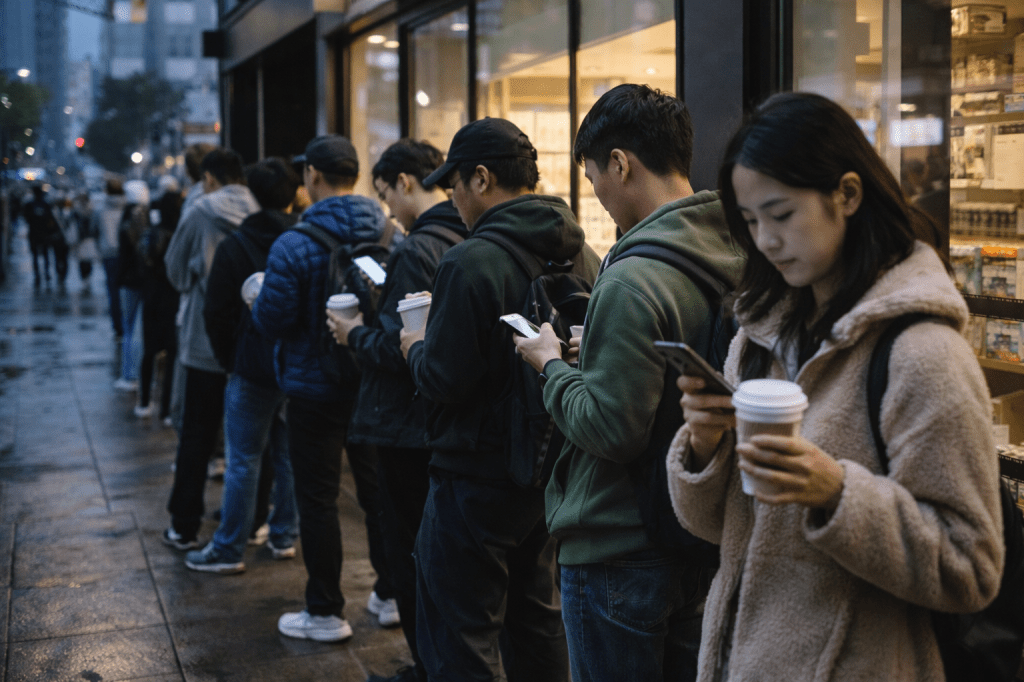
| The rise of the drop (model) |
Warm-up question: Have you ever waited in line or rushed to buy something before it sold out? What was it?
Listen: Link to audio [HERE]
Read:
Amy Scott: This is Marketplace, I’m Amy Scott. The Starbucks Barista, the Trader Joe’s mini tote, Crocs’ new Lego clog—these are just a few examples of recent limited-edition products that have driven people to stores and into long lines to buy one before they’re gone. Ellen Cushing, a staff writer at The Atlantic, wrote about the rise of the product drop and why every brand seems to be doing it. Ellen, thanks for being here.
Ellen Cushing: Thrilled to be here to talk about this pressing matter.
Amy Scott: All right, for the uninitiated, what is a drop and how do these things typically work?
Ellen Cushing: So, a drop is just a slightly different way of releasing products. Instead of companies making goods at the rate of expected demand and releasing them without fanfare, what they’re doing instead is producing in intentionally low quantities and then releasing those products in these discrete, hyped event product launches.
Amy Scott: And it seems like everyone’s doing it these days, but it hasn’t always been this way. How did it sort of begin?
Ellen Cushing: In the US, it really started with, like, sneaker culture and streetwear. So, the most famous company in this realm is Supreme, which in the 2000s started releasing its products in these super limited quantities. They say that they did that for practical reasons—they just, you know, did not have large production capabilities and so they didn’t have a ton of stuff. What they did was they would say, like, “We’re releasing this product today, and we’re going to release this product next week, and we’re going to release this product the week after,” rather than putting everything they had on shelves at once.
Amy Scott: Yeah, and you point out, I mean, luxury brands have been doing this for a long time, right? If there were ubiquitous Birkin bags, they would not be worth so much. But, you know, if everybody’s doing it, what’s the point?
Ellen Cushing: Yeah, I mean, this is sort of the moment we’re at now. In the story, I call it “late-stage drop.” It’s like big companies that make their stuff in factories, like Stanley cup and Skims and a huge number of snack food companies, were also releasing in drops. And the stuff itself isn’t really special. It’s—it’s not a pair of sneakers that are hand-stitched, it’s not a bag that was made by artisans; it’s just a coffee cup that was, like, injection molded. And now what you’re seeing is it’s getting knocked off online.
Amy Scott: Right. Or just sold on eBay for much more than the shopper paid. It seems like the real winner here is the collector who gets it in time to put it online and sell it for an inflated price.
Ellen Cushing: Yeah, I mean, this is a huge industry. The people who stand in line at Trader Joe’s—Trader Joe’s has done a very good job of this. They have these ultra-limited edition pastel-colored tote bags last year that were incredibly popular. And they retail for $2.99 in most markets, but online you could get them for, like, $500 because they were so limited.
Amy Scott: Two dollars and 99 cents. Right?
Ellen Cushing: Yeah, sorry, $2.99, you know, less than the cost of most things Trader Joe’s sells. Yeah, and so if you’re—if you’re happy to get in line at 3:00 in the morning for one of those, then you’re—you’re making a couple hundred dollars an hour, which is pretty good
Amy Scott: Well, you call this late-stage drop; it also speaks to late-stage capitalism. I mean, how much longer do you think this sort of frenzy goes on before people kind of, like, shrug at the latest drop of a factory-produced item?
Ellen Cushing: You know, we’ve seen that the sneaker resale market is really cooling off. At the same time, we’re seeing the market for resold, like, Labubus increase and get hotter. So, who really knows how long this will last? But I find it interesting that people are no longer as hyped about limited-edition sneakers as they were 10 years ago, which may suggest that maybe people are getting tired of it.
Amy Scott: All right, Ellen Cushing had the story in The Atlantic. I recommend reading it—it’s—it’s fun. Thanks so much, Ellen.
Ellen Cushing: Thank you.
Vocabulary and Phrases:
- Product drop: a limited release of a product at a specific time, often in small quantities to create excitement.
- Uninitiated: people who are not familiar with or experienced in something.
- Discreet: done in a careful, low-key, or not obvious way.
- Streetwear: casual fashion style that originated from urban culture, especially linked to skateboarding and hip-hop.
- Ubiquitous: present or found everywhere.
- Artisans: skilled workers who make products by hand.
- Knocked off: copied or imitated, usually cheaply and without permission.
- Late-stage capitalism: a term used to describe modern capitalism, often suggesting excess, inequality, or unusual consumer trends.
- Frenzy: a state of intense excitement or activity, often uncontrolled.
Fill in the Blank Use the correct word or phrase from the vocabulary list.
- These handmade products were created by local ____________.
- For the ____________, the concept of limited releases can be confusing at first.
- Many popular brands today are influenced by ____________ culture.
- Smartphones have become ____________ in modern society.
- The brand announced a new ____________ that sold out within minutes.
- The design was quickly ____________ and sold online at a lower price.
- The company launched the product in a ____________ way, without much advertising.
- Some critics argue that trends like this reflect ____________.
- The store opening caused a buying ____________ among customers.
Comprehension Questions:
- What is a product drop, and how does it differ from traditional product releases?
- Where did the idea of product drops originally come from?
- Why do companies intentionally produce limited quantities of products?
- What problem occurs when many brands start using the same strategy?
- How do some people make money from product drops?
Discussion Questions:
- Do you think product drops are a smart marketing strategy or a manipulation of consumers? Why?
- Why do people value limited or hard-to-get products?
- Have you ever bought something because it was limited edition? How did you feel about it afterward?
- Do you think trends like this will continue, or will people eventually lose interest?
- What does this trend say about modern consumer behavior?
 LanguageLeap