This lesson focuses on a new type of solar technology that allows people to generate electricity at home using simple plug-in panels. You will learn vocabulary related to energy costs, utilities, and government regulation, while also improving your ability to follow how complex issues are explained in news reports. The material highlights how lawmakers, utility companies, and advocacy groups respond differently to new technology, especially when safety and competition are involved. As you work through the lesson, you will practice understanding key arguments, identifying different perspectives, and discussing how innovation can challenge existing systems.
| Easy-to-use solar panels are coming, but utilities are trying to delay them |
Warm-up question: Do you think individuals should be allowed to generate their own electricity at home? Why or why not?
Listen:
Read:
LEILA FADEL, HOST:
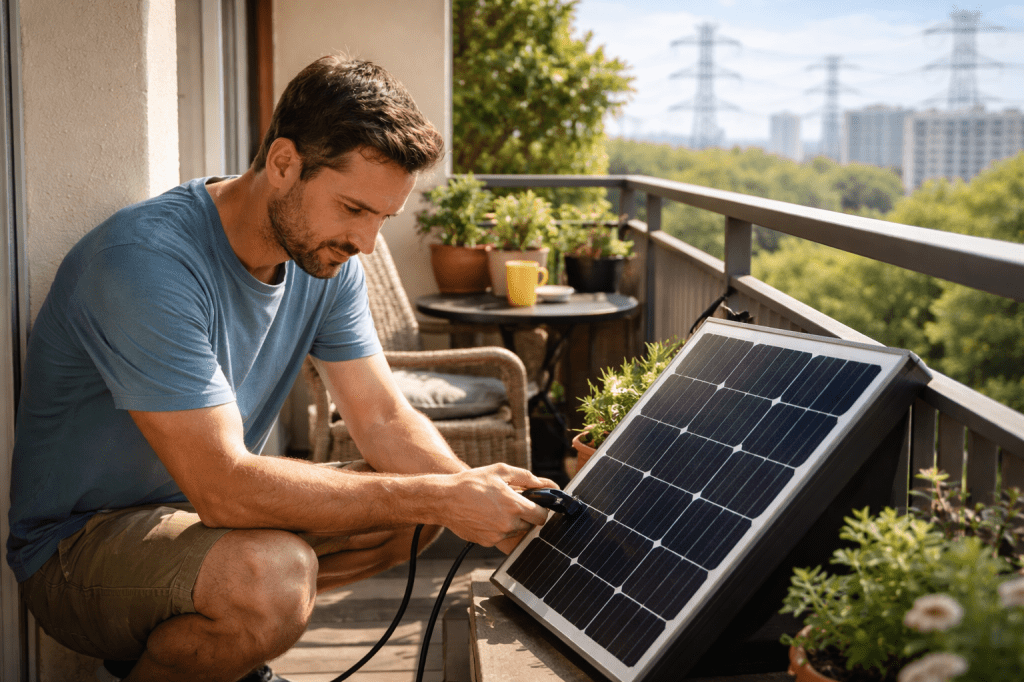
Americans are concerned about higher energy prices. Plug-in solar panels come with a promise to shave off part of your utility bill. These panels can be purchased at a store, placed on a porch or balcony and plugged into a regular outlet. Lawmakers around the country are considering bills that would make it easier to use these solar panels, but now utilities are raising safety issues. Jeff Brady from NPR’s climate desk is here to talk about all this. Good morning, Jeff.
JEFF BRADY, BYLINE: Good morning.
FADEL: So how do these bills in state legislatures make it easier to use plug-in solar panels?
BRADY: Well, these plug-in solar panels – they’re a lot cheaper than rooftop systems, and these bills exempt them from complicated connection agreements with utilities. Those are needed for the larger rooftop solar panel systems because they send electricity out onto the grid, where a utility buys it. And these agreements, along with installation and permitting costs – they can double the price of solar panels. So last year, Utah was the first state to pass a law exempting plug-in or balcony solar panels from these connection agreements. More than 30 bills have been introduced in state legislatures, but now at least six of those have been withdrawn because utilities told lawmakers they have safety concerns.
FADEL: OK. Let’s dig into that. What kind of safety issues are utilities raising about plug-in solar panels?
BRADY: These panels – they’re different from most appliances that people use because they generate electricity rather than consume it. So the plug on the end of the cord, that could shock someone. And utilities, they’re more concerned about what happens during a power outage. Theoretically, a plug-in panel that they don’t know about – it could send electricity through a house’s wiring and out onto the grid where it could shock a utility worker. Here’s Emily Pateuk. She’s a lobbyist with Georgia Electric Membership Corporation, which represents cooperative utilities, and this was at a committee hearing last month.
EMILY PATEUK: Providing safe, reliable and affordable power is a key mission of every EMC in the state, and the safety of our linemen and others that work on that system is a reason that we oppose House Bill 1304.
BRADY: There was a lot of confusion at that hearing about how plug-in panels work and what safety measures already exist. So the committee chair decided to delay a vote until questions could be addressed, and similar bills have been delayed in Arizona, Indiana, New Mexico, Washington state and also in Wyoming.
FADEL: How are the safety issues being addressed?
BRADY: There are technologies available that shut plug-in solar panels down in less than a second when there’s a power outage. So the risk of shock goes away under those circumstances. The company UL Solutions – it used to be called Underwriters Laboratories – they test and certify products to make sure they meet safety standards. But, you know, probably the most compelling piece of evidence is Germany. That country has more than 1.2 million balcony solar panels registered, with no safety problems reported. I talked with Cora Stryker. She’s at the advocacy group Bright Saver. She thinks these concerns are less about safety and more about utilities facing competition.
CORA STRYKER: Kicking up dust regarding safety concerns is definitely a strategy being used by people who don’t want this for their own self-interested reasons.
BRADY: The utilities and trade groups we contacted for this story didn’t comment on Stryker’s kicking-up-dust allegation.
FADEL: So as lawmakers consider the remaining bills, how soon might people be able to buy these plug-in solar panels?
BRADY: You know, they’re actually available now, but the ones on the market are not certified by UL Solutions yet. That company says we can expect certified products in a matter of months.
FADEL: Jeff Brady from NPR’s climate desk. Thanks for your reporting, Jeff.
BRADY: Thank you.
Vocabulary and Phrases:
- Shave off: to reduce something by a small amount, especially costs or time.
- Utilities: companies that provide essential services like electricity, water, or gas.
- Exempt: to officially excuse someone or something from a rule or requirement.
- Dig into (something): to examine or explore something in detail.
- Kicking up dust: creating unnecessary concern or confusion, often to distract or delay action.
- Self-interested: acting to benefit oneself rather than others.
Fill in the Blank Use the correct word or phrase from the vocabulary list.
- Many people are frustrated with rising costs from local ____________.
- Small businesses may be ____________ from certain taxes under the new law.
- The new budget plan aims to ____________ expenses by 10% this year.
- His argument seemed more ____________ than focused on the public good.
- The committee will ____________ the issue before making a final decision.
- Some critics say the company is just ____________ to avoid stricter regulations.
Comprehension Questions:
- Why are plug-in solar panels becoming more popular among consumers?
- How do these panels differ from traditional rooftop solar systems?
- What is one reason lawmakers want to make plug-in solar panels easier to use?
- What safety concerns are utilities raising about these panels?
- How do some experts respond to the safety concerns raised by utilities?
Discussion Questions:
- Would you consider using plug-in solar panels at your home? Why or why not?
- Do you trust large utility companies to act in the public interest? Why or why not?
- How should governments balance innovation and safety when introducing new technologies?
- Do you think companies sometimes exaggerate risks to protect their business? Can you think of an example?
- How might widespread use of small-scale solar panels change the energy industry in the future?
 LanguageLeap