This lesson focuses on the return of BTS after a long break and explores why their comeback is such a major event in South Korea. You will learn vocabulary related to media attention, public reaction, and cultural identity, while improving your ability to follow detailed explanations about social and economic impact. The material highlights how entertainment, national identity, and government decisions can become closely connected, and gives you practice understanding both positive reactions and criticism in a real-world news context.
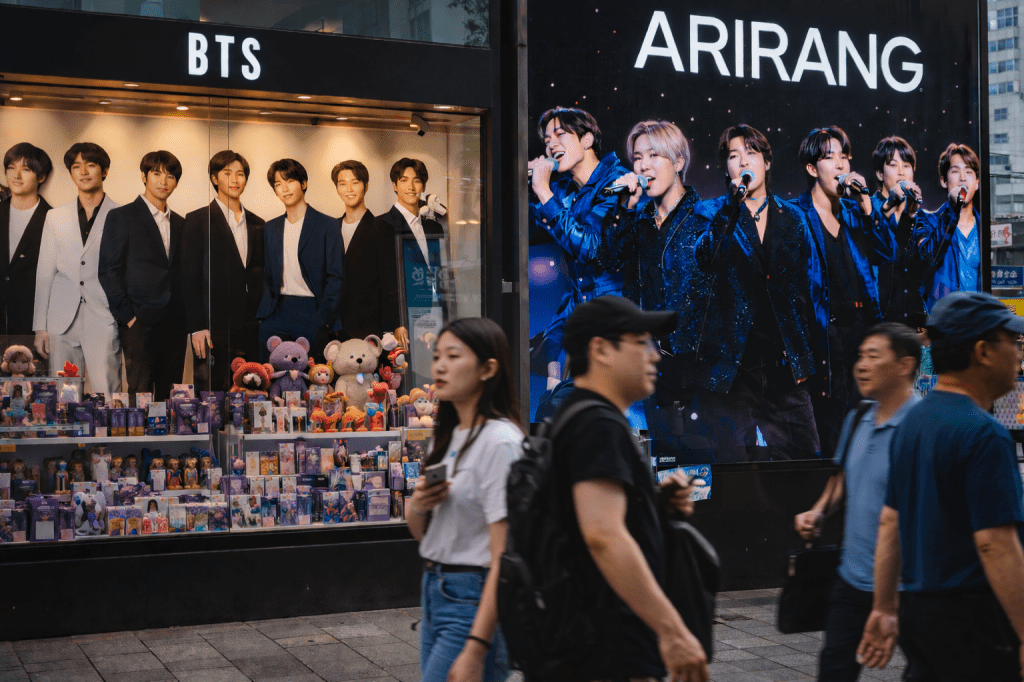
| K-pop group BTS returns with an epic live concert in Seoul |
Warm-up question: Why do you think some musicians or celebrities become symbols of a country?
Listen: Link to audio [HERE]
Read:
ADRIAN MA, HOST:
After a yearslong hiatus, one of the world’s most beloved boy bands is back.
BTS: We’re back.
MA: BTS. Yesterday, the K-pop group put on a massive concert, performing songs off their first new album in almost four years. Thousands of fans gathered to see them in Seoul, South Korea, while millions more reportedly tuned in on Netflix. To tell us more about it, journalist Kelly Kasulis Cho joins us from Seoul. Thanks for being here.
KELLY KASULIS CHO: Thanks for having me.
MA: And to start off, BTS has been on a break for the last few years while several members completed mandatory military service. Can you describe what the anticipation was like in South Korea for their return and also what it was like at the concert?
KASULIS CHO: South Korea really rolled out the red carpet for BTS. It’s a seven-member group. They have become very aligned with Korea’s national identity. The city of Seoul, which is about 10 to 25 million people, depending on how you want to measure it, literally shut down around the massive Gwanghwamun Palace – its historical palace – for about three subway stops. So we’re talking about kilometers and kilometers of closed traffic, tens of thousands of people showing up. They even had a national drone show where thousands of drones were painting the faces of the band members the night before, so it looked like these holograms of their faces floating in the sky. Police were mobilized to keep people safe. It was really quite an incredible scene to welcome them back after nearly four years.
MA: Can you talk about why the government was making this massive preparation?
KASULIS CHO: BTS has really become one of South Korea’s greatest cultural exports. I’m sure people in the United States have heard of other major acts, like BLACKPINK or the South Korean film “Parasite,” the Netflix show “Squid Game.” But BTS is really South Korea’s kind of entry into the mainstream, globalized pop culture kind of taste-making world. And so it’s really important that South Korea keeps them big as a cultural export.
South Korea’s economy is also struggling a little bit, and BTS is estimated to bring some 3.6 billion to its economy every year. And, you know, its latest album is even named “Arirang,” which is a word that every South Korean person knows. It’s a word that’s really attached to the Korean cultural and ethnic identity. It’s a famous folk song. And so, really, BTS is about bringing people to South Korea, getting people interested in Korean culture, and they’ve been very successful at that on virtually every continent.
MA: So amongst all this fanfare, is everyone kind of into it, or are there any people in South Korea who are sort of BTS haters?
KASULIS CHO: It’s funny. In my experience, most people do actually like BTS here, or at least like what they’re doing for South Korea’s reputation. I know very few people that are too cool for BTS, so to speak, although there are plenty of amazing indie Korean artists that people should check out.
There has been a little blowback to the band over the last few years because South Korea has treated them, you know, maybe better than an average citizen. That’s always been the charge, the accusation. They’ve gone away for their military service. There was a lot of public scrutiny over whether or not the South Korean government was going to grant them an exemption from their military service since they were bringing so much to the country’s economy, and a lot of people didn’t want that to happen.
MA: We’ve been speaking with journalist Kelly Kasulis Cho In Seoul. Thanks for joining us.
KASULIS CHO: Thanks for having me.
Vocabulary and Phrases:
- Hiatus: a break or pause from an activity, often for a long period.
- Roll out the red carpet: to give someone a very special or enthusiastic welcome.
- Aligned with: closely connected or in agreement with something.
- Literally: used to emphasize that something is true in a real or exact sense (though often used for emphasis).
- Ethnic identity: a person’s sense of belonging to a particular cultural or national group.
- Virtually: almost entirely; nearly.
- Fanfare: a lot of attention, excitement, or publicity around an event.
- Blowback: negative reaction or criticism after an action.
- Scrutiny: careful and detailed examination or criticism.
- Exemption: official permission not to do something that others are required to do.
Fill in the Blank Use the correct word or phrase from the vocabulary list.
- The movie was released with a lot of media ____________.
- The product is ____________ available in every major market around the world.
- The company’s actions came under intense ____________ from regulators.
- Some athletes receive an ____________ from mandatory military service.
- The company returned after a long ____________ and quickly regained popularity.
- His personal values are closely ____________ his company’s mission.
- The city decided to ____________ for the visiting world leaders.
- The entire city ____________ stopped traffic for the major event.
- The festival celebrates the country’s cultural traditions and ____________.
- The decision caused significant ____________ from the public.
Comprehension Questions:
- Why had BTS been on a hiatus for several years?
- How did Seoul prepare for BTS’s return concert?
- Why is BTS considered important to South Korea’s economy?
- What cultural significance does the album name “Arirang” have?
- What criticism or controversy has BTS faced in South Korea?
Discussion Questions:
- Do you think celebrities can represent a country’s identity? Why or why not?
- Should governments support or promote popular artists? Why or why not?
- Is it fair to give special treatment to people who contribute to the economy?
- How can cultural exports (music, movies, etc.) impact a country’s global image?
- Can you think of an example where a celebrity received public criticism or “blowback”? What happened?
 LanguageLeap