For decades, car safety improvements have focused primarily on the front seat, leading to major reductions in injuries and fatalities through better seat belts, crumple zones, and other technologies. However, new crash tests by the Insurance Institute for Highway Safety reveal that rear seats have not kept pace with these advancements. After adding a crash test dummy to the back seat in 2022, researchers found that many vehicles — including minivans — performed poorly, causing top safety ratings to drop sharply. As more adults use ride-sharing and older children continue riding in the back, rear-seat safety has become a growing concern. Automakers are now responding with redesigned seat belts, seat cushions, and other innovations, as safety researchers work to raise standards beyond minimum requirements for all passengers.
| Back seats aren’t as safe as they should be. A crash test is trying to help |
Warm-up question: Have you ever thought about which seat in a car is the safest — the front or the back? Why do you think that?
Listen:
Read:
JUANA SUMMERS, HOST:
If you spend your time in the front seat of a car, it’s gotten a lot safer there thanks to new technologies and designs, but not all those features have made it to the back seat, at least not yet. Right now, rear passengers are an intense focus for safety researchers, as NPR’s Camila Domonoske reports.
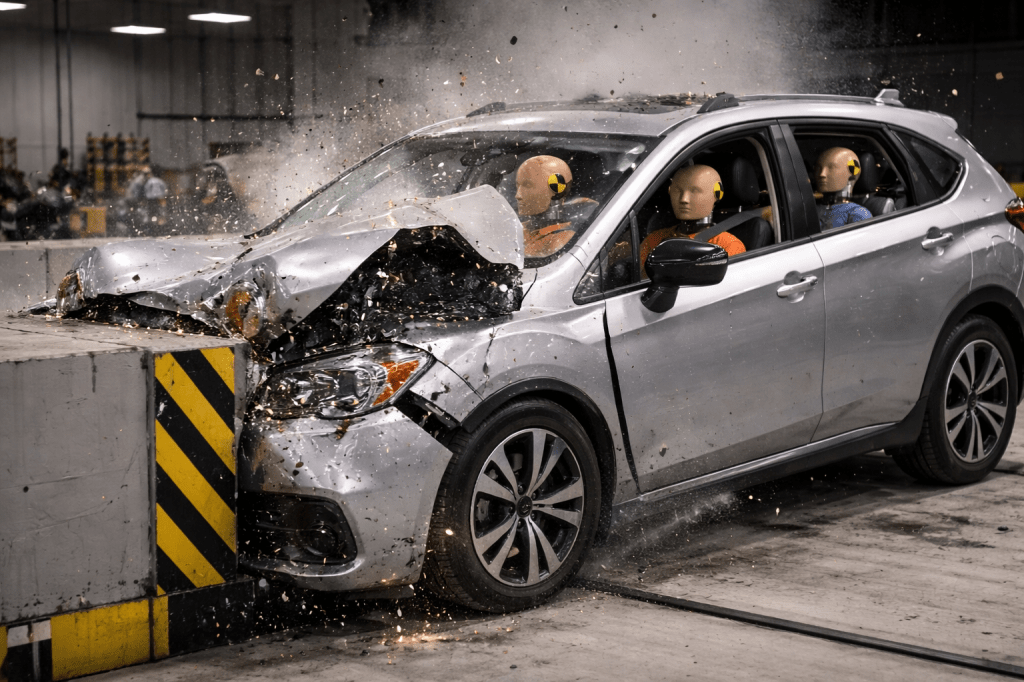
CAMILA DOMONOSKE, BYLINE: The Insurance Institute for Highway Safety regularly slams cars into a giant block of concrete and steel for science. I was standing on a platform looking out at that crash barrier next to Jessica Jermakian, the senior vice president of vehicle research. The test we were about to see simulates a head-on collision where the cars are slightly offset from each other. The institute has done this test for 30 years with a dummy in the driver’s seat. And over that time, vehicles got a lot safer in that front seat – more effective crumple zones, better seat belts.
JESSICA JERMAKIAN: Lots of improvements, and we’ve seen that play out in the field data with a reduction in injury and fatality risk.
DOMONOSKE: A big metal door was rising behind us. A Subaru Crosstrek was about to be yanked into that crash barrier at around 40 miles per hour. But this car didn’t just have a dummy in the front seat. It also had one in the back. The original test focused on the front seat because, well, it’s a frontal collision. But then came all those decades of better and better engineering.
JERMAKIAN: What we saw when we went back and looked at the field data is that, while we’ve made lots of improvements for the front seat, the rear seat hadn’t kept pace.
DOMONOSKE: In fact, compared to the front, the rear seat now looked less safe. Now, to be clear, the rear seat is still definitely safer for small children in their car seats, but older kids also ride in the back, so do more and more adults because of ride-sharing. Rear seats need to be safe, too. So in 2022, the Insurance Institute for Highway Safety made that change, adding that dummy in the back seat. This test was suddenly much harder. Right away, the number of vehicles that won the institute’s top safety scores dropped sharply.
DOMONOSKE: Earlier, I’d watched the dummies get set up. The one in the back is about the size of a 12-year-old. Now the car was being propelled down a track toward that mass of concrete with both its inanimate occupants.
DOMONOSKE: Even though I was expecting the crash, it was still jarring when it actually happened.
DOMONOSKE: And in the aftermath, I spotted that small dummy’s hand flung by the force of the collision.
Oh, my God, the little hand thrown out the window.
I asked Jermakian if she ever got emotional about these tests. She said she started working in vehicle safety by doing research on real crashes that had injured real people.
JERMAKIAN: And in fact, I spent five years working for a children’s hospital studying how children are hurt – get hurt in car crashes.
DOMONOSKE: So no is the answer. Watching dummies get crashed is a relief. And the data from the dummies will help real kids avoid injuries. The test was updated again in 2024, and it’s revealing a lot of shortcomings. Minivans used to do pretty well in the group’s tests, but under the latest version, not a single minivan was a top safety pick from the institute, because even the quintessential family vehicle does pretty badly on this backseat safety. But automakers have responded quickly, says Jermakian. The generation of cars coming out right now are showing improvements to the back seat. The first changes were some easy swaps.
JERMAKIAN: Things like changing out the seat belt for ones with more advanced technology.
DOMONOSKE: And now some trickier improvements, harder to redesign.
JERMAKIAN: Like changes to the seat cushion.
DOMONOSKE: And who knows what innovations we might see next. That’s the point of these particular crash tests. They aren’t testing for minimum safety standards but trying to raise the bar for safety in the front seat and in the back. Camila Domonoske, NPR News, Ruckersville, Virginia.
Vocabulary and Phrases:
- Simulate: To imitate the appearance or character of something (used here to describe a laboratory crash that mimics a real accident).
- Offset: Placed at an angle or not perfectly aligned (describing a collision where cars don’t hit center-to-center).
- Dummy: A life-sized model of the human body used in scientific tests.
- Crumple Zone: A part of a motor vehicle, especially the front and rear, designed to deform and absorb energy during a collision.
- Field Data: Information collected from real-world environments rather than controlled laboratory settings.
- Keep Pace: To move or develop at the same speed as something else.
- Propelled: Pushed or moved forward with great force.
- Inanimate: Not alive; showing no signs of life.
- Jarring: Causing a physical shock, jolt, or even a mental feeling of being shaken.
- Aftermath: The consequences or aftereffects of a significant unpleasant event.
- Get Emotional: To be moved by strong feelings (sadness, fear, or relief).
- Shortcomings: Failures to meet a certain standard; flaws or defects.
- Quintessential: Representing the most perfect or typical example of a quality or class.
- Raise the Bar: To increase the standards or expectations of a particular activity.
Fill in the Blank Use the correct word or phrase from the vocabulary list.
- Engineers use a crash test __________________ to measure how much force a human body would experience during an accident.
- Although the front seat has seen massive safety upgrades, the rear seat unfortunately hasn’t __________________ with those improvements.
- The loud “bang” of the car hitting the concrete was incredibly __________________ for the researchers standing nearby.
- Modern cars are designed with __________________ that fold up to absorb the energy of an impact, protecting the cabin.
- In the __________________ of the crash, technicians carefully inspect the vehicle to see which parts held up and which failed.
- The minivan is often seen as the __________________ family car, making its poor rear-seat safety results quite surprising.
- The IIHS aims to __________________ for the entire industry by creating tests that go beyond minimum government requirements.
- To __________________ a real-world scenario, the car is __________________ down a track at 40 miles per hour toward a solid barrier.
- Researchers compare their laboratory results with __________________ from actual hospital records to see if the tests are accurate.
- The new testing protocol revealed several __________________ in minivan designs that automakers are now rushing to fix.
Comprehension Questions:
- Why have front seats become safer over the past 30 years?
- What new change did the Insurance Institute for Highway Safety make in 2022?
- Why did the number of vehicles with top safety scores drop sharply?
- Why are rear seats now an important focus for safety researchers?
- What did researchers discover about minivans under the updated test?
- How have automakers responded to the new crash test standards?
- What is the purpose of these updated crash tests?
Discussion Questions:
- Were you surprised that rear seats may now be less safe than front seats? Why or why not?
- Do you usually sit in the front or back of a car? Has this story changed your thinking?
- Why do you think safety improvements focused on the front seat for so long?
- Should safety organizations raise standards beyond minimum legal requirements? Why?
- If you were designing a new car, what safety feature would you prioritize?
- Ride-sharing is becoming more common. How might this change the way cars are designed in the future?
 LanguageLeap