While retail theft like “smash-and-grabs” or shoplifting often makes the headlines, a much larger form of shrinkage is quietly impacting the global supply chain: cargo theft. Between 2021 and 2024, these crimes increased by more than 90%, evolving from small-scale operations into sophisticated, international crime rings. From Oculus headsets to frozen lobsters, thieves are swiping entire trailers directly from the logistics hubs that move our economy.
This lesson explores how these “invisible” crimes happen—ranging from plain-clothes stakeouts to complex “strategic thefts” involving fraudulent digital communications. We will also examine the heavy toll this trend takes on businesses, including broken chains of custody that force companies to destroy recovered goods, rising insurance costs from wary underwriters, and the final expenses that inevitably trickle down and are baked into the price for consumers.
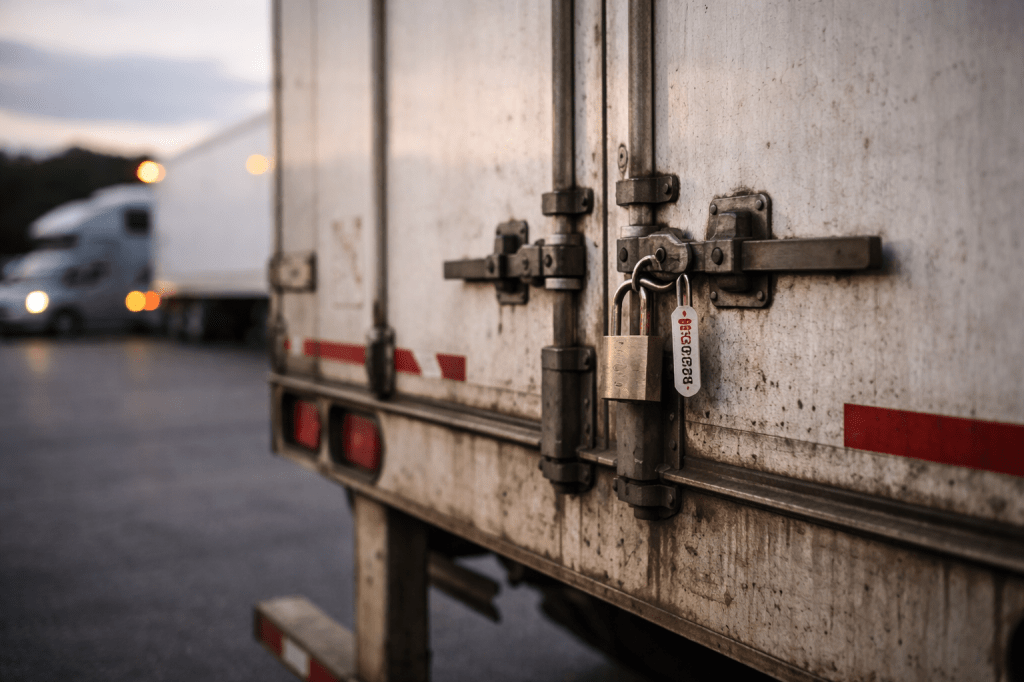
| Cargo Theft and the “Invisible” Cost of Shrinkage |
Warm-up question: Think about the last thing you bought online or in a store (a pair of shoes, a box of cereal, a new phone). How many different people, trucks, and warehouses do you think that item touched before it reached your hands? How many opportunities were there for it to be stolen?
Listen: Link to audio [HERE]
Read:
Kai Ryssdal: Retail theft—”shrinkage,” as they call it in the trade—comes in many forms. A smash-and-grab, perhaps? A little sleight of hand at the self-checkout? But the crime that’s perhaps affecting companies the most right now happens before any products make it to store shelves: cargo theft. People are stealing pallets off trucks or even whole trucks full of stuff—anything from TVs to lobsters. As Marketplace’s Kristen Schwab reports, the American Trucking Association says last year was likely the biggest for cargo theft on record.
Kristen Schwab: The cargo was loaded in Indiana, Kentucky, and Ohio. Trucks full of Oculus headsets, Bose speakers, and products from Bath & Body Works destined for warehouses all over the country. But they never made it there. When drivers took breaks to eat, sleep, or refuel, thieves swooped in.
Timothy O’Malley: They stole the trailer, obviously changed the identifier markers on the trailer, and drove the goods down to Florida to be resold.
Kristen Schwab: Timothy O’Malley, a special agent at the FBI in Indianapolis, says over 18 months, a group of men staked out warehouses and tracked drivers. In total, they swiped more than a dozen trucks. Now, these were not like the dramatic heists you see on TV. O’Malley says cargo thefts usually aren’t—no ski masks, no weapons.
Timothy O’Malley: This one was kind of more just plain old bad guys watching trucks and then waiting for an opportunity to steal those loads.
Kristen Schwab: Cargo theft increased more than 90% between 2021 and 2024. Scott Cornell, chair of the Transported Asset Protection Association, says the nature of the crime has changed.
Scott Cornell: It went from fathers, sons, uncles, cousins, brothers all making up the crew, to now massive international crime rings.
Kristen Schwab: As logistics technology has gotten better, so have thieves. And every time goods exchange hands, it creates an opportunity to steal. It’s why cargo theft is most common near major logistics hubs—places with ports and warehouses like California and Texas. And thieves, they steal really anything and everything, from pharmaceuticals to livestock. Cornell says the most popular category is food.
Scott Cornell: There’s no barcode on frozen chicken; there’s no serial number on frozen meat. Easier to sell and easier to hide. The evidence is consumed.
Kristen Schwab: Most stolen goods end up on third-party selling sites—think eBay and Facebook Marketplace—or they get shipped overseas. Often, the “big boss” is somewhere abroad operating online. David Mitsui, director of risk and compliance at freight brokerage Total Quality Logistics, says this kind of theft, called strategic theft, is becoming more common.
David Mitsui: We had a carrier—it was a legitimate carrier that we contracted for a load. The driver was hired to move a truckload of copper, but while on the road, he got an email from someone he thought was from Total Quality Logistics. They said, “Hey, I know that this load is supposed to be going to X. Instead of delivering there, we’re going to have you take it to this warehouse that’s really close to where you are right now”.
Kristen Schwab: The copper was eventually recovered, but even in this “best-case” type of scenario, there are consequences.
David Mitsui: A lot of times, if it’s food and beverage, even if you recover it, you have to dispose of it because you’ve lost chain of custody.
Kristen Schwab: All of this, of course, comes with a price. Mitsui’s anti-theft team has grown from 4 to 40 in the last two years. Janelle Griffith at Marsh, a supply chain and logistics consultancy, says a lot of cases go unreported, partly because it’s hard to decide which party—the warehouse, the freight broker, the trucking company—should file an insurance claim.
Janelle Griffith: Is it theft? Is it fraud? Is it a cyber intrusion? Who was the one at fault? Still, insurance claims have increased, which means so has the cost of insurance. I’ve had underwriters that have said, “If this continues in this vein, it very well might be that cargo becomes uninsurable”.
Kristen Schwab: And at the end of the day, all these costs trickle down to consumers, baked into the price of, say, a warm vanilla sugar candle from Bath & Body Works. I’m Kristen Schwab for Marketplace.
Vocabulary and Phrases:
- Shrinkage: A business term for the loss of inventory due to theft, shoplifting, or administrative error.
- Sleight of Hand: Skillful use of the hands when performing a trick (used here metaphorically to describe clever retail theft).
- Cargo Theft: The criminal taking of any cargo including goods, money, or baggage that is part of a commercial shipment.
- Destined: Headed toward a specific place or intended for a particular purpose.
- Swiped: A casual term for stealing something quickly.
- Heist: A grand-scale robbery, typically involving a high level of planning and a valuable target.
- Crime Ring: A group of criminals who work together in a highly organized way.
- Chain of Custody: The chronological documentation or paper trail showing the seizure, custody, control, and transfer of property (critical for food safety).
- At Fault: Responsible for an unfortunate event or a mistake.
- Underwriters: People or companies (usually in insurance) who assess the risk of a person or property and decide the insurance premium.
- In this Vein: In a similar way or of a similar kind.
- Trickle Down: The process by which costs or benefits passed from the top of an economic system eventually reach those at the bottom.
- Baked into the Price: When a cost (like insurance or theft loss) is already included in the final price of a product.
Fill in the Blank Use the correct word or phrase from the vocabulary list.
- When a shipment of food is recovered, if the ________ is broken, the goods usually have to be destroyed for safety.
- Many people think of a ________ as a dramatic movie scene with masks, but real cargo theft is often just a crime of opportunity.
- Because insurance claims are rising, the extra cost of protection is ultimately ________ of the items we buy.
- Logistics hubs in Texas and California are often where trucks ________ for warehouses are most vulnerable.
- Large ________ now operate globally, moving stolen goods across borders to be resold on third-party sites.
- If the trend of rising thefts continues ________, some experts worry that cargo will become completely uninsurable.
- Retailers often struggle to determine which party in the supply chain is actually ________ when a shipment disappears.
- While shoplifters might use ________ at a self-checkout, cargo thieves prefer to steal entire pallets or trailers.
- Total Quality Logistics reported that a group of men ________ more than a dozen trucks over an 18-month period.
- High ________ figures are a major headache for retailers, but “cargo theft” is much harder to track than simple shoplifting.
Comprehension Questions:
- What percentage did cargo theft increase between the years 2021 and 2024?
- According to Special Agent Timothy O’Malley, what did the thieves do to the trailers after stealing them to avoid being caught while driving to Florida?
- What two specific states are mentioned as being common locations for cargo theft due to their status as major logistics hubs with ports and warehouses?
- Why does Scott Cornell say that frozen meat and chicken are “easier to hide” and “easier to sell” than other goods?
- How many people were on David Mitsui’s anti-theft team two years ago, and how many are on that same team now?
- According to the reporter, where do most stolen goods eventually end up being sold to the public?
Discussion Questions:
- Security vs. Profit: Is it smarter for a company to spend millions on high-tech security, or just accept theft as a “cost of doing business” and pass the expense to customers?
- Who is at Fault?: If a driver is tricked by a fake email into delivering cargo to thieves, who should be held responsible: the driver, the IT department, or the freight broker?
- The Waste Dilemma: Should companies be legally allowed to donate recovered food if the “chain of custody” is broken, or is the risk of a lawsuit/illness too high?
- Consumer Transparency: Should retailers be required to list a “theft surcharge” on receipts so customers know exactly how much shrinkage is costing them?
- The Automation Argument: Will the rise of international crime rings accelerate the push for driverless trucks to eliminate human error and “insider” threats?
- The Future of Insurance: If cargo becomes “uninsurable,” how would businesses move goods across the country? Would small companies survive?
 LanguageLeap