Each year, the editors of MIT Technology Review identify technologies they believe are poised to significantly influence the world in the coming year. From artificial intelligence companions and AI-written software to private space stations and autonomous vehicles, these developments raise important questions about productivity, relationships, and responsibility. This lesson explores several of these emerging technologies and invites students to consider not just what is possible—but what is desirable.
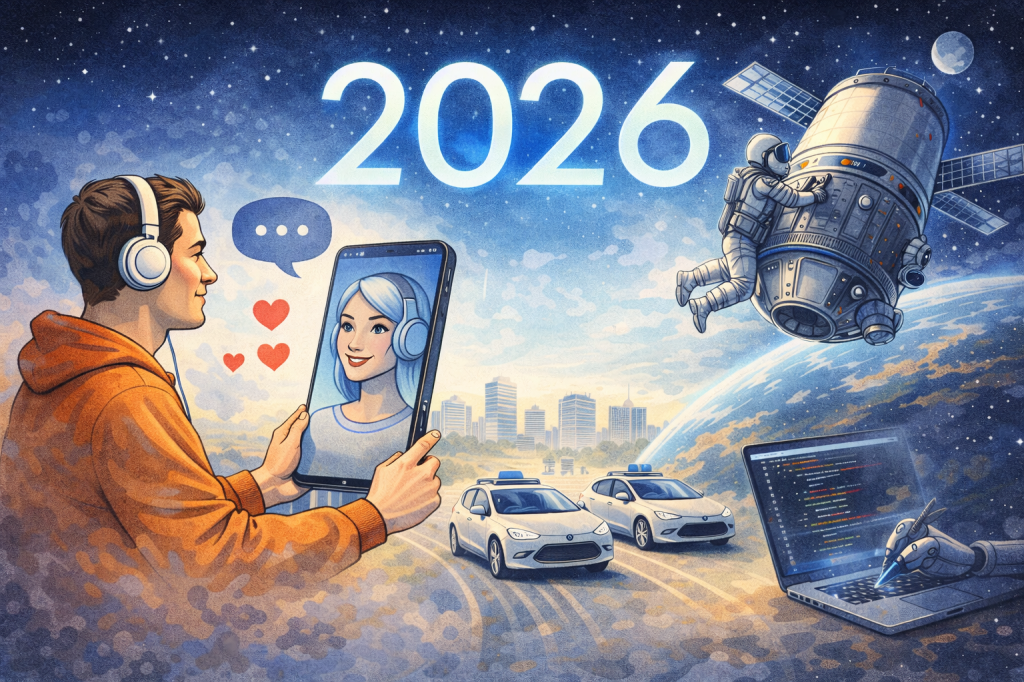
| Will these tech trends take off in 2026? |
Warm-Up Question: When you hear the phrase “breakthrough technology,” do you usually feel more excited or more concerned? Why?
Listen: Link to audio [HERE]
Read:
ROB SCHMITZ, HOST: Each year, the editors of the MIT Technology Review publish their list of 10 breakthrough technologies poised to make big impacts in the coming year. Plenty of intriguing items on this year’s list, including commercial space stations, personalized gene editing, next-generation nuclear power and plenty of innovations involving artificial intelligence, of course, including AI companions. To talk us through a few of these, we’ve got Amy Nordrum back on the line. She’s one of the editors that helps put this list together. Welcome back, Amy.
AMY NORDRUM: Hi. Thanks. Great to be here.
SCHMITZ: So I want to start with something that’s on everyone’s mind these days, artificial intelligence. Now, your team at MIT predicts that chatbots will play an even bigger role this year. A recent survey shows that 72% of teenagers have used these chatbots for companionship. And you write that OpenAI CEO Sam Altman has expressed approval of this trend. And as a parent of two teens, my initial reaction is, what? Please explain this for us.
NORDRUM: Well, you know, more people are forming close, personal relationships with chatbots, sometimes even romantic ones. These kinds of relationships have almost become mainstream in the past year, and we expect this will only continue. In some cases, they can be great. They can be really fun or helpful companions to people who want to use them to vent a little bit about their day, or maybe they’re feeling a bit lonely, or they want to try and work through a problem they’re facing in their personal life. But they can also be potentially harmful, possibly creating some emotional dependence or distance from real people in somebody’s life.
SCHMITZ: Romantic connections with AI. You’re also predicting that AI will be doing more of the work of writing software. Tell us what is this going to look like, and will this lead to AI replacing humans who work on this?
NORDRUM: Yeah. I mean, tech CEOs, in particular, have been quite bullish on this, saying that a good chunk of new code written at Microsoft and Google is now done by AI. And there is some data that suggests that the vast majority of developers are using AI coding tools in their work day to day. So I don’t think that this is going to reverse. I think we’ll see more and more of this. The question is, you know, when is it really useful for those developers? When does it actually make them faster and more productive in their work? Or when are they just generating more code but not necessarily good code that’s helping them actually solve problems in the code base?
SCHMITZ: So let’s pivot, Amy, to space stations. I was intrigued to learn that in the coming months, there are plans to launch a new private space station into orbit.
NORDRUM: That’s right. A lot of people might have heard of the International Space Station, but what they might not know is that the ISS has been up there orbiting Earth for almost 30 years, and NASA does plan to decommission it in just a few years, around 2030. And NASA’s not going to replace it. Instead, that agency and its international partners have decided to let private companies do that and build and operate space stations as a business. And space agencies like NASA that want to do research will then book time on those private stations. So the first wave of these new private space stations is starting to take shape right now, and the very first one could be launched as soon as May of this year by a company called Vast. And there are several other firms with plans to launch their own space stations over the next couple of years.
SCHMITZ: Wow. So lastly, Amy, we are journalists, and it’s always good to fact-check and assess our track record of years past. You know, you joined us last year with predictions on autonomous taxis, a high-powered telescope and mitigating the climate impact of cow burps. Did these breakthrough technologies end up breaking through?
NORDRUM: That’s a very fair question. I’m glad you asked. In some cases, yes. I think the Vera Rubin Observatory, which was the new telescope that we talked about on last year’s list, it opened as planned, and we saw the first images come through in June. They showed, you know, millions of galaxies in a single image. They showed, you know, thousands of asteroids that had never been seen before, just incredible stuff. Robotaxis did, as we thought they would, expand into more and more cities. The cow burping pills that you mentioned – those were to reduce the methane emissions that cattle give off. That’s a big climate problem, and that did run into a little bit of a setback this year. There were some safety concerns that some farmers raised.
SCHMITZ: Amy, 2 out of 3 is not bad. So I think…
NORDRUM: We’ll take it. Predicting the future is hard…
SCHMITZ: …We’ll take it.
SCHMITZ: That was Amy Nordrum, executive editor for operations at the MIT Technology Review. Amy, thank you so much.
NORDRUM: Thanks for the time.
Vocabulary and Phrases:
- Poised: Ready or prepared to do something important or impactful.
- Intriguing: Interesting in a way that makes you want to learn more.
- On the line: At risk; likely to be affected by an outcome.
- Companionship: Emotional support or comfort gained from spending time with someone or something.
- Vent: To express emotions, frustrations, or concerns openly.
- Emotional dependence: A situation in which someone relies heavily on another person or thing for emotional support.
- Bullish: Confident and optimistic about future growth or success, especially in business or technology.
- Pivot: To shift focus, direction, or strategy.
- Decommission: To officially take something out of service or operation.
- Autonomous: Able to operate independently without human control.
Fill in the Blank Use the correct word or phrase from the vocabulary list.
1. The idea of AI companions forming emotional bonds with users is both exciting and __________.
2. Tech executives remain __________ about AI’s ability to improve productivity.
3. Teenagers’ emotional well-being may be __________ if they rely too heavily on chatbots.
4. Robotaxis are an example of __________ technology already operating in some cities.
5. Several new technologies are __________ to reshape industries in the coming year.
6. Many people use chatbots as a form of __________ when they feel lonely.
7. Critics worry that long-term chatbot use could create unhealthy __________.
8. The discussion then __________ to the future of private space stations.
9. NASA plans to __________ the International Space Station around 2030.
10. Some users turn to AI to __________ about daily frustrations.
Comprehension Questions:
- What is the purpose of MIT Technology Review’s annual list of breakthrough technologies?
- Why are AI companions becoming more common, especially among teenagers?
- What benefits and risks do AI companions present, according to Amy Nordrum?
- How is artificial intelligence changing the way software is written?
- What concerns exist about AI-generated code replacing human developers?
- Why is NASA moving away from operating its own space station?
Discussion Questions
- Do you think AI companions can provide real companionship, or is something essential missing? Why?
- Where should the line be drawn between helpful emotional support and emotional dependence on technology?
- Would you feel comfortable if AI wrote most of the software used in daily life? Why or why not?
- What advantages and risks come with private companies operating space stations instead of governments?
- Which technology mentioned in the interview do you think will have the biggest impact on everyday life?
- When predicting future technology, should society focus more on what can be built or what should be built?
 LanguageLeap