Every winter, ballet companies across the United States perform The Nutcracker, a production that has become both a cultural tradition and a financial lifeline. While audiences enjoy the familiar music, costumes, and holiday atmosphere, these performances also play a crucial role in keeping dance organizations operating throughout the year. This lesson looks at how tradition, economics, and artistic balance come together behind the scenes—and why relying too heavily on one beloved performance can be both a strength and a risk.
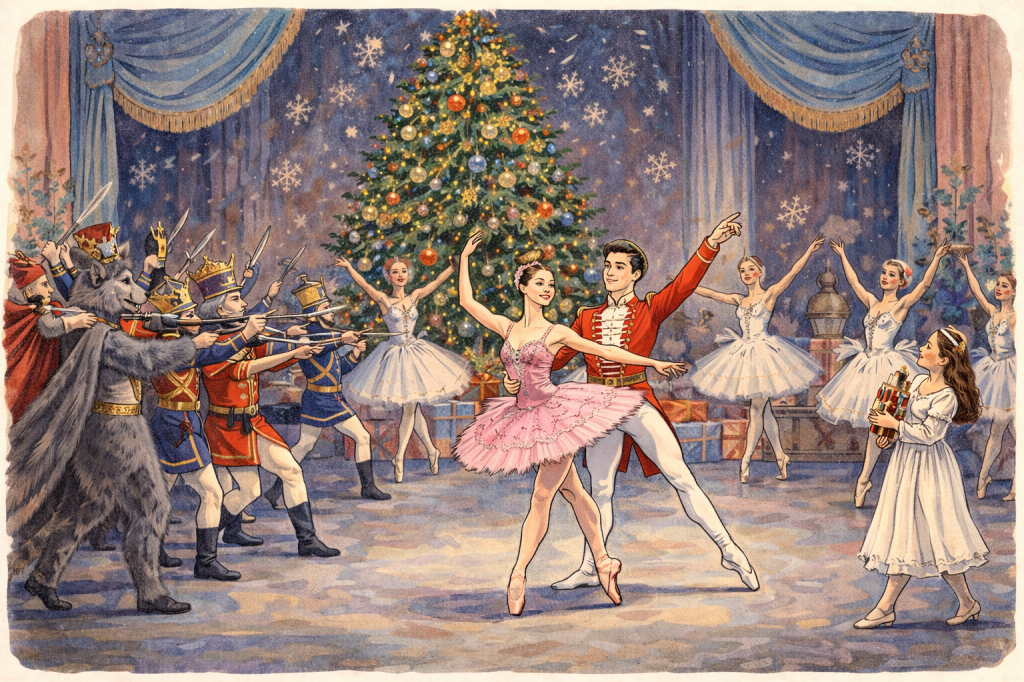
| ‘The Nutcracker’ isn’t just a cozy classic. It helps ballet companies pay the bills |
Warm-up question: Many people have holiday traditions they repeat every year. Do you have any traditions you try to observe regularly? Why do you think people hold on to traditions, even when life gets busy or expensive?
Listen: Link to audio [HERE]
Read:
STEVE INSKEEP, HOST:
Every winter, dance companies across the United States present “The Nutcracker.” Attending performances of Tchaikovsky’s composition is a tradition, which my family observed this year. There’s a great one in D.C. For ballet companies, this is big business. NPR’s Anastasia Tsioulcas reports.
ANASTASIA TSIOULCAS, BYLINE: A battle between brave toys and marauding mice, an elegant waltz of the snowflakes, the dance of the sugar plum fairy that’s just as sweet as any holiday dessert. For many Americans, watching these scenes in Tchaikovsky’s ballet “The Nutcracker” is a holiday must, so much so that major ballet companies across the United States now depend on “The Nutcracker” to keep them going. Here’s Kathy Brown, executive director of the New York City Ballet and the David H. Koch Theater. Her company does about 50 performances of “The Nutcracker” each year.
KATHY BROWN: The revenue that it brings in is about 45% of our total ticket revenue for the whole year. So it is enormously important to the business model.
TSIOULCAS: And it’s become even more so after the pandemic as audiences have returned to live performances. According to Dance/USA, which advocates for and supports dance, large American dance companies reported that their ticket revenue specifically for “The Nutcracker” has been zooming up. For these organizations, total ticket revenue for “Nutcracker” between 2022 and 2024 rose from just over $57 million to well over $84 million. Attendance for “Nutcracker” has leaped up, too, 18%.
But costs have been rising precipitously – labor, electricity, sprucing up old costumes and stage sets, even pointe shoes. New York City Ballet buys most of their pointe shoes from England, which means tariffs have caused shoe prices to skyrocket. And “Nutcracker” requires enormous forces, says Adam Sklute. He’s the artistic director of Ballet West in Salt Lake City, Utah. For their three dozen or so “Nutcracker” performances, Ballet West uses 52 professional dancers, a live orchestra of about 50 musicians, at least 30 crew members. And then there are all the kids.
ADAM SKLUTE: We use upwards of 15 to 20 of our advanced-level students, trainees and such. And then we use 75 smaller children in any given production. We alternate four different casts of those 75 kids, so that makes up 300 children.
TSIOULCAS: And of course, a steady stream of proud family members and friends coming to see them perform.
(SOUNDBITE OF SIR SIMON RATTLE AND BERLINER PHILHARMONIKER’S PERFORMANCE OF TCHAIKOVSKY’S “THE NUTCRACKER, OP. 71, ACT 2: DIVERTISSEMENT”)
TSIOULCAS: The trick, though, is getting “Nutcracker” fans to come back for other productions, says Kathy Brown of New York City Ballet. They may not come back to see an evening of contemporary choreography. But maybe they can be lured back to see, say, another classic, like “Swan Lake.”
BROWN: We try all the time to communicate with those folks and really try to invite them back. And because we know that they enjoyed a story ballet, we will try to invite them back for similar kinds of things.
TSIOULCAS: Each winter, these dance companies have to strike a careful balance. They’ve got to keep visions of sugar plum fairies dancing in audience members’ dreams but not become so reliant on one ballet that they endanger their other work. It’s enough to keep any dance company on its toes.
Anastasia Tsioulcas, NPR News, New York.
Vocabulary and Phrases:
- Observing (traditions): Following or honoring customs, practices, or habits over time.
- Marauding: Moving around in a violent or destructive way, often stealing or causing damage.
- Advocate: A person or organization that publicly supports or argues in favor of something.
- Precipitously: Very quickly and sharply, often in a sudden or dramatic way.
- Spruce up: To improve the appearance of something by cleaning, repairing, or decorating it.
- Lure: To attract or persuade someone to do something by offering something appealing.
- Keep (someone) on their toes: To make someone stay alert, flexible, or ready to respond to challenges.
Comprehension Questions:
- Why is The Nutcracker especially important to ballet companies in the U.S.?
- What percentage of annual ticket revenue does The Nutcracker generate for some companies?
- How has audience attendance changed since the pandemic?
- What types of costs have increased for ballet companies in recent years?
- Why is it challenging to turn Nutcracker audiences into repeat customers for other productions?
- What balance do dance companies need to maintain to stay financially healthy?
Discussion Questions:
- Do you think it’s risky for organizations to depend so heavily on one product or event? Why or why not?
- Have you ever continued supporting something mainly because of tradition rather than personal interest?
- What businesses or industries today rely on seasonal or “must-see” events like The Nutcracker?
- How do you feel about rising costs in the arts—should ticket prices increase, or should public funding play a bigger role?
- Can you think of a time when something that kept you “on your toes” actually helped you grow or improve?
- If you ran a cultural organization, how would you try to lure people back for less popular events?
 LanguageLeap