Nvidia’s stunning financial results have made it the most valuable company in the world—and the face of the booming artificial intelligence industry. But even as the company reports gangbuster earnings and piles up gobs of money, many investors and tech leaders are sounding alarms. They worry that the frenzy around AI may be overheating the market and pushing stock prices too high, too fast. In this lesson, you’ll explore key vocabulary related to markets, risk, and economic commentary; read about why investors are getting jittery; and discuss how enthusiasm for new technology can sometimes gloss over deeper economic concerns.
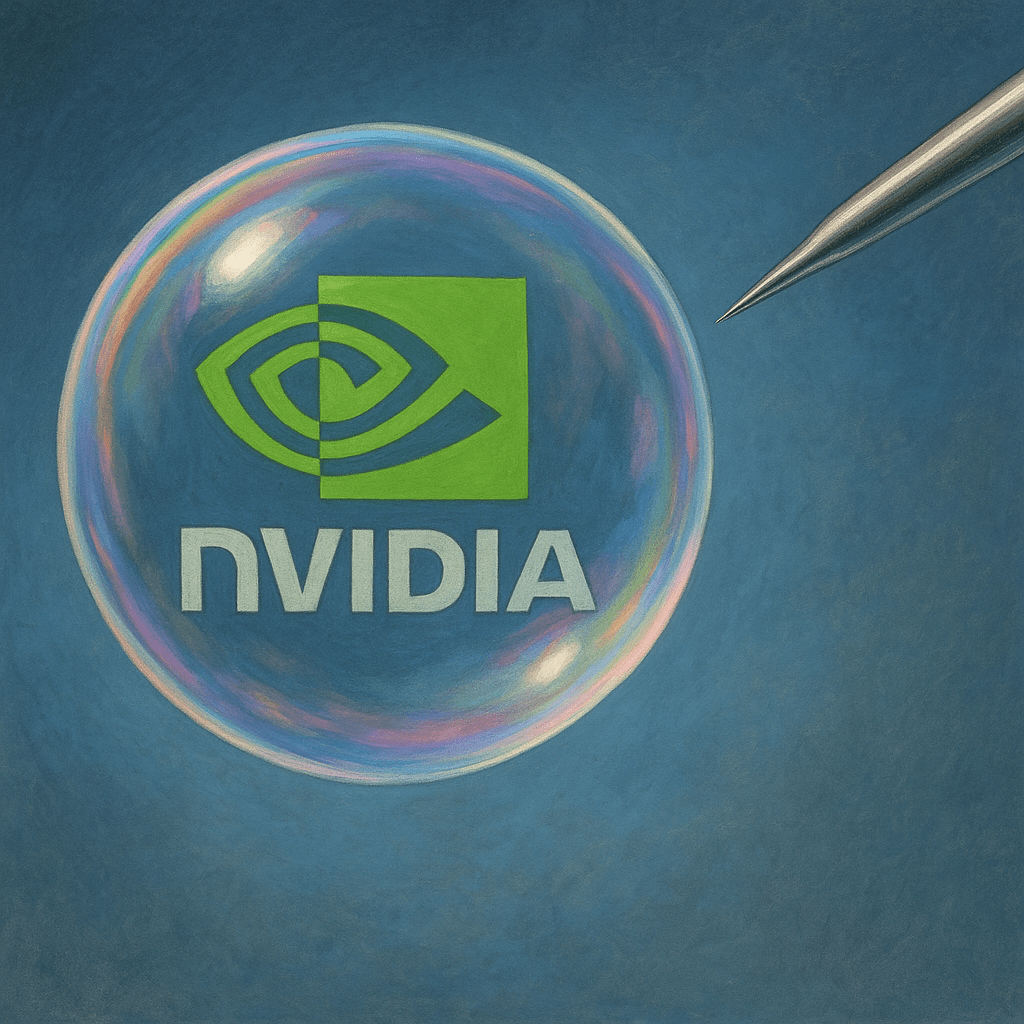
| The AI industry is booming. Is this massive bubble about to burst? |
Warm-up question: Do sudden rises in the stock market make you feel excited, nervous, or skeptical? Why?
Listen: Link to audio [HERE]
Read:
JUANA SUMMERS, HOST:
The stock market has been skyrocketing this year, thanks in large part to tech and the booming AI industry. This afternoon, the tech company Nvidia delivered its latest financial results. It told investors that it made another $32 billion in the last three months. But are these gangbuster results something to cheer or fear? And is this massive AI bubble about to burst? NPR finance correspondent Maria Aspan has been covering this, and she’s with us now, hey.
MARIA ASPAN, BYLINE: Hey, Juana.
SUMMERS: So, Maria, let’s just start with Nvidia. Why is this one company at the center of all of this?
ASPAN: This one company is the most valuable company in the world. Last month, it became the first ever company to be worth $5 trillion. Now, it got that way by selling the semiconductors that are powering the AI boom, and it is making gobs of money from that. But as you alluded to, the frenzy over AI has become this double-edged sword.
SUMMERS: OK, help me understand this. Tell us more about why this frenzy is concerning.
ASPAN: Well, at scale, we’re just not seeing a lot of these AI investments pay off yet. And that’s a problem because tech companies in general, and Nvidia in particular, have a huge influence on how the overall stock market is doing. So we’ve seen investors start to get really jittery over the last few days. Some of the biggest tech stocks have been selling off. And the S&P 500 in particular is coming off its worst losing streak since August.
SUMMERS: I mean, people have been worried about an AI bubble for years, as you’ve reported and we’ve talked about. So what is different now?
ASPAN: Right. Well, as we’ve talked about, Nvidia’s earnings reports have become this huge deal every three months. This one is coming at a time when we’ve seen warnings from top investors, including the heads of Goldman Sachs and Morgan Stanley. They’re warning that tech stocks are too hot and the market is due for a correction. And now Silicon Valley leaders are also sounding the alarm, like Sundar Pichai. He’s the CEO of Google parent company Alphabet, which we should note is a financial supporter of NPR. In an interview with the BBC this week, Pichai was surprisingly candid.
SUNDAR PICHAI: I think it’s both rational and there are elements of irrationality through a moment like this.
ASPAN: Elements of irrationality. He also acknowledged that sometimes the tech industry overshoots in investment cycles.
SUMMERS: Which is pretty notable to hear from Google, I have to say. How do investors respond?
ASPAN: So I talked today to Pam Haggerty. She’s a tech investor and lead portfolio manager at BNP Paribas. And she told me that it’s normal to have these periods of ups and downs as the markets adjust to a new technology.
PAM HAGGERTY: I think the worst that could happen is in two or three years or longer, there could be a digestion period.
ASPAN: That said, it sounds like we’re probably in for some more of these short-term market corrections at least.
SUMMERS: So just help us understand. What does this mean for, like, regular everyday people who do not care about the stock market?
ASPAN: Right. This is my obligatory disclaimer that the stock market is not the economy. But the problem is that the AI boom in the stock market is glossing over a lot of questions about what is going on in the economy. Tariffs are cutting into company profits, consumer prices are going up, the job market is weakening. And tomorrow, we’re going to get the long-delayed September jobs report. So AI has been this big bright spot, but it’s unclear how long it can last.
SUMMERS: NPR’s Maria Aspan. Thank you.
ASPAN: Thank you.
Vocabulary and Phrases:
- Gangbuster: Extremely successful, impressive, or booming; performing much better than expected.
- Gobs of money: A very large amount of money (informal).
- Alluded: Mentioned indirectly; referred to without saying something directly.
- Frenzy: A situation of extreme excitement, activity, or worry, often chaotic or excessive.
- Jittery: Nervous, anxious, or uneasy, especially about what might happen in the near future.
- Correction: In finance, a short-term drop in stock prices after they have risen too quickly.
- Candid: Honest, direct, and open, even when it’s surprising or uncomfortable.
- Obligatory: Required or expected, often because it’s standard practice rather than because someone wants to do it.
- Disclaimer: A statement that limits responsibility or clarifies something that might otherwise be misunderstood.
- Glossing over: Ignoring, downplaying, or skipping the important or difficult parts of something.
Fill in the Blank Use the correct word or phrase from the vocabulary list to complete each sentence.
- Some investors have grown __________ in recent days as tech stocks begin to fall.
- The CEO gave a surprisingly __________ interview, openly discussing risks in the industry.
- Her statement came with the __________ note that short-term stock movements don’t reflect the entire economy.
- Analysts say the market may be due for a __________ after months of rapid gains.
- The company made __________ last quarter thanks to record demand.
- In the interview, she __________ to concerns about an overheated tech market without saying it directly.
- The hype surrounding AI has created a __________ that has both excited and worried investors.
- He warned that people were __________ the real economic issues hidden beneath the AI boom.
- Sales have been absolutely __________ this year, far exceeding expectations.
- It’s almost __________ for financial reporters to remind audiences that predictions are uncertain.
Comprehension Questions:
- Why is Nvidia currently at the center of discussions about the stock market?
- What double-edged effect does the AI “frenzy” create?
- Why are some investors becoming jittery despite Nvidia’s strong performance?
- What have major financial leaders been warning about regarding tech stocks?
- How might a “correction” in the market affect future AI-related investments?
- What economic issues does the excitement around AI risk glossing over?
Discussion Questions:
- Do you think the AI boom will continue, or is it heading toward a bubble that might burst? Why?
- Are companies like Nvidia genuinely worth their massive valuations, or are people caught up in hype?
- Is it reasonable for investors to become jittery even when results look extremely strong?
- What role should financial leaders play in warning the public about overheated markets?
- Do you agree that “the stock market is not the economy”? Explain your understanding.
- Are you personally more motivated by opportunities (growth) or worried about risks (corrections)?
 LanguageLeap