For more than 200 years, technological innovation has driven economic growth and improved living standards. But progress also brings challenges — industries change, jobs disappear, and societies must adapt. In this lesson, you’ll read about the three economists who won the Nobel Prize for studying how innovation transforms economies and how their findings apply to today’s breakthroughs, including artificial intelligence. You’ll explore why growth requires both creativity and stability, learn new vocabulary related to technology and economics, and discuss how societies can balance innovation with fairness.
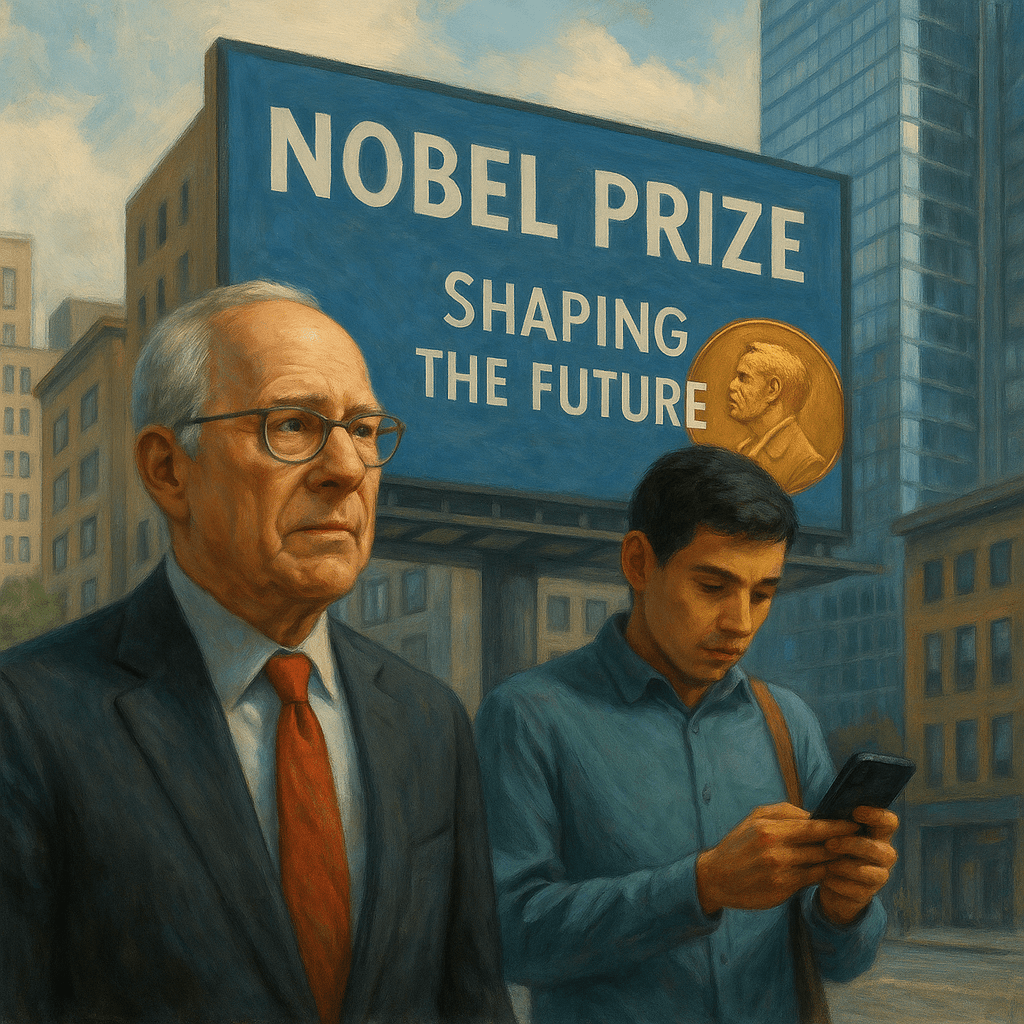
| Experts on tech innovations’ impacts on standards of living earn economics Nobel |
Warm-up question: How do you think technology has changed your life the most in the last ten or twenty years? Has it always been for the better?
Listen: Link to audio [HERE]
Read:
ANDREW LIMBONG, HOST:
Technological innovation has led to a steady rise in standards of living for the last two centuries. Three men who study that process were rewarded today with the Nobel Prize in economics. Their findings could help shape our response to next-generation breakthroughs like artificial intelligence. NPR’s Scott Horsley explains.
SCOTT HORSLEY, BYLINE: To illustrate the dizzying advance of technology over the last 200 years, members of the Nobel Prize committee held up a slide this morning showing the evolution of the telephone from an antique hardwired desktop model to a sleek, modern smartphone. Despite those advances, though, 2 out of 3 econ prize winners missed their congratulatory phone call this morning from the Nobel committee.
JOEL MOKYR: (Laughter) See, my phone is set in such a way that I can only receive phone calls from people on my contacts list because otherwise I get junk calls in the middle of class.
HORSLEY: That’s Joel Mokyr of Northwestern University, who only discovered he’d won the Nobel Prize when he later fired up his computer and found a note of congratulations. Mokyr is an economic historian. He found that innovation doesn’t necessarily lead to economic growth, only when it’s paired with the know-how to commercialize a new technology and with a society that’s open to change. John Hassler of the Nobel committee says that combination has allowed living standards to more than double with each generation thanks to new medicines, better communication and more efficient sources of energy.
JOHN HASSLER: Over the span of one or two centuries, almost everything has changed. Change, not stagnation, has become the new normal.
HORSLEY: But as with telephones, technology that’s state-of-the-art one moment can soon be eclipsed by something better. So Mokyr shares the Nobel Prize with two other economists who helped describe that process of creative destruction – Peter Howitt of Brown University and Philippe Aghion of the College of France. Howitt says it’s important to create safety nets for workers who might be displaced by new technology. Otherwise, they’re likely to fight it in a way that limits economic growth.
PETER HOWITT: Every new technology that has a great impact creates great losses as well. People have to be compensated, people have to be negotiated with in order to resolve that conflict in a way that allows the technologies to proceed.
HORSLEY: Artificial intelligence could be the next big innovation, but Howitt says it’s vital to maintain a competitive environment and not allow a handful of superstar firms to short-circuit the next round of innovation.
HOWITT: New technologies are brought in by disruptive outsiders who are interested in shaking up the status quo. But if they succeed in doing that, they become the status quo. And they are very resistant to people that want to do that in turn to them.
HORSLEY: Howitt is skeptical about claims that AI will trigger widespread unemployment. He says similar fears about earlier technological advances proved to be unfounded. Still, Howitt and his fellow prize winners did warn of dark clouds on the horizon. Cuts to university research could create potholes in one path to innovation. Aghion says the Trump administration’s protectionist trade policies could also hamper economic growth.
PHILIPPE AGHION: Openness is a driver of growth. Anything that gets in the way of openness is an obstacle to growth.
HORSLEY: The winners will split a prize of 11 million Swedish krona, or about $1.2 million. Aghion plans to invest his share into research with younger colleagues in further pursuit of creative destruction.
Scott Horsley, NPR News, Washington.
Vocabulary and Phrases:
- Dizzying: So fast, exciting, or confusing that it’s hard to follow or fully understand.
- Fired up: Excited, motivated, or full of energy.
- Commercialize: To develop something so it can be sold or used to make money.
- Stagnation: A lack of growth or movement; a situation where progress has stopped.
- State-of-the-art: The most modern and advanced level of technology or design.
- Eclipsed: Surpassed or replaced by something newer or better.
- Safety nets: Systems or programs that protect people from major loss or hardship (like unemployment benefits).
- To be compensated: To receive money or another form of payment for a loss, injury, or work.
- Short-circuit: To stop or interrupt a process before it can be completed.
- Status quo: The existing state of things; the normal or current situation.
- Skeptical: Doubtful; not easily convinced that something is true or will happen.
- Unfounded: Not based on facts or evidence.
- Hamper: To slow down or prevent progress.
Fill in the Blank Use the correct word or phrase from the vocabulary list to complete each sentence.
- The company introduced a __________ smartphone that can translate speech in real time.
- Economic __________ can lead to unemployment and declining living standards.
- The professor was __________ with excitement after hearing he’d received the award.
- Even though her idea was great, she didn’t know how to __________ it into a real business.
- The older model was quickly __________ by a newer, more efficient design.
- The pace of technological change can feel __________, especially for older generations.
- Workers who lose their jobs to automation should have access to __________ to support them.
- He insisted that people affected by the merger would need __________ for their losses.
- Allowing one company to dominate a new industry could __________ innovation.
- Many leaders are afraid to challenge the __________, even when change is needed.
- She remained __________ about the new AI system until she saw how well it actually worked.
- Some people’s fears about robots taking every job are __________.
- Political conflicts could __________ international research partnerships and slow global progress.
Comprehension Questions:
- What achievement earned the three economists the Nobel Prize?
- How does Joel Mokyr explain the link between innovation and economic growth?
- According to the winners, what must accompany new technologies for them to benefit society?
- Why does Peter Howitt say safety nets are important for technological progress?
- What warning did Howitt give about large companies and innovation?
- What are some current threats to future innovation mentioned in the report?
Discussion Questions:
- Do you agree that new technology always improves people’s lives? Why or why not?
- What kinds of “safety nets” do you think governments should create for workers affected by automation or AI?
- Why might big companies resist new technologies that could disrupt their success?
- Have you ever felt “skeptical” about a new technology at first but later came to trust it?
- What can countries do to encourage innovation while still protecting people who might lose out because of it?
 LanguageLeap