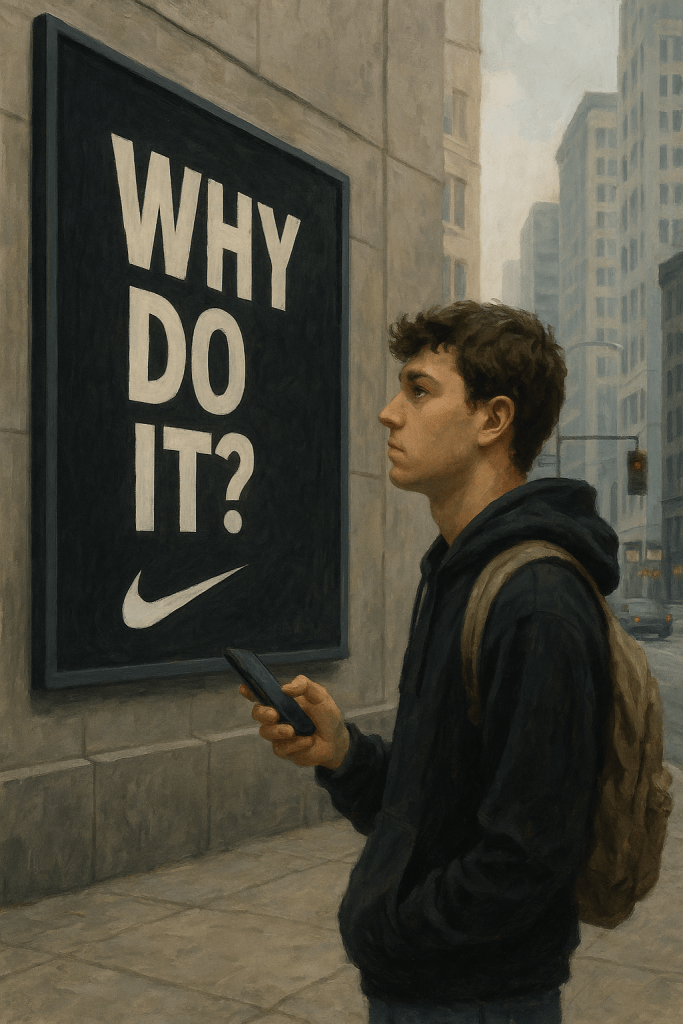
Nike built its global image on the slogan “Just Do It,” encouraging people to push through challenges. But in its new campaign, the company flips the message, asking a very different question: Why do it? The ad speaks to the fears of younger consumers — fear of trying, failing, or looking “cringe” under the scrutiny of social media. In this lesson, you will explore how Nike is attempting to reconnect with Gen Z, why Adidas has recently cornered the sneaker market, and what makes a brand agile enough to keep up with fast-changing trends. Along the way, you’ll learn new vocabulary, practice comprehension, and share your own views on branding, culture, and resilience in the world of marketing.
| Unlocking the Gen Z consumer |
Warm-up question: Can you think of an advertisement that really spoke to your generation? What made it effective or memorable?
Listen: Link to audio [HERE]
Read:
AILSA CHANG, HOST:
A new Nike ad asks kind of an existential question.
TYLER THE CREATOR: Why do it?
CHANG: Why do it? The company famous for telling people to just do it is now asking, why even try?
TYLER THE CREATOR: Seriously, why? You can give everything you have and still lose.
CHANG: Nike says it’s targeting a new generation by addressing the fear of trying, the fear of failing and the fear of earnest effort in a world of social media scrutiny, fear of being, as a Gen Zer might say, cringe. But does this kind of advertising reach its intended audience? Well, to help us answer that question, we turn to Casey Lewis. She writes the “After School” newsletter about youth culture and trends. Welcome to ALL THINGS CONSIDERED.
CASEY LEWIS: Thank you so much for having me.
CHANG: So what did you make of the new Nike ad?
LEWIS: I mean, it’s been a tough go for Nike over these last couple of years. They, for so long, really cornered the youth culture market. They were the pinnacle of cool. And then the last couple of years, not so much. But I think they’re trying to, you know, lean away from this idea of perfection and, you know, pressure and hustle culture.
CHANG: OK. Well, then if this is intended for younger people, like, what is the urgency for Nike to target young people? Were they not connecting with Gen Z, or are companies like Nike just generally anxious about their sales right now?
LEWIS: I think yes and yes. Adidas has very much dominated the top spot among young people in terms of cool sneakers – the Samba, the Campus. These have been, like, status sneakers among teens. There’s a quarterly survey of teens’ favorite brands – Piper Sandler. You know, Nike has, for years, been the No. 1 brand in footwear. So they’re not irrelevant, but they are no longer creating trends in the way that they once were, and I think they want that back.
CHANG: So what are companies like Adidas getting right? Or what are companies – other companies not like Adidas getting wrong when it comes to marketing to Gen Z?
LEWIS: What makes it hard to be a brand these days, chasing cool, is the teens are very much the ones setting the trends, and it’s happening very quickly on social media. Now, one cool kid on TikTok can upload a video of himself wearing a pair of Adidas Sambas. That video can go viral, and then suddenly Sambas are selling out, and it really can happen that quickly. So Adidas really is just – they found themselves in a lucky position. Of course, they have history of creating amazing shoes, but a lot of it is the, you know, luck of the draw.
CHANG: OK. So if it’s sometimes luck of the draw, I’m just thinking, if teens are the ones who are identifying what is cool first, how are companies responding to that? How are they shifting their marketing campaigns to adapt to that?
LEWIS: The companies that are able to respond the best to these young consumers are the ones that have built themselves to be able to respond quickly. One that comes to mind is Hollister. But they have really figured out how, you know, if this oversized sweatshirt is suddenly selling, they will introduce it in 15 different patterns and colors, you know, overnight. And, you know, that’s a crazy thing for a company that’s been around for so long to be able to figure out. And so it really just comes down to infrastructure, which isn’t an easy answer. And, you know, it’s not like on the marketing teams. It’s a lot more complicated than that.
CHANG: Quick-footed agility. That is Casey Lewis. She writes the “After School” newsletter and studies Gen Z consumer trends. Thank you so much for coming on.
LEWIS: Thank you so much for having me.
Vocabulary and Phrases:
- Existential question: A deep question about the meaning or purpose of life.
- Earnest: Serious and sincere in effort or intention.
- Scrutiny: Close examination or critical attention.
- Cringe: To feel embarrassed or uncomfortable because something seems awkward or uncool.
- What did you make of (something): A way to ask someone’s opinion or reaction.
- Cornered the market: To dominate or control a particular area of business or culture.
- Pinnacle: The highest or most successful point.
- Irrelevant: Not connected or important to the subject at hand.
- Luck of the draw: Success or failure based on chance rather than planning.
- Agility: The ability to move or respond quickly and easily.
Fill in the Blank Use the correct word or phrase from the vocabulary list to complete each sentence.
- The celebrity’s behavior was under intense media __________ after the viral video.
- When he gave his speech, it was clear that his tone was __________ and sincere.
- The company once __________ in athletic footwear, leaving little room for competitors.
- For many young people, being called “__________” online is one of the worst social labels.
- The movie star reached the __________ of fame in the 1990s but later struggled to stay popular.
- She asked me, “__________ the new campaign?” because she wanted my honest opinion.
- Whether the small brand became trendy or not seemed like pure __________, depending on social media attention.
- The teacher posed an __________ to the class: “Why should we try at all if failure is always possible?”
- That comment was totally __________ to the discussion, so most people ignored it.
- The brand showed real __________ by quickly releasing new styles when teens’ tastes changed.
Comprehension Questions:
- What unusual question does Nike’s new ad campaign ask?
- According to Casey Lewis, why has Nike lost some of its dominance with young consumers?
- How has Adidas gained popularity among Gen Z in recent years?
- What role does social media play in setting fashion and branding trends today?
- What example does Lewis give of a company that shows strong agility in responding to consumer demand?
Discussion Questions:
- Do you think Nike’s “Why do it?” campaign will connect with young people, or could it backfire? Why?
- How does social media change the way companies try to market to consumers compared to the past?
- Can brands ever truly control what is “cool,” or is it always up to the public to decide?
- Have you ever bought something just because you saw it trending online? How did you feel afterward?
- What qualities make a brand resilient in a fast-changing market?
 LanguageLeap