Artificial intelligence is changing the workplace in ways that make many workers uneasy, especially new graduates thinking about their careers. Some jobs may seem “AI-proof,” while others could be transformed or even disappear. In this lesson, you will read about how economists and researchers are trying to measure which jobs are most exposed to AI, what skills humans still do best, and how workers can find a “sweet spot” where technology becomes a tool instead of a threat. You’ll also learn useful vocabulary from the article, test your understanding with comprehension questions, and practice sharing your own ideas in discussion.
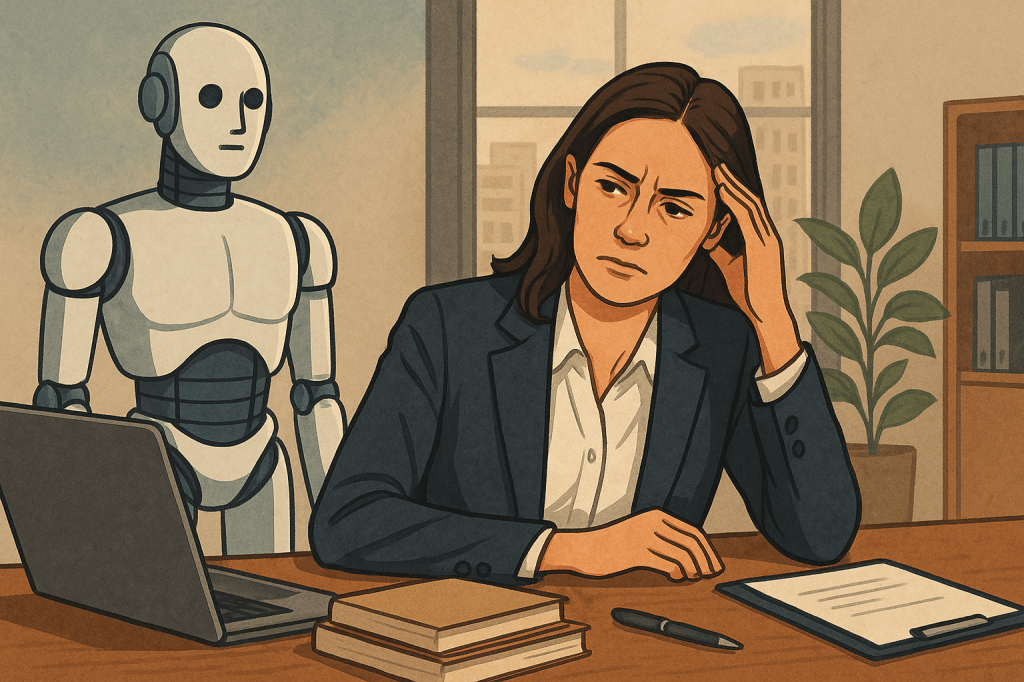
| AI is causing anxiety about the future of the workforce. But are there AI-proof jobs? |
Warm-up question: What skills do you think are most important for workers to stay successful in the age of artificial intelligence?
Listen: Link to audio [HERE]
Read:
LEILA FADEL, HOST:
A lot of people are feeling anxious about artificial intelligence and how it might reshape the workforce in the next few years, especially new college grads. Sally Helm, from our Planet Money team, went on a quest to find a way to think about which jobs might be AI-proof or at least less threatened.
SALLY HELM, BYLINE: Charlie Baker recently graduated from Rutgers University in New Jersey. He was thinking about heading to law school, but he’s delayed that plan for now, because he’s worried that AI might soon replace lawyers.
CHARLIE BAKER: If I’m going to graduate with, say, a hundred thousand dollars in debt to a legal field where they’re decreasing the jobs, I mean, that’s a really bad situation.
HELM: I went looking for something simple, a list of jobs that might be immune from a robot takeover. And for a moment, I thought I’d found it. I came upon a list that takes a thousand or so jobs and ranks them on something called AI exposure. That’s essentially a measure of how much AI can help you do your job. As you’d expect, at the top of the list, more exposed are knowledge workers – writers, physicists, concierges. At the bottom, blue-collar and physical jobs – dancers, welders, short-order cooks. But here’s the thing – exposure is not the same as this job will be automated.
DANIEL ROCK: If you’re really exposed, it could be great for you.
HELM: Economist Daniel Rock is the man behind the list. His co-authors on his paper about this were researchers at OpenAI. He said if you can use AI to get a lot more productive and the world wants even more of what you’re producing, then maybe your field will see an explosion of growth. On the other hand, if news writers get more productive and the world doesn’t want even more news articles, maybe you do see job loss. At the same time, jobs at the bottom of the list aren’t necessarily safe. Rock gave me a thought experiment. Say everyone fleeing knowledge work decides to become a welder at once.
ROCK: You’ve got a huge supply increase, and these folks who were working in what they thought were safe roles are seeing their wages fall as other people compete with them.
HELM: So finding AI-safe jobs requires a second framework. Isabella Loaiza is a researcher at MIT. She wrote a paper with the economist Roberto Rigobon, and they kind of turned Daniel Rock’s research inside out. Instead of looking at what tasks AI can help do, they asked, what are humans good for?
ISABELLA LOAIZA: Let’s look at what is complementary that humans can do very well that machines still can’t do that well, at least for now.
HELM: She and her co-author came up with something called the EPOCH score. It’s an acronym. Covers empathy, presence, opinion, aka ethical judgment, creativity and a silent H, hope, the ability to plan and execute a vision. High EPOCH jobs, ones that require more human skills, might be more resilient to AI. Managers tended to have high EPOCH scores, and clerical workers scored low. And in our hunt for an AI-proof job, there was one more thing. If you have a very human task to do and a linked task that’s very automatable, then you might be in a sweet spot where AI doesn’t automate your job but rather augments it. Like for a professor, one of their tasks might be making slides for a lecture. AI can probably do that. But a linked task, giving a lecture, that’s pretty human. Or take lawyers.
LOAIZA: The task that is delivering the argument in front of the judge requires a lot of presence, so it’s really hard to automate that task. But then writing the brief about it, you know, that task might be very automatable.
HELM: You know, this is actually making me think of a listener who wrote into us. His name’s Charlie.
I told Loaiza about Charlie Baker, who’s decided to delay law school. She said he’s right that the legal field will be affected by AI, but some legal jobs require a lot of human skills.
LOAIZA: All the different occupations that require critical thinking, judgment, even creativity, that is not going to go away.
HELM: Of course, this is all just a theory. AI might get a lot more human-like, or we might just not care that it’s only simulating something like empathy. I learned a definitive AI-proof job list doesn’t exist. But Loaiza’s advice to Charlie Baker – go to law school and don’t worry so much about the boring stuff. Really learn how to think.
Sally Helm, NPR News.
Vocabulary and Phrases:
- Grad: Short for “graduate,” a person who has recently finished a degree or academic program.
- Quest: A search or long effort to achieve something important.
- Say: Used to give an example or possibility (“If I graduate with, say, $100,000 in debt…”).
- Immune: Protected from something or not affected by it.
- Knowledge worker: A person whose main job is to think, analyze, or create knowledge, rather than perform physical labor (e.g., writers, researchers).
- Short-order cooks: Cooks in diners or small restaurants who prepare simple, fast meals.
- Behind: The person or group responsible for something (“the man behind the list”).
- Thought experiment: An imagined situation used to test an idea or theory.
- Framework: A system or structure for organizing ideas or solving problems.
- Complementary: Adding to or improving something by providing qualities the other lacks.
- Resilient: Able to recover quickly and remain strong in difficult situations.
- Sweet spot: The perfect or most effective balance between two different things.
Comprehension Questions:
- Why is Charlie Baker delaying his plan to attend law school?
- What does the list of “AI exposure” measure?
- According to Daniel Rock, how could being highly exposed to AI be positive?
- What is the EPOCH score, and what skills does it include?
- Why might some jobs be in a “sweet spot” when it comes to AI?
- What advice did Isabella Loaiza give to Charlie Baker about law school?
Discussion Questions:
- Do you agree that jobs requiring empathy, creativity, or judgment will be harder for AI to replace? Why or why not?
- How could workers in your field use AI as a tool instead of fearing it as competition?
- What human skill do you think is the most difficult for AI to copy?
- Is it better for students today to choose “AI-proof” jobs, or should they focus on learning how to adapt?
- How can governments or schools prepare workers for changes caused by AI?
Fill-in-the-Blank Activity
Complete each sentence with the correct word from the box. Use the correct form of the word if needed.
Word Bank: grad, quest, say, immune, knowledge worker, short-order cooks, behind, thought experiment, framework, complementary, resilient, sweet spot
- The manager encouraged her team to build a new __________ for solving problems in a structured way.
- He stayed surprisingly __________ after his company downsized, finding a new job within weeks.
- Economists often use a __________ to test ideas that are difficult to study in real life.
- The politician is the person __________ the new AI regulation plan.
- When she finished her MBA, the young __________ was eager to start her career.
- In restaurants, __________ are expected to prepare meals quickly and efficiently.
- AI tools are most useful when they play a __________ role to human creativity and judgment.
- If you spend, __________, $10,000 on training but the job disappears, it can be a serious risk.
- Some jobs seem __________ to automation, but technology is always changing.
- The professor is a __________ who relies on ideas and analysis rather than physical labor.
- Researchers are on a __________ to identify which jobs will survive the AI revolution.
- Teachers may be in a __________ where AI helps with lesson prep but cannot replace classroom presence.
 LanguageLeap