Georgia has worked for decades to build close economic ties with South Korea, bringing billions of dollars of investment and thousands of jobs to the state. But a recent immigration raid at a Hyundai-linked factory has created political tension and raised questions about the future of U.S.–Korean relations. In this lesson, we’ll explore how one event can put leaders in a difficult position, why balancing local politics and international business is such a challenge, and what it might mean for the partnership between these two countries.
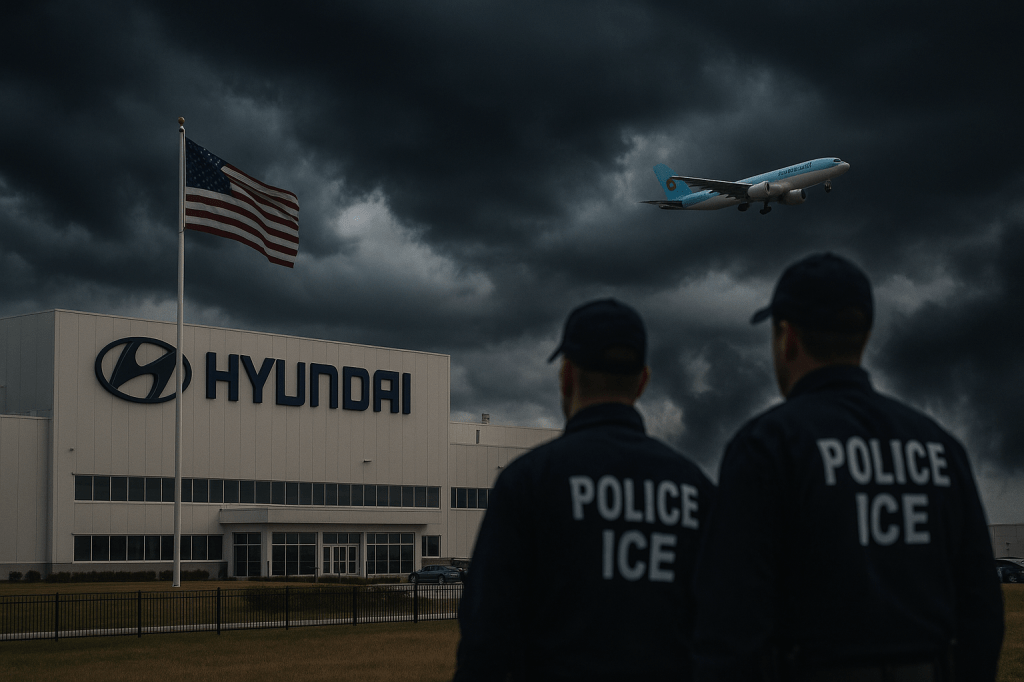
| Georgia built ties with South Korean companies over years. Then came the factory raid |
Warm-up question: How do you think the immigration raid in Georgia might affect the relationship between the United States and South Korea?
Listen: Link to audio [HERE]
Read:
JUANA SUMMERS, HOST: Republicans in Georgia spent years building ties with companies in South Korea, culminating in Hyundai locating a multibillion-dollar electric vehicle plant outside Savannah. But last week, federal immigration agents raided a battery factory at that site. They detained some 300 South Korean citizens. And as WABE’s Sam Gringlas reports, the incident has put Republicans in an awkward position.
SAM GRINGLAS, BYLINE: When the Trump administration announced the largest workplace immigration raid in American history, many Georgia Republicans swiftly cheered the news. Round ’em up, posted Congressman Mike Collins. Representative Buddy Carter applauded what he called Trump’s bold action. But apart from a statement by a spokesperson saying in part that Georgia remains committed to not allowing the incident to undo decades of mutually beneficial partnerships, GOP Governor Brian Kemp himself hasn’t said anything.
BRIAN ROBINSON: He’s the one who does have somewhat of a balancing act.
GRINGLAS: That’s Republican strategist Brian Robinson.
ROBINSON: He’s got to, on the one hand, consider his politics in Georgia, but also he’s got to make sure that the South Koreans feel appreciated and make sure that bridges don’t get burned.
GRINGLAS: During Kemp’s first campaign for governor, he ran an ad offering to round up illegal immigrants himself in his truck. This summer, he dispatched the Georgia National Guard to help with immigration enforcement. But Kemp has also pledged to make Georgia the electric mobility capital of the world, aiming to create thousands of new jobs with the help of generous state incentives.
The Hyundai plant has been billed as the largest economic development project in state history. South Korean companies SK Battery and solar panel maker Qcells have invested billions here too. Kemp has even accepted The Korea Society’s most prestigious award.
BRIAN KEMP: The peach is a meaningful symbol to us both. I understand that in Korea, it represents happiness, prosperity and longevity. That pretty well sums up Georgia’s relationship with Korea.
GRINGLAS: That relationship goes back decades. In 2006, Hyundai’s parent company, Kia, broke ground on a huge plant in west Georgia. Robinson remembers traveling to South Korea with Kemp’s predecessor, dining with Hyundai executives at a fancy hotel in Seoul.
ROBINSON: We had these South Korean companies come in and really transform parts of the state. All of a sudden, there’s some Korean restaurants in former sleepy Southern towns.
GRINGLAS: Robinson says these investments brought new life to struggling parts of rural Georgia. Trump has also urged big companies to make their products in the U.S. He was asked about the raid on Monday.
PRESIDENT DONALD TRUMP: And we’re going to have to train people. And the way you train people is bring people in that know what they’re doing and let them stay for a little while and help. So I’m going to look at that.
GRINGLAS: On Thursday, South Korea’s president said Korean companies will likely hesitate to continue investing in the U.S. without improvements to the visa system. The raid at the plant, a joint venture of Hyundai and LG Energy Solution, has also provided an opening for more populist Republicans to dial up their criticism of the foreign corporations coming into Georgia. Congressman Collins, who’s running for U.S. Senate, posted, tax dollars should not be used to steal jobs away from Georgia workers. Collins and other Senate candidates have tried to tie Hyundai to their opponent, Democratic U.S. Senator Jon Ossoff, but not to Kemp. And it’s not just Republicans walking a fine line.
DEREK MALLOW: I’m ashamed as to where we’re headed. I almost wish we would take the Statue of Liberty and send it back to France because we’ve lost our way.
GRINGLAS: Democrats, like State Senator Derek Mallow of Savannah, have slammed Trump’s immigration tactics.
MALLOW: But I also want to make sure that I don’t have a corporate entity that is knowingly and intentionally subverting the law. And I also want to make sure that the people who are citizens in this state are receiving the opportunities that were promised when this project came.
GRINGLAS: A chartered Korean Air jet took off from Atlanta Thursday to bring the South Koreans back to Seoul. But the economic, diplomatic and political fallout from the incident is far from over.
Vocabulary and Phrases:
- Culminating: reaching the highest or final point of something.
- Awkward: uncomfortable, difficult, or embarrassing.
- Balancing act: managing two or more opposing needs or pressures at the same time.
- Burn bridges: to damage a relationship beyond repair.
- Prestigious: highly respected or admired.
- Predecessor: the person who had a job or position before someone else.
- Hesitate: to pause before acting because you are unsure.
- Walking a fine line: being in a situation where it is easy to upset people on either side.
- Slammed: strongly criticized.
- Subverting: secretly working to weaken or undermine authority or rules.
- Chartered: hired for a special trip or purpose (like a plane or bus).
Fill in the Blank Use the correct word or phrase from the vocabulary list to complete each sentence.
- The governor faced a difficult __________, trying to satisfy both local voters and foreign investors.
- After the raid, some politicians worried that it could __________ with South Korean companies.
- Hyundai’s new factory is considered one of the most __________ projects in Georgia’s history.
- The senator strongly __________ the government’s immigration tactics in his speech.
- The company sent a __________ plane to bring its workers back to Seoul.
- Some leaders warned that strict immigration enforcement might cause investors to __________ before starting new projects in the U.S.
Comprehension Questions:
- How did some Georgia Republicans react to the immigration raid?
- Why does Governor Brian Kemp face a “balancing act”?
- What role have South Korean companies played in Georgia’s economy?
- How has South Korea’s president responded to the raid?
- What did Derek Mallow say about immigration enforcement and corporations?
Discussion Questions:
- Should politicians prioritize economic partnerships with foreign companies or focus more on local workers? Why?
- How can strong immigration enforcement affect international business relationships?
- What risks do leaders face if they “burn bridges” with foreign investors?
- How might local communities benefit or struggle when large foreign companies move in?
- If you were a governor in this situation, how would you balance political pressure from voters and the need to attract foreign investment?
 LanguageLeap