In recent years, computer chips have become one of the most important resources in the global economy. They power everything from cars and smartphones to advanced weapons systems. The United States government recently made an unusual move: it bought a major stake in Intel, America’s largest chipmaker. This decision highlights the growing competition with countries like China and the need to secure technology for both economic and national security reasons. In this lesson, you will read about why the government stepped in, what challenges Intel faces, and how these choices could shape the future of technology.
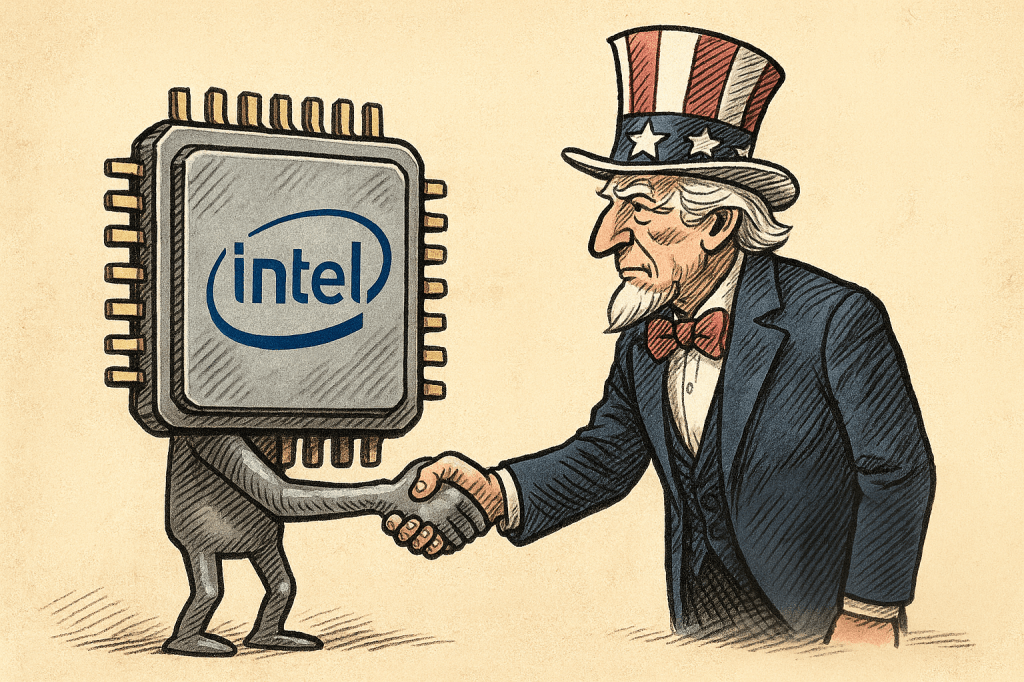
| The U.S. government is taking a stake in Intel. It’s rare — and it has some risks |
Warm-up question: Why do governments sometimes get involved in private companies, such as technology or energy firms? When might it be necessary?
Listen: Link to audio [HERE]
Read:
JUANA SUMMERS, HOST: In August, the Trump administration took a roughly 10% stake in the chipmaker Intel, becoming its biggest single shareholder. The company designs and produces microchips that go in everything from self-driving cars to data centers. It’s far from the first time the U.S. government has taken a stake in an American company, but as NPR tech correspondent John Ruwitch reports, the circumstances are unique.
JOHN RUWITCH, BYLINE: During the great financial crisis, the government took stakes in the insurer AIG, as well as General Motors and Chrysler, to keep them from collapsing. Over the years, the FDIC has taken over failing banks with an eye towards protecting depositors and keeping the economy stable. There have been national security cases also. At the height of World War II, President Franklin Roosevelt made this announcement when coal miners threatened the war effort with a strike.
RUWITCH: Under capitalism, generally this doesn’t happen. Markets pick winners, and governments stay out of business unless it’s an emergency. When they do get involved, it tends to spark criticism and can create significant political fallout. But as competition with China has heated up and the race for artificial intelligence intensifies, U.S. politicians concerned about national security have trained their focus on California-based chipmaker Intel. President Biden last year funneled billions of dollars in grants to Intel via the CHIPS and Science Act.
JOE BIDEN: And this historic funding will be used to build new semiconductor fab facilities and modernize and expand existing ones in Arizona, Ohio, New Mexico and Oregon.
RUWITCH: Now, the Trump administration is converting those and other grants into its equity stake. Journalist Michael Malone wrote a book called “The Intel Trinity.” The company invented the modern microchip, he says, and for years it led the sector.
MICHAEL MALONE: Intel really ruled the chip world. Everybody else was, you know, planets next to this sun.
RUWITCH: But it failed to get in early on the smartphone boom, and later missed the boat on chips for AI data centers. Now, he says, TSMC in Taiwan leads the pack, followed by South Korea’s Samsung, and Intel is behind.
MALONE: It’s not a dying company, but it’s not a healthy company. And it’s certainly not the – you know, the dominant firm of this era.
RUWITCH: Thing is, analysts say Intel is the best and really only option the United States has for retaking the lead in high-end chip manufacturing.
JENNIFER LIND: Companies that can actually physically manufacture those advanced chips are very strategically important because there’s just not many of them.
RUWITCH: Jennifer Lind is a professor of government at Dartmouth College.
LIND: Intel is the only one in the U.S.
RUWITCH: So both the Biden and Trump administrations have sought to prop it up. Jacob Feldgoise is an analyst at Georgetown University’s Center for Security and Emerging Technology. The idea, he says, is to reduce the risk of foreign supply shocks, like the shutdown of fabrication plants.
JACOB FELDGOISE: That’s a general way to say government is worried about China invading Taiwan and TSMC’s fabs being knocked offline.
RUWITCH: Some 90% of the most advanced chips in the world are made by TSMC. The other reason to back Intel, Feldgoise says, is to reduce the risks posed by foreign-made chips in critical national security systems.
FELDGOISE: This is basically the concern that, hey, if, you know, a chip that is going into a missile is made overseas, that some kind of – something could be inserted into it that causes the missile to fail.
RUWITCH: Intel’s CEO, Lip-Bu Tan, said in a statement the company was grateful for the confidence that Trump and his administration have placed in Intel. Lind, of Dartmouth, says government backing can sometimes make a huge difference.
LIND: Exhibit A is Taiwan’s semiconductor industry. The government basically said, we are going to have a semiconductor industry. And by God, they succeeded.
RUWITCH: Whether or not an equity stake is the best way forward is a different question. The U.S. government won’t have voting or governance rights in Intel, but the company may still feel political pressure.
LIND: Generally, when you have government intervention, there’s a lot of inefficiency, there’s a lot of politicization and favoritism and so on.
RUWITCH: And that, she says, may stifle innovation, which is exactly what the government wants from Intel. John Ruwitch, NPR News.
Vocabulary and Phrases:
- Stake: ownership or financial interest in a company.
- With an eye towards: with the goal of achieving something in the future.
- Fallout: the negative consequences or effects of an event or decision.
- Trained (one’s) focus on: directed attention toward something in a concentrated way.
- Equity stake: shares of ownership in a company, representing partial control or interest.
- Missed the boat: failed to take advantage of an opportunity at the right time.
- Prop (something) up: to support or strengthen something that is weak or failing.
- Supply shocks: sudden changes in the availability of goods that cause disruption in the market.
- By God: an emphatic phrase used to show determination or strong emphasis.
- Stifle: to hold back, suppress, or prevent something from developing.
Comprehension Questions:
- What percentage of Intel did the Trump administration take control of in August?
- Which other companies did the U.S. government previously take stakes in during the financial crisis?
- Why have U.S. politicians recently focused so much attention on Intel?
- What companies currently lead in high-end chip manufacturing ahead of Intel?
- According to Jennifer Lind, why is Intel strategically important to the United States?
Discussion Questions:
- Should governments invest in private companies to protect national security or economic stability? Why or why not?
- What are the risks of relying on foreign companies like TSMC and Samsung for advanced technology?
- Do you think government support usually helps or hurts innovation in the long term?
- How could missing out on key markets, like smartphones or AI, affect a company’s future success?
- Have you ever seen an example where government intervention made a positive difference in your country’s economy?
- If you were Intel’s CEO, how would you use this government support to strengthen the company?
 LanguageLeap