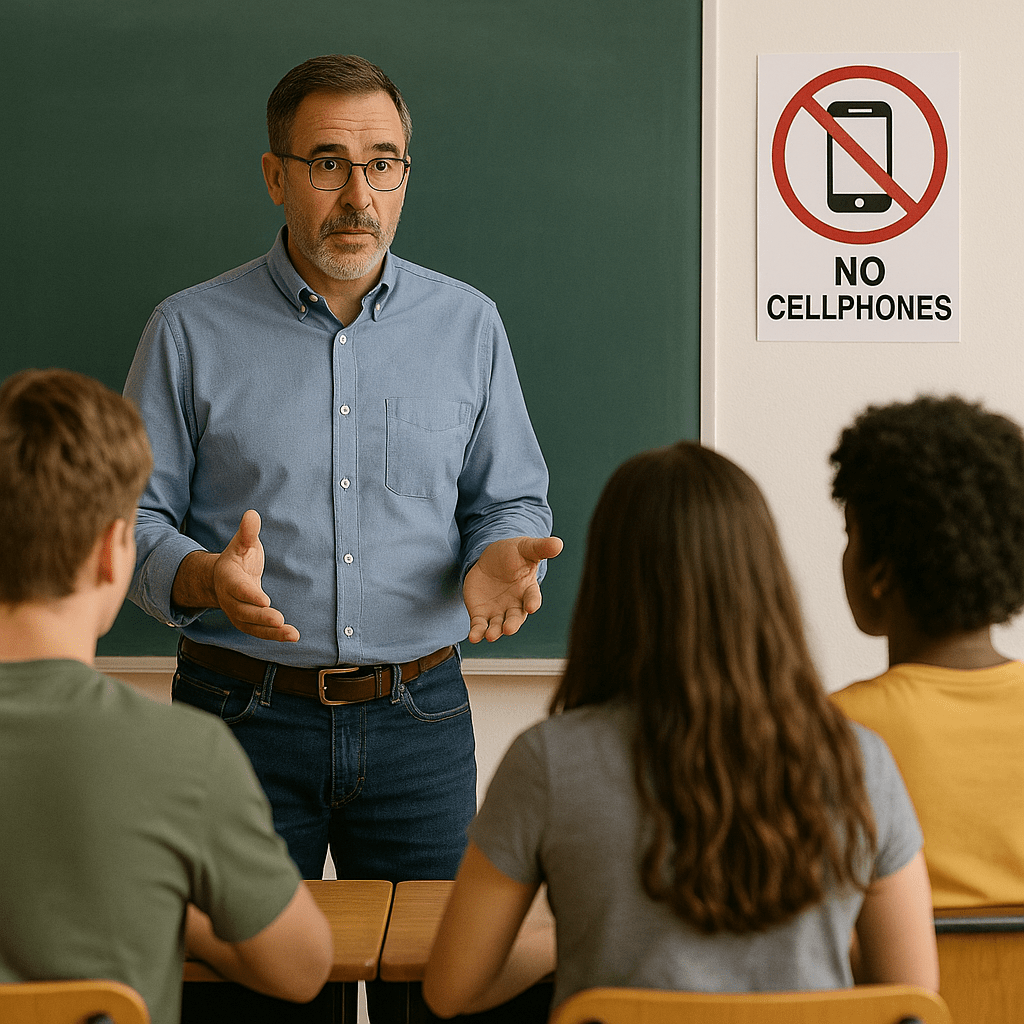
Cellphones are part of our everyday lives, but more and more schools are choosing to ban them during the school day. Supporters believe this makes classrooms more focused and fair, while many students feel the rules are inconvenient or even unnecessary. In this lesson, you will read about how different schools are handling cellphone bans, learn new vocabulary from a real news story, and practice expressing your own thoughts on the topic in English. This material is created for learners who want to expand their vocabulary, strengthen comprehension skills, and build confidence discussing real issues in English.
| More students head back to class without one crucial thing: their phones |
Warm-up question: Do you think banning cellphones in schools makes classrooms better places to learn, or do you think it causes more problems? Why?
Listen: Link to audio [HERE]
Read:
STEVE INSKEEP, HOST: More states are banning students from using their phones during school hours. Some individual schools, as well. One of my kids has to zip the phone in a little bag during school hours. NPR’s Sequoia Carrillo has the story.
SEQUOIA CARRILLO, BYLINE: This school year is the first one where every student in Texas public and charter schools will be without their phones during the school day. But Brigette Whaley, an associate professor of education at West Texas A&M University, has a hunch of how things will go.
BRIGETTE WHALEY: A more equitable environment, a more engaging classroom for students.
CARRILLO: She spent the last year surveying the rollout of a cellphone ban in a public high school in West Texas, focusing on how teachers felt about the program. They saw improved engagement and more conversation between students.
WHALEY: They were really happy to see that students were more willing to work with each other.
CARRILLO: Student anxiety also plummeted, according to her research. The primary reason? Students weren’t afraid of being filmed at any moment and embarrassing themselves.
WHALEY: They could relax in the classroom and participate and not be so anxious about what other students were doing.
CARRILLO: The findings in West Texas align with the results from many of the states and districts that are heading back to school without phones. Students learn better in a phone-free environment. It’s been a rare issue with bipartisan support, allowing a rapid adoption of policies across many states. That fast pace, Whaley says, can sometimes be a hazard to the policy’s impact. While most teachers at the school she studied supported the ban…
WHALEY: There was one teacher that didn’t enforce the policy well, and that seemed to cause difficulty for other teachers.
ALEX STEGNER: Every teacher had a little bit different policy on that.
CARRILLO: That’s Alex Stegner, a social studies and geography teacher in Portland, Oregon, talking about his district’s cellphone ban. He says the different types of enforcement were normal at his school. Last year, each teacher at Lincoln High School got a lockbox to collect phones at the start of class.
STEGNER: Some teachers did not lock the boxes. Some teachers left the doors wide open. And some teachers, like me, locked them. I was just committed to kind of going all in with it, and I liked it.
CARRILLO: He said last year was the first year in a decade he didn’t spend class time chasing cellphones around the room. Now, as Lincoln goes into its second year with some kind of ban, things are changing a bit. This year, students’ phones will be locked away for the entire day, not just class time. Stegner thinks it will be a learning curve, but not just for teachers and students.
STEGNER: I think some parents will struggle. But I do think that there seems to be this kind of collective understanding that we got to do something different.
CARRILLO: Like a lot of schools, Lincoln High School will be distributing individual locked bags, known as Yondr pouches, to students this year – the same ones that were used in the district Whaley studied in Texas and for about 2 million students nationwide.
STEGNER: I heard stories last year about Yondr pouches, you know, cut open, destroyed. And there’s a whole logistical thing that comes with giving students these pouches and telling them, OK, now that’s your responsibility.
CARRILLO: So teachers seem to like cellphone bans. But as for the kids…
ROSALIE MORALES: You’ll see a different response from students.
CARRILLO: Rosalie Morales is in her second year overseeing Delaware’s pilot program for a statewide cellphone ban. She surveyed teachers and students at the end of the first year to ask if the ban should continue. Eighty-three percent of teachers said yes, while only 11% of students agreed.
ZOE GEORGE: It’s annoying.
CARRILLO: Zoe George, a student at Bard High School Early College in Manhattan, says no one asked her before New York State banned cellphones.
GEORGE: I wish that they would hear us out more.
CARRILLO: She’s worried about the implications for homework and schoolwork during free periods. She says her school doesn’t have enough laptops for every student, so often students would use their phones. But also, it’s just a nuisance.
GEORGE: It’s not the worst because it’s my last year. But at the same time, it’s my last year.
CARRILLO: Next year, she hopes to be at college, and she’s looking forward to the freedom.
Sequoia Carrillo, NPR News.
Vocabulary and Phrases:
- Has a hunch: to have a feeling or guess that something might be true, even without proof.
- Equitable: fair and equal for everyone.
- Plummeted: dropped or decreased very quickly.
- Align with: to match or agree with something.
- Bipartisan: supported by people from two different political groups or parties.
- Go all in: to fully commit to something without holding back.
- Learning curve: the amount of time and practice needed to get good at something new.
- Pilot program: a test version of a new plan or idea, tried out before using it everywhere.
- Hear (someone) out: to listen carefully to everything a person has to say before deciding.
- Nuisance: something that is annoying or causes problems.
Comprehension Questions:
- What new rule are many schools in Texas and other states adopting?
- According to Brigette Whaley’s research, what happened to student anxiety when phones were banned?
- How did Alex Stegner handle the lockboxes for phones in his class?
- What change is Lincoln High School making in its second year of the phone ban?
- How do teachers and students feel differently about the bans, according to Rosalie Morales’ survey?
Discussion Questions:
- If you were a student, would you support or oppose a phone ban at your school? Why?
- How do you think phones help or hurt learning in the classroom?
- Should students be asked for their opinion before schools make rules like phone bans? Why or why not?
- What other school rules do you think would make classrooms more fair or more distracting?
 LanguageLeap