This lesson explores how artificial intelligence is changing the way people find information online—and how that’s affecting content creators and businesses. Through the story of a travel blogger and interviews with tech leaders, students will consider the future of the internet, the challenges of AI, and the ways companies are adapting to survive.
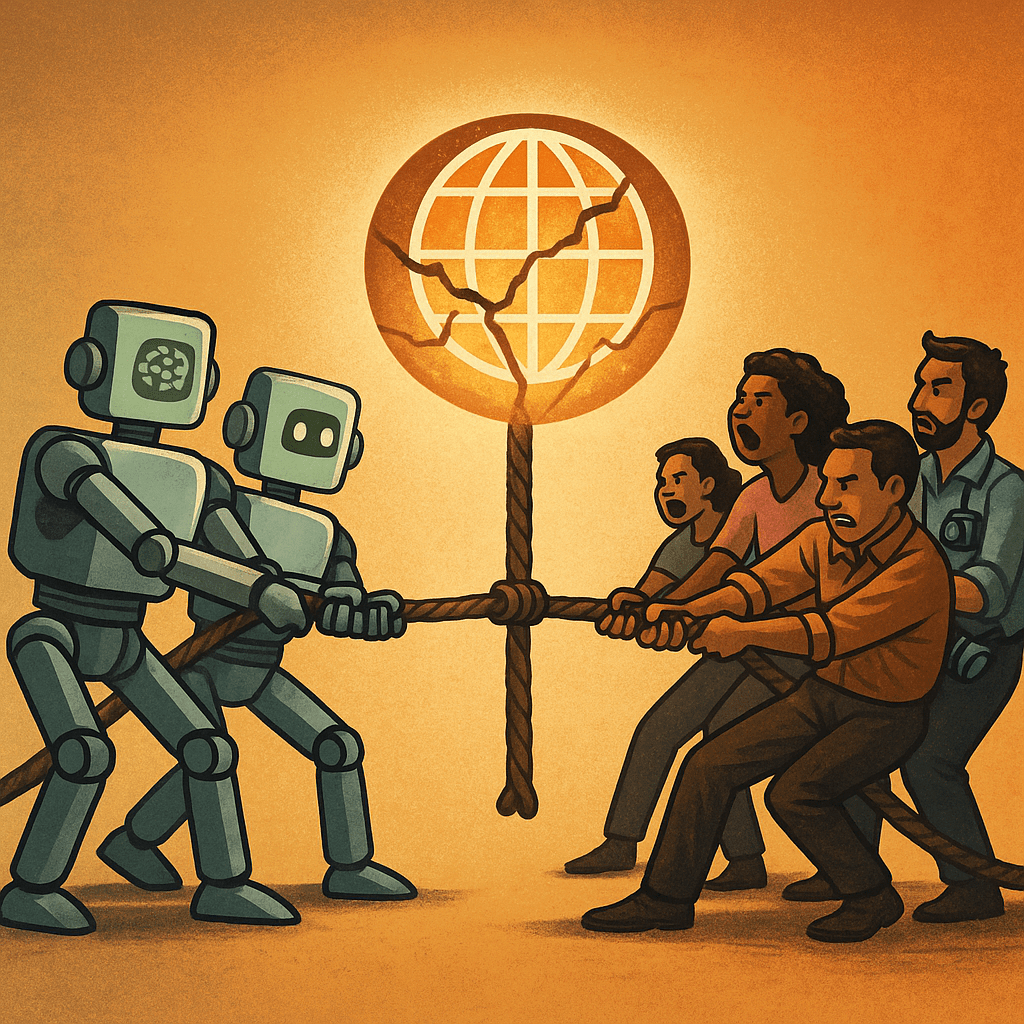
| How businesses are adapting to the AI chatbots’ takeover of search engines |
Warm-up question: What do you usually do when you want to find information online? Do you trust websites more or answers from AI tools?
Listen: Link to audio [HERE]
Read:
JUANA SUMMERS, HOST: It’s been almost 20 years since Google as a verb was added to the dictionary. It’s synonymous with internet search and has helped shape the internet. But now, artificial intelligence chatbots are shaking things up. NPR’s John Ruwitch takes a look at how some businesses are adapting. And a note – Google is a financial supporter of NPR.
JOHN RUWITCH, BYLINE: Nate Hake’s career path took an adventurous turn nine years ago.
NATE HAKE: I left my corporate legal job in 2016. I thought I was just going to take a sabbatical year to travel the world.
RUWITCH: On the road, he started blogging. One thing led to another, and now he runs a travel site called Travel Lemming.
HAKE: I live in hotels, quite literally.
RUWITCH: Hake’s company posts advice and reviews, like this video he made.
HAKE: Hey, guys. So I’m coming at you from Ushguli, which is the highest continuously occupied settlement in Europe and really just, like, my favorite part of Georgia.
RUWITCH: Like countless other sites, Travel Lemming has been able to stay in business because of an unwritten grand bargain that’s underpinned the way the internet works.
HAKE: Google crawls websites and then they provide search results.
RUWITCH: Traditionally, that’s been a list of links. Those links get clicks, websites get visitors. And for many publishers, like Travel Lemming, they make money off ads and referrals to products and services.
HAKE: Making a travel blog is a volume game. You need a lot of readers in order for it to be economically viable because you’re only making a penny or two per visitor.
RUWITCH: Most AI chatbots work differently. They put answers front and center, rather than links. Google search still produces web links, but it now offers AI-produced answers at the top of some queries.
HAKE: So they’re no longer a search engine, they’re an answer engine. And what that’s had the effect of doing is just dramatically reducing clicks.
RUWITCH: Hake says he thinks Google also changed its search algorithm around the time it started to focus heavily on AI in late 2023, and he thinks that contributed to the collapse of his traffic. In a statement to NPR, Google said website traffic can fluctuate for many reasons. It said those algorithm updates were separate from the launch of AI search features. Google said it prioritizes sending traffic to the web, and it wants AI search experiences to lead to clicks.
Publishers say the threat from AI is real, though. Some have accused AI companies of copyright infringement by consuming content without licenses and providing answers based on work that others did. Companies are scrambling to come up with solutions. One of them is Cloudflare, a major player in web security. Matthew Prince is its CEO.
MATTHEW PRINCE: If we are going to have an increasingly AI-driven web, which I think is inevitable, the business model of the web needs to change, and content creators need to get compensated in a different way.
RUWITCH: Cloudflare’s approach, unveiled in July, is called pay-per-crawl. Customers can now toggle an online switch so that when an AI bot tries to visit their website to get information, it blocks them if they don’t pay a fee. Prince says it’s a first step in addressing a huge problem.
PRINCE: If content creators can’t get compensated for their content, they’ll stop creating content, and I think we all will suffer as a result of that.
RUWITCH: Others are running the other direction, straight into AI’s arms. Chris Andrew is CEO and cofounder of Scrunch AI. Scrunch tries to help customers’ websites get noticed by AI bots so that their name or products appear in AI answers.
CHRIS ANDREW: We’re seeing companies that are desperate to get their content consumed by AI models.
RUWITCH: He’s talking about companies that sell products and services, like sneakers or oil changes. Andrew says that visibility can lead to more transactions, even if there are fewer overall clicks. He sees a future where a whole new post-human web emerges to feed AI. The websites of today, full of pictures and videos, were designed primarily for eyeballs.
ANDREW: So I have a thesis that we’re going to move to a nonvisual internet because the internet is going to be for AI.
RUWITCH: And AI wants words.
ANDREW: The secret is in the name. Large language models want language. And as a society, we have built a very confusing, over-designed, over-incentivized internet that is heavily interactive.
RUWITCH: Websites as we know them won’t vanish altogether, he says. People will still need to visit them to buy stuff. And that’s where Nate Hake thinks there might be a future for Travel Lemming. His company recently launched a Paris itinerary planning service, and they’re branching out to other destinations soon.
HAKE: And it may be that we’re not even really an information source in five years. It may be that we’re more of a tour company.
RUWITCH: Tours, after all, are in person, he says, and AI can’t replace that. John Ruwitch, NPR News.
Vocabulary and Phrases:
- Synonymous: having the same meaning or being closely connected in people’s minds.
- Shaking things up: causing major changes in a situation or system.
- Sabbatical: a break from work, often to travel or rest.
- Unwritten bargain: an informal agreement that people follow without it being official.
- Underpinned: supported or held up by something.
- Crawls: scans websites to collect information.
- Referrals: when someone is sent to a product, service, or site by another source.
- Volume game: a strategy that depends on getting a large number of users or sales.
- Economically viable: able to make enough money to continue.
- Put (something) front and center: make something the most important or visible part.
- Fluctuate: to go up and down or change unpredictably.
- Copyright infringement: using someone else’s creative work without permission.
- Scrambling: quickly trying to solve a problem or deal with a difficult situation.
- Inevitable: certain to happen; unavoidable.
- Toggle: to switch between two settings.
- Thesis: a main idea or belief that someone wants to prove or explain.
Comprehension Questions:
- What did Nate Hake do after leaving his legal job?
- How did Travel Lemming originally make money?
- What change did Hake notice in Google’s search behavior in late 2023?
- What is Cloudflare’s new solution for protecting content from AI bots?
- Why does Chris Andrew believe companies want AI to notice their content?
- What is Andrew’s prediction about the future design of the internet?
- What new service is Travel Lemming offering to adapt to the changes in AI?
Discussion Questions:
- Do you think AI tools should be allowed to use content from websites without paying? Why or why not?
- How might the internet change if it becomes more focused on AI instead of people?
- Do you agree with the idea that tours and other in-person experiences can’t be replaced by AI? Why or why not?
- What kind of internet do you want to see in the future—one for people, for AI, or something in between?
 LanguageLeap