This lesson explores Ferrero’s acquisition of WK Kellogg, the iconic American cereal brand known for products like Froot Loops and Frosted Flakes. Students will examine the challenges facing the traditional cereal market, shifts in consumer preferences, and Ferrero’s strategy for innovation and growth in the U.S. food industry. The material includes vocabulary support, reading comprehension, and discussion questions related to global business and brand evolution.
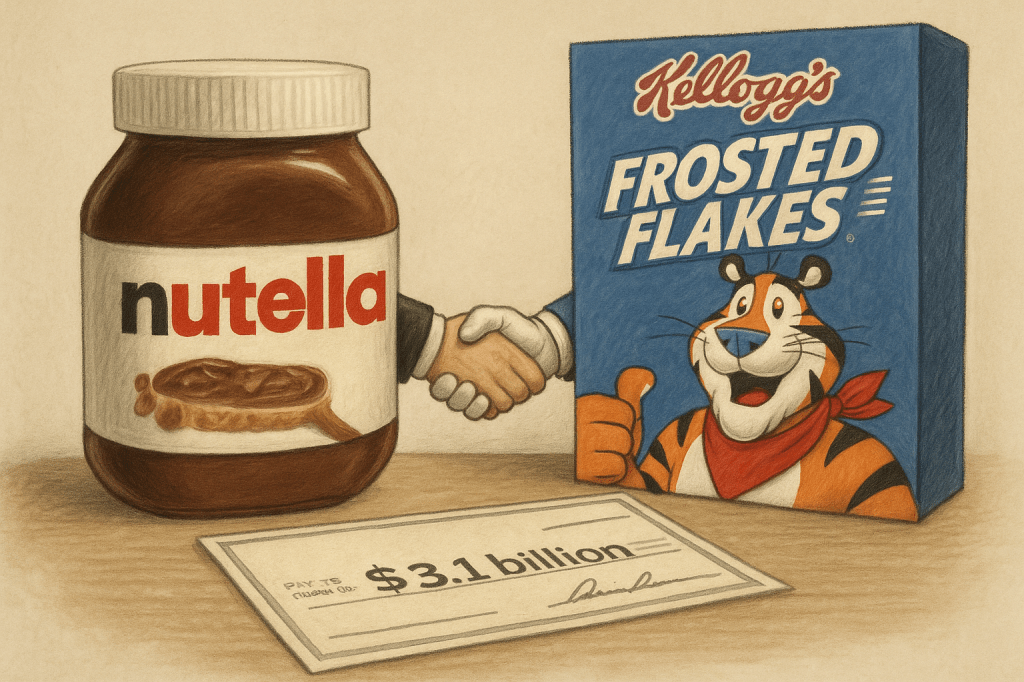
| Nutella-maker Ferrero to gobble up cereal giant Kellogg for $3.1 billion |
Warm-up question: Have you ever tried a new version of a favorite food that surprised you? What was it, and how did it compare to the original?
Listen: Link to audio [HERE]
Read:
SCOTT DETROW, HOST:
Two of the world’s most storied food brands are striking a sweet deal. The makers of Nutella in Europe, Ferrero, is buying the iconic American cereal company WK Kellogg, the maker of Froot Loops, Rice Krispies and – my favorite – Frosted Flakes. NPR’s Alina Selyukh reports.
ALINA SELYUKH, BYLINE: It’s a marriage of some of the oldest brands. Ferrero is nearly 80 years old, founded in Italy after World War II and still family run. Kellogg’s roots date back over a century, giving America some classic food mascots like Froot Loops’ Toucan Sam…
And, of course, Tony the Tiger.
SELYUKH: A few years ago, Kellogg split into two businesses – snacks and cereals. The snack side, with Cheez-Its and Pop-Tarts, was quickly sold to candy-maker Mars, based in Virginia. That deal was a whopping $36 billion. The cereal business plodded along and, well, got stale.
HANK CARDELLO: The cereal business as a standalone business has difficulty today.
SELYUKH: That’s Hank Cardello, a longtime food executive now at Georgetown University. Shoppers’ tastes are changing. Many are skipping name brands and choosing store brands to save money. Some shoppers are still willing to spend more on breakfast, but with a caveat. Here’s Kellogg CEO Gary Pilnick, speaking in May.
GARY PILNICK: We observed consumers placing even greater emphasis on health.
SELYUKH: Shoppers chasing more nutrition or lower prices have Kellogg cereal crushed in the middle. The company began losing sales and went on sale. For less than a tenth of that snacking deal with Mars, WK Kellogg now is selling for about $3 billion, and the buyer is the European giant Ferrero Group. Here’s Cardello again.
CARDELLO: They’ve really come onto the scene in North America very strongly.
SELYUKH: Ferrero is on a quest to expand its American reach. It’s acquired the ice cream company that makes Blue Bunny and Halo Top brands, it bought Nestle’s U.S. chocolate business, and Kellogg brings Ferrero to the breakfast table. What will they serve up there? Cardello says Ferrero’s secret weapon is being ready and willing to try fresh ideas with iconic brands. He thinks back to when he was a marketing director at Coca-Cola, launching the revolutionary Diet Coke.
CARDELLO: Everybody was just shaking in their boots, saying, oh, what are we doing? Are we adulterating the core brand here? And, you know, that model’s proven to be very successful over the years, so I think Ferrero’s gotten the memo on that.
SELYUKH: They put Nutella on pretzel sticks for snacking on the go. They made Tic Tac mints chewy in the middle. And now, for the first time in decades, Nutella is trying a new flavor for the American palate – adding peanuts.
CARDELLO: They’re setting very high standards for innovation in the food industry right now.
SELYUKH: And that could mean a shake-up for your cereal box. Will Tony the Tiger eat Nutella flakes? They can have this idea for free.
Alina Selyukh, NPR News.
Vocabulary and Phrases:
- Storied: Having a long, interesting, or celebrated history.
- Iconic: Widely recognized and well-established as a symbol or classic example.
- Whopping: Very large or impressive in size or amount.
- Plodded along: Got stale: Became uninteresting, old-fashioned, or less effective over time.
- Got stale: Became uninteresting, old-fashioned, or less effective over time.
- Standalone: Functioning independently or not connected to something else.
- Caveat: A warning or condition that should be considered before making a decision.
- Come onto the scene: To appear or become involved in a situation or industry for the first time.
- Shaking in their boots: Very nervous or afraid, often because of change or competition.
- Adulterating: Changing or lowering the quality of something by adding other ingredients or elements.
- Get the memo: To understand or realize something that others already know.
Comprehension Questions:
- What are Ferrero and Kellogg known for?
- Why was the cereal business described as “stale”?
- What changes in shopper behavior are affecting big-name cereal brands?
- How is Ferrero expanding its presence in the U.S.?
- What is Ferrero’s approach to innovation, according to Hank Cardello?
Discussion Questions:
- Do you think traditional food brands need to change to stay popular? Why or why not?
- How do your own shopping choices reflect a preference for health, price, or brand loyalty?
- Would you try a new cereal flavor like “Nutella Flakes”? Why or why not?
- Do you think putting new twists on old brands is a good business strategy?
 LanguageLeap