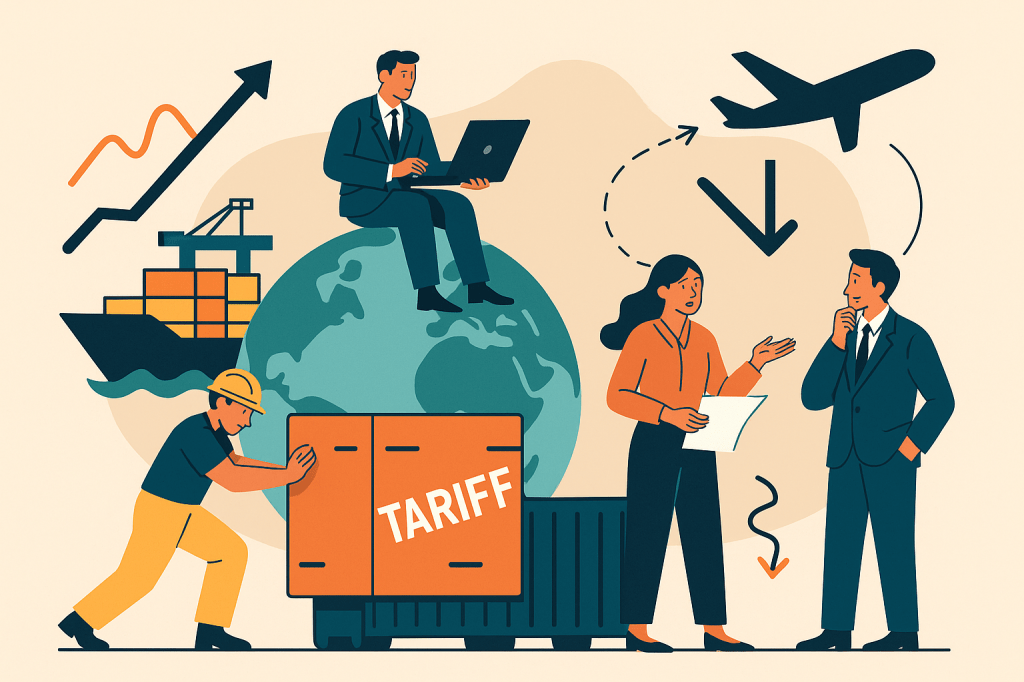
| Despite the pause on high tariffs, Chinese factories still face high uncertainty |
Warm-up question: Have you ever had to prepare for something uncertain—like a delay, a price increase, or a new rule? What did you do to get ready?
Listen: Link to audio [HERE]
Read:
A MARTÍNEZ, HOST:
Just a few weeks ago, goods from China faced a tax of up to 245% if they came to the U.S. Then there was a 90-day pause in most of those tariffs, but as NPR’s Emily Feng and Aowen Cao report, there is still uncertainty among exporters in China.
EMILY FENG, BYLINE: It’s really hard to get in touch with export brokers in China these days because after most U.S. tariffs were temporarily paused in May, exporters are working day and night.
FENG: This is Tian Xin, a freight forwarder based in the southern city of Shenzhen. He helps U.S. companies get big shipments of goods made in China onto transpacific ships and clear customs into the U.S. And he says all his clients are trying to get as much of his product as possible to the U.S. over the next three months. They’re stockpiling in case tariffs go back up again.
Jenny Tian – no relation – works in freight forwarding in the southern Chinese city of Shenzhen as well, and she says she’s been fielding calls for huge product orders, but the problem is shipping.
FENG: As in, she says she’s had cases where she managed to secure and pay for a container on a ship. But in the end, her shipment didn’t get loaded at all and was pushed onto the next available vessel.
Eric Martin-Neuville is encountering these shipping snarls firsthand from his perch in Singapore, where he handles Asia-Pacific trade for Geodis, a French supply chain and logistics company. A lot of shipping lines were diverted to Europe after U.S. tariffs in early April.
ERIC MARTIN-NEUVILLE: You need those vessels, at minimum, to come back. And you create disturbances and you don’t have enough empty containers, etc., etc.
FENG: The mood among Chinese factories, however, is even more grim. They say orders are still down as spooked major American retailers hedge over whether tariffs will come roaring back after the 90-day pause. One of those affected is Ivy Lee (ph), a sales manager at a Chinese homeware manufacturer, which sells to retailers in the U.S., including Walmart.
FENG: Lee says some American retailers still have not made a decision about whether to buy from her. They have not responded to her emails, she laughs.
FENG: “The U.S.’ policies are really uncertain right now,” added Chris Que. He’s a regional director at a home appliances factory in the southern city of Guangzhou. Uncertain because tariffs can be raised or changed at any moment.
Joyce Tian is frustrated by this uncertainty. She’s a sales manager in China’s Dongguan city, where many factories are located.
FENG: She says, “watching the U.S. and China negotiate over trade is like watching two children play a game.” She says she’s on guard for any more messes they make.
Tian, the freight forwarder in Shenzhen, says she trusts top leaders in China will handle any fallout from trade friction with the U.S. But she and other exporters NPR talked to say they’re looking for new customers every day.
FENG: She says they all know this tariff reprieve probably will not last much longer, and she’s eyeing clients in Europe now. China’s National Statistics Bureau showed that in April, during the height of U.S. tariffs, overall exports actually jumped by more than 8%, when compared to the same value in goods exported the year before. Trade with the U.S. had dropped by more than 20%, but exports to Southeast Asia and Europe surged more than enough to make up for lost business with the U.S.
Vocabulary and Phrases:
- Freight forwarder: a person or company that organizes the shipping of goods from one place to another on behalf of other companies.
- Transpacific: across or spanning the Pacific Ocean, especially in reference to trade or travel.
- Stockpiling: collecting and storing a large supply of something for future use, especially in case of shortages or emergencies.
- Fielding calls: handling or responding to phone calls, often many or difficult ones.
- Vessel: a large boat or ship used for transporting goods or people.
- Snarls: complications, delays, or problems, especially in transportation or communication systems.
- Perch: a high or elevated position or point of observation.
- Grim: depressing or worrying in appearance or outlook; not hopeful or cheerful.
- Hedge: to protect oneself against possible loss or risk, often by being cautious or preparing for different outcomes.
- On guard: being cautious and prepared to respond to danger or problems.
- Fallout: negative consequences or side effects, especially from a political or economic decision.
- Reprieve: a temporary delay or relief from something difficult or unpleasant.
Comprehension Questions:
- What role does a freight forwarder play in international trade?
- Why are companies stockpiling goods right now?
- What are some problems exporters are facing with shipping?
- Why are some American retailers not placing new orders with Chinese companies?
- What does it mean when the text says exporters are “on guard” for more disruptions?
Discussion Questions:
How do you think long-term uncertainty affects employees at companies involved in trade?
Have you ever seen a situation where people or companies stockpiled something? What was the result?
What are the risks and benefits of relying on international trade for everyday products?
How do you think businesses can prepare for political or economic changes they can’t control?
 LanguageLeap