Have you ever wondered where the products you use every day actually come from? It’s not always as straightforward as you might think. In today’s global economy, a single product can involve raw materials from one country, assembly in another, and finishing touches in yet another. This lesson explores the complex world of country of origin laws, focusing on the concept of substantial transformation and how it impacts everything from sticky notes to high-tech devices. Perfect for advanced English learners, this material will expand your vocabulary on international trade, manufacturing, and customs regulations while sparking thoughtful discussions about globalization and consumer choices.
| Made in… Where? |
Warm-up question: Have you ever bought a product that was made in multiple countries? Did you know where it actually came from? How did you decide if it was worth buying?
Listen: Link to audio [HERE]
Read:
STEVE INSKEEP, HOST:
Of all the tariffs the United States has imposed on products from around the world, the highest are for products made in China, which has forced companies to ask themselves – what really counts as made in China? Jeff Guo from NPR’s Planet Money podcast says this is a simple question without a simple answer.
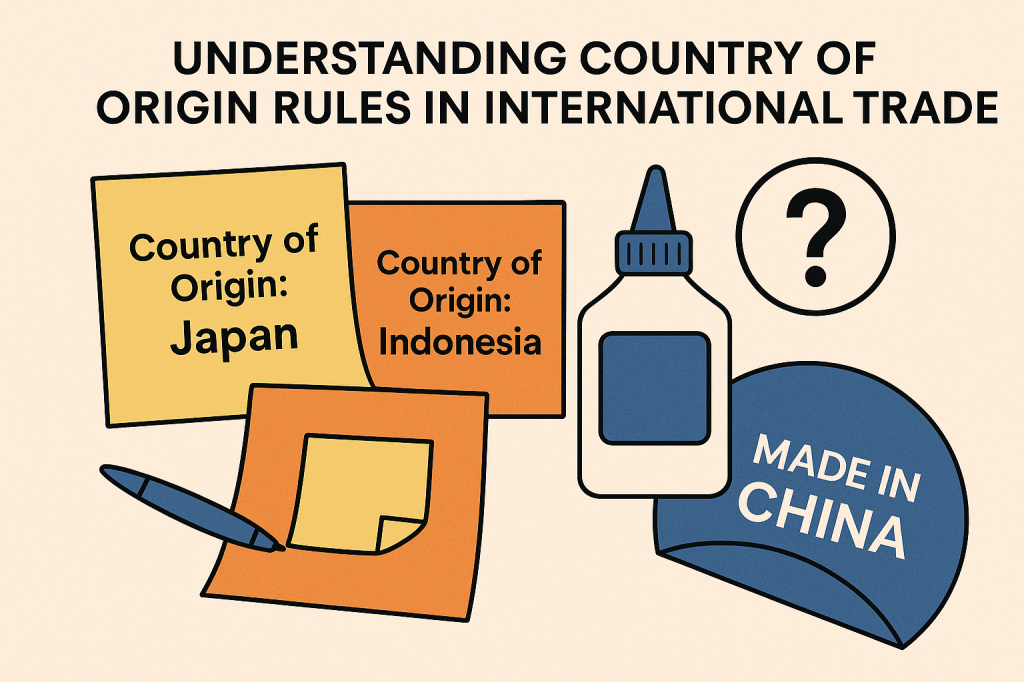
JEFF GUO, BYLINE: Imagine you’re a company making sticky notes. You buy paper, which comes from either Japan or Indonesia. You buy glue, which comes from Taiwan. And then, in China, workers cut up the paper, apply the glue, and you’ve got yourself some sticky notes. Now, here is the million-dollar question these days – what is the country of origin of these sticky notes? Like, what is the official country they come from?
MAUREEN THORSON: So U.S. law is very unique in its approach to country of origin.
GUO: Maureen Thorson is an international trade lawyer. She says companies are often surprised when she explains just how it all works.
THORSON: You can have products, including fairly sophisticated products, where most of the components and the assembly is all happening in China, but the product is not deemed Chinese under U.S. laws.
GUO: U.S. law says that a product’s country of origin is based on the place where its parts or ingredients were transformed into something new. The term for this is a substantial transformation. For example, if a company takes avocados from Mexico, brings them to China and then turns them into guacamole, that is a substantial transformation. Customs would say that company’s guacamole is a product of China. But not every example is quite so simple. Over the years, questions about country of origin have gotten pretty confusing.
LARRY FRIEDMAN: The complexity of supply chains has grown over time, and that’s really what drives the difficulties.
GUO: Larry Friedman is a longtime trade lawyer. He co-wrote the textbook on customs law. He says that as manufacturing has gotten more complicated, courts and customs officials have been raising the bar on what counts as a substantial transformation.
FRIEDMAN: Basically, the rule now is that simple assembly, as opposed to more complex assembly, is often not enough to result in a substantial transformation.
GUO: That brings us back to our sticky note example, which, by the way, is a real case that customs looked at several years ago. And what customs decided was that the final step of the manufacturing process, where the paper and the glue were combined in China – that was not a substantial transformation. So those sticky notes would not count as products of China.
THORSON: I think they were persuaded by the fact that, what do you use a sticky note for? To write on like paper, ’cause it’s made of paper. So it’s the paper that is important here. The stickiness is a bell and whistle to the sticky note, not the essence of the sticky note.
GUO: The essence of a product is what tends to matter these days. Here, customs decided that a sticky note is basically paper, so its country of origin is where that paper was made – in this case, Japan or Indonesia. Recently, Maureen has been helping companies think about changing their manufacturing so their products are no longer considered made in China. And sometimes you don’t have to move everything out of China, as long as another country is supplying the key component – the essence of the product. Whatever that means.
Jeff Guo, NPR News.
Vocabulary and Phrases:
- Sophisticated – Highly developed or complex, often referring to advanced technology or systems.
- Components – The individual parts that make up a product or system.
- Deemed – Considered or judged in a particular way.
- Substantial – Large in amount or importance; significant.
- Drives – Causes or motivates something to happen or develop.
- Raising the bar – Increasing the standards or expectations for quality or performance.
- Persuade – To convince someone to do or believe something through reasoning or argument.
- Bell and whistle – Extra features added to a product to make it more attractive, but not essential.
- Essence – The most important or defining part of something.
Comprehension Questions:
- What is a substantial transformation, and why is it important for determining a product’s country of origin?
- Why did U.S. customs decide that sticky notes assembled in China were not considered Chinese products?
- Why is the “essence” of a product important for deciding its country of origin?
- How has the complexity of modern supply chains affected customs decisions?
- Why might some companies want to move their manufacturing out of China?
Discussion Questions:
- Have you ever thought about where the products you buy are actually made? Why or why not?
- Should companies be required to clearly state where their products are made, including the origins of all their components? Why or why not?
- What are the advantages and disadvantages for a company that chooses to produce goods in multiple countries?
- How do you think changes in tariffs affect consumers?
- Is it fair to consider the “essence” of a product when deciding its country of origin, or should all components matter equally?
 LanguageLeap