Rare earth minerals are essential for technologies ranging from smartphones to fighter jets — but the U.S. faces major challenges in securing them. This lesson explores how China’s dominance over mining and processing rare earths creates vulnerabilities for American industries and national security. Students will learn key vocabulary related to economics and geopolitics, practice reading and listening comprehension, and discuss real-world issues of global supply chains, strategic resources, and economic negotiation.
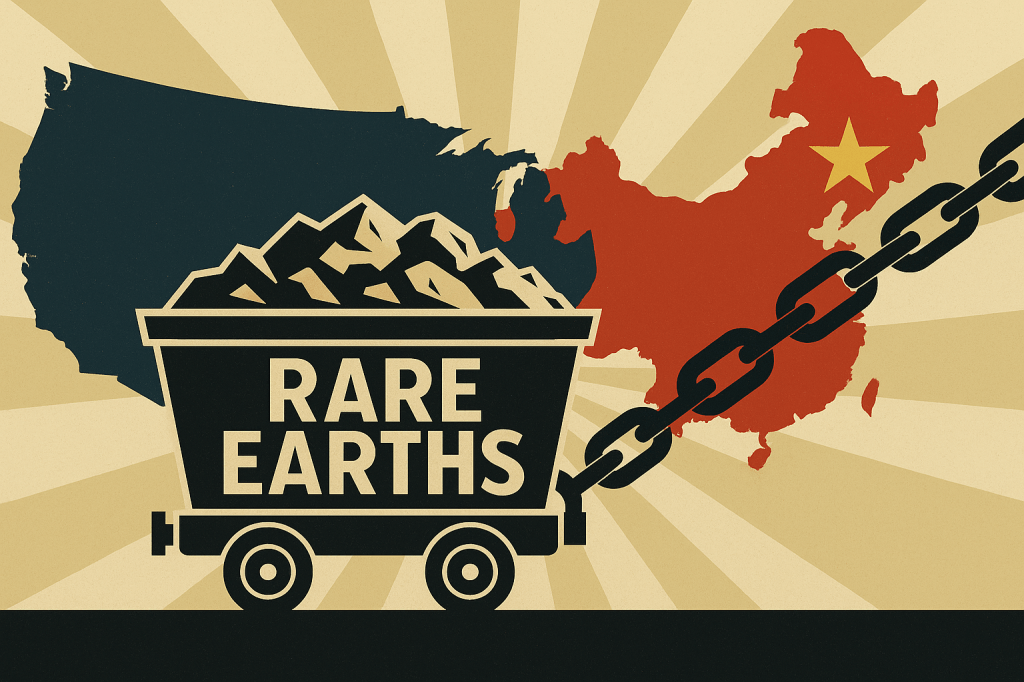
| Rare earth minerals aren’t rare, but the U.S. is having a hard time getting them |
Warm-up question: Have you ever relied heavily on a product or service only to realize later that it was risky to depend on it too much? What happened?
Listen: Link to audio [HERE]
Read:
A MARTÍNEZ, HOST: President Trump is calling for the Commerce Department to look at the possible security risks from America’s reliance on imported rare earth minerals. Those are 17 elements that are difficult to mine, but are crucial for U.S. defense. And the ask comes after China curbed exports of some of those minerals as part of its retaliation against American tariffs. China dominates the rare earth mineral market, mining about 60% of the world’s supply. And the White House says America’s dependence on imports exposes the country to, quote, “economic coercion.”
So does this give China an advantage in the trade war? I asked Gracelin Baskaran about that. She directs the Critical Mineral Security Program at the Center for Strategic and International Studies. And we’ll note we spoke before the president ordered the security review.
So, Gracelin, what minerals exactly are we talking about here? Rare earth minerals sounds very, very space age.
GRACELIN BASKARAN: So rare earth minerals are actually a misnomer because they’re not rare. They’re actually found everywhere. However, they’re found in very small quantities in a lot of places. There’s two types of rare earths. We have light rare earths, and we have heavy rare earths, and we – they’re categorized by literally their weight. Now, these restrictions are targeted at heavy rare earths. And the difficulty is that China actually processes near a hundred percent of these, which means not only do they mine them, they source heavy rare earths from around the world, bring them back, and they separate them – where they take the actual rare earths out of the rest of the rock – in China, which makes the rest of the world highly vulnerable to any restrictions that they place.
MARTÍNEZ: Are they pretty much the kingpin there on rare earth minerals?
BASKARAN: China has an absolute dominance here.
MARTÍNEZ: And what does the U.S. military use rare earth minerals for?
BASKARAN: So rare earths are used in almost every form of defense technology, from warships and fighter jets to missiles, lasers and tanks. And for you to understand just how much of them we use, in an F-35 fighter jet, we use about 900 pounds of rare earth elements.
MARTÍNEZ: So is the U.S. looking at a situation where they might have to stop building things for its defense?
BASKARAN: The U.S. does have capabilities; however, we are very late to the game. So we have actually given out over $400 million through the Defense Production Act to build those separation facilities here in the United States. But the difficulty is mining and processing is a long-term effort. I can’t just build that overnight. The second thing is we do have stockpiles in the U.S. The big question mark for us is this is not a ban on rare earth. What China is doing is they are making companies apply for a license to export these materials. We don’t expect this to be a transparent process.
While China works out that licensing process, we will have a pause, and the hope is that our stockpiles will tide us over. But ultimately, if China wants to make these restrictions more strict, for example, by putting in a ban, that would potentially cause disruption to both military use but also our civil use. I mean, rare earths are in the – in your MRI scanners and your PET scanners, for example.
MARTÍNEZ: So are these restrictions, you think, impactful enough that China could force the U.S. to back down from tariffs?
BASKARAN: It’s a very powerful negotiating tool that they have. Absolutely. At the end of the day, the U.S. is going to have to make a decision, whether it’s going to continue on its tariff trajectory with China but at the cost of the very minerals that we need for our national security, our economic competitiveness – they are in your semiconductors and your iPhone – and our energy resilience because they are in most forms of energy technology as well.
MARTÍNEZ: Gracelin Baskaran is director of the Critical Minerals Security Program at the Center for Strategic and International Studies. Gracelin, thanks.
BASKARAN: Thank you so much for having me.
Vocabulary and Phrases:
- Crucial – Extremely important or necessary for success or survival.
- 13 Retaliation – An action taken in return for an injury or offense; revenge.
- Economic coercion – Using financial pressure or threats to force another country or group to act in a certain way.
- Space age – Related to the time when space exploration became possible; often used to describe something very futuristic.
- Misnomer – A wrong or inaccurate name or description for something.
- Literally – Exactly, in a true and accurate sense, without exaggeration.
- Kingpin – The most important person or thing in an organization or situation.
- Late to the game – Getting involved in something after others have already been working on it for a while.
- Tide (us) over – To help someone through a difficult period, usually with a temporary solution.
- Trajectory – The path or progression of something over time, especially toward a particular result.
Comprehension Questions:
- What are rare earth minerals, and why are they important to the U.S.?
- Why does Gracelin Baskaran say that rare earth minerals are a misnomer?
- What role does China play in the rare earth mineral market?
- How does the U.S. currently deal with its dependence on rare earth minerals?
- What could happen if China further restricts rare earth mineral exports?
Discussion Questions:
- Why do you think rare earth minerals are such an important strategic resource?
- Should the U.S. invest more in domestic mining even if it takes a long time? Why or why not?
- How should countries balance short-term needs with long-term risks in supply chains?
- Have you ever had to “tide over” during a shortage of something important in your life? How did you manage?
- Do you think economic coercion is an effective tool in international relations? Why or why not?
 LanguageLeap