Elon Musk is making headlines again—this time for helping the Trump administration orchestrate mass layoffs of federal employees. As part of a new cost-cutting initiative, Musk argues that reducing the government workforce will make agencies run more efficiently, mirroring tactics he has used in Silicon Valley. However, critics argue that cutting staff won’t significantly reduce government spending and could disrupt essential services. This lesson explores the debate over government efficiency, the economics of mass layoffs, and the historical push to reduce federal bureaucracy. Ideal for advanced English learners, this material introduces key vocabulary in politics, economics, and corporate strategy while fostering critical discussions on government reform.
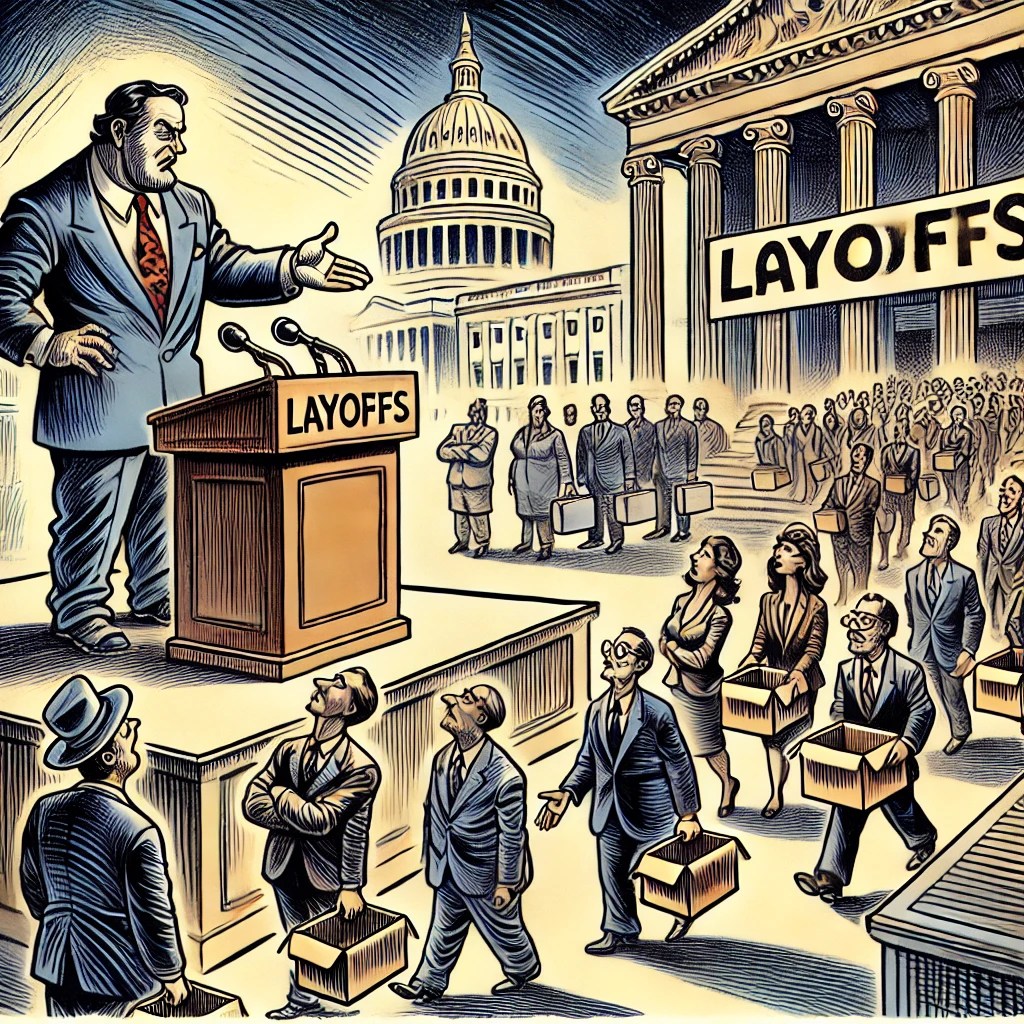
| Will Musk’s tactic of firing people to cut costs make the government more efficient? |
Warm-up question: Have you ever been in a workplace that made major changes, like layoffs or restructuring? How did it affect the employees and the overall work environment?
Listen: Link to audio [HERE]
Read:
SCOTT DETROW, HOST:
Billionaire Elon Musk is helping the Trump administration orchestrate mass firings of thousands of federal workers. That’s been the centerpiece of Musk’s Department of Government Efficiency, a team focused on slashing costs. And it’s a tactic Musk has used in his business career. But as NPR’s Bobby Allyn reports, the Silicon Valley-style moves are up against different realities in the federal government.
BOBBY ALLYN, BYLINE: In the past month, Musk has gleefully posted on X about sacking federal workers and pulling apart entire agencies. Talking to Fox News host Sean Hannity Tuesday night, Musk said this is what the mass layoffs are about.
ELON MUSK: In order to save taxpayer money, it comes down to two things – competence and caring.
ALLYN: Musk claims you have to care enough to find ways to cut spending, and you have to be competent enough to figure out how. As to opposition from Democratic lawmakers, some judges and government workers who are suing?
MUSK: I guess we must be over the target of doing something right, you know? Like, they wouldn’t be complaining so much if they – we weren’t doing something useful, I think.
ALLYN: In Silicon Valley, when tech companies need to cut costs, firing lots of people is a useful way to save money. Musk, who runs six companies, knows this. After Musk bought Twitter in 2022, he got rid of 80% of the staff. That’s because for many tech companies, employee salaries and benefits are the No. 1 expense. Not so in the federal government, where personnel costs make up just about 4% of the entire budget.
MAX STIER: The idea that this exercise of slashing the headcount of the federal workforce is about cost savings makes no sense. And it makes no sense because it is not the primary cost center.
ALLYN: That’s Max Stier. He runs the Partnership for Public Service. It’s a nonprofit focused on improving government. He says there are about 2 million federal employees nationwide.
STIER: People should know that’s about the same size as it was in 1969. So headcount has actually not grown even in absolute terms, and it’s shrunk in relative terms to the whole population.
ALLYN: A recent Washington Post estimate put it another way. Laying off a quarter of the entire federal workforce would only reduce federal spending by 1%. So if slashing civil servants isn’t going to save much money, then why has Musk launched a campaign against rank-and-file workers? I asked author and historian Thomas Frank this question. His 2008 book, “The Wrecking Crew,” examined how Presidents Ronald Reagan and George W. Bush also tried to declaw the federal bureaucracy. Frank says what Musk and DOGE are doing are part of a long conservative tradition.
THOMAS FRANK: The Chamber of Commerce had a slogan back in the 1920s. They used to say, more business in government, less government in business. And this has always been kind of close to the heart of how Republicans have administered the state.
ALLYN: In other words, replace career government workers with business types under the banner of saving money. Trump has also made his personal resentment of what he calls the deep state clear. He insists the federal bureaucracy is undermining him out of political animosity, which is why Musk has tapped loyalists as part of DOGE. They’re a crew of mostly Silicon Valley engineers and managers trying to terminate staff and completely dismantle agencies. Frank says what Musk and DOGE are doing to shrink the size of government already goes well beyond what past Republican administrations tried to accomplish thanks to Trump’s buy-in.
FRANK: He is this embodiment of this long-standing Republican dream. In a lot of ways, he’s doing a lot of the same things that Ronald Reagan set out to do, that George W. Bush set out to do. Only, he’s doing it a lot more forcefully.
ALLYN: Frank says if Trump and Musk really want to cut government costs, they’ll have to find ways to attack the biggest government expenses, Social Security, health care and defense. Together, that’s 60% of U.S. spending.
Vocabulary and Phrases:
- Orchestrated: Carefully planned and coordinated to achieve a specific goal.
- Centerpiece: The most important or central part of something.
- Competence: The ability to do something well and efficiently.
- Personnel: The employees or staff of an organization.
- Headcount: The total number of employees in a company or organization.
- Rank-and-file workers: Ordinary employees who are not in leadership or management positions.
- Declaw: To weaken or remove power from something or someone.
- Close to the heart: Something that is very important or meaningful to someone.
- Animosity: Strong hostility or dislike.
- Embodiment: A person or thing that represents or is the perfect example of an idea or quality.
Comprehension Questions:
- What is Elon Musk’s role in the Trump administration’s plan to cut federal workers?
- Why does Musk claim mass layoffs will benefit taxpayers?
- What argument does Max Stier make against the idea that reducing government employees will save money?
- How has the size of the federal workforce changed since 1969?
- According to Thomas Frank, why do some conservatives support reducing the size of the federal government?
- What are the three largest expenses in the U.S. government budget?
Discussion Questions:
- Do you think layoffs are an effective way to improve efficiency in a workplace? Why or why not?
- How do you feel about the idea of replacing government workers with private sector employees? Would it make the government more efficient or less effective?
- Should governments operate like businesses, focusing on cost-cutting and efficiency, or do they have different responsibilities?
- What are some possible consequences of reducing the federal workforce by a large percentage?
- Have you ever experienced or witnessed animosity between coworkers or between employees and management? How was it handled?
 LanguageLeap