Are you an advanced English learner seeking thought-provoking lessons? This educational material dives into the landmark case of The New York Times suing OpenAI for copyright infringement. By examining this real-world legal battle, you’ll expand your vocabulary on technology, law, and media ethics, while mastering complex sentence structures and professional-level English expressions. Perfect for learners aiming to improve their comprehension and critical thinking, this lesson offers a unique opportunity to engage with cutting-edge issues while advancing your language skills.
| ‘The New York Times’ takes OpenAI to court for copyright infringement |
Warm-up question: Have you ever used a chatbot like ChatGPT or similar tools? How did it help you, and what did you think of its responses?
Listen: Link to audio [HERE]
Read:
STEVE INSKEEP, HOST:
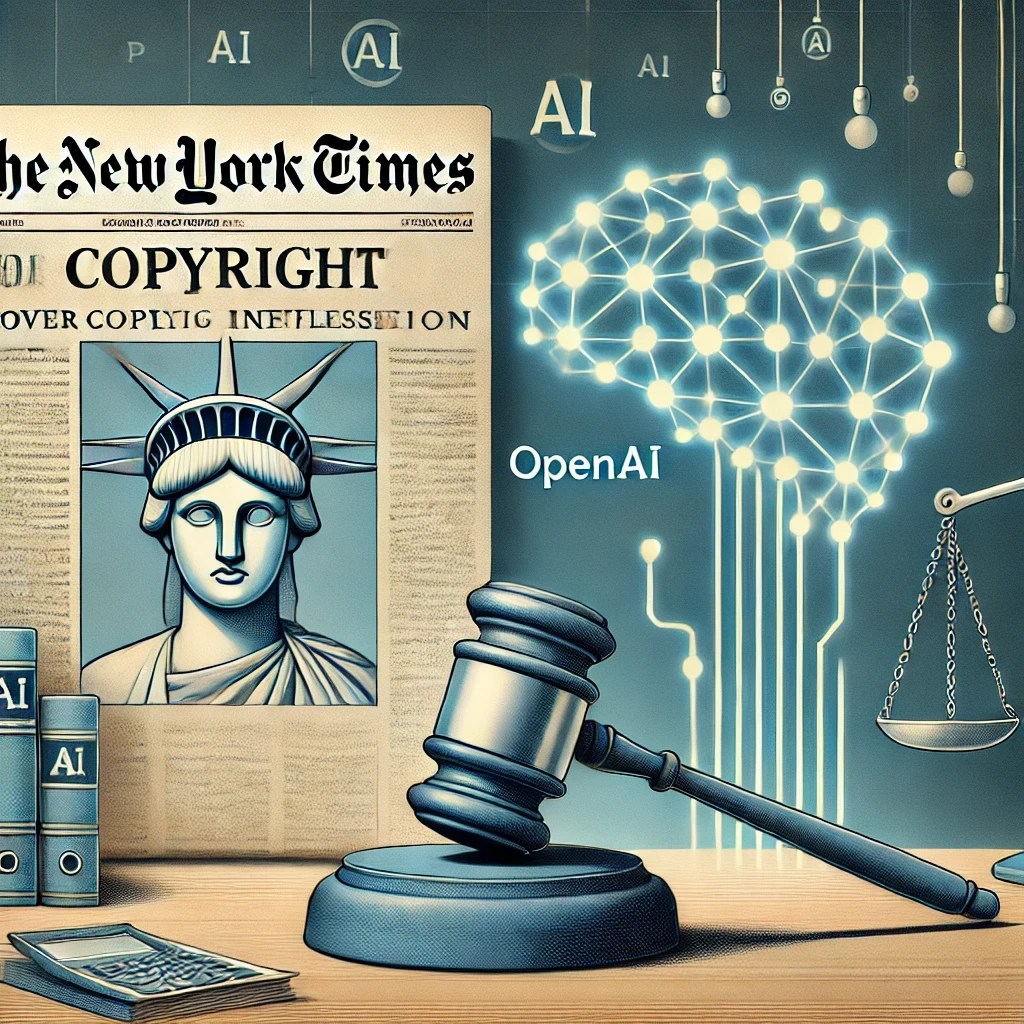
If you should ask ChatGPT a question, the answer from that chatbot on the internet may include information first reported by The New York Times. The Times says it never gave ChatGPT or its maker, OpenAI, permission to do this. So the newspaper and other publishers sued OpenAI for copyright infringement. The case may depend on a hearing that happened yesterday in New York, which NPR’s Bobby Allyn was covering. Hey, there, Bobby.
What was it like in court yesterday?
ALLYN: Well, it was pretty contentious. Both sides were arguing before a federal judge about whether this case should move to trial or be dismissed. And the judge didn’t rule right away. He said he will rule soon. And as you mentioned, this is a copyright case. So pretty wonky. The details get pretty dense, but it boils down to this – was it legal for OpenAI to feed ChatGPT The Times’ digital archive as it was scanning the entire internet? And The Times says, absolutely not. Lawyers for the paper say they never approved it, they never paid for it and they say they have examples of the chatbot reproducing verbatim Times’ articles.
INSKEEP: Yeah. They write the first few words of the article in a prompt, as they say, and the entire article comes back, except with that attribution to The Times or paying The Times. So how did ChatGPT’s owner respond?
ALLYN: Yeah. OpenAI’s legal team told the judge that ChatGPT isn’t a document retrieval system, it’s a large language model, meaning it’s not made to spit out entire Times articles and that The Times was only able to get ChatGPT to do this after asking it thousands of different questions.
INSKEEP: They’re not denying that they used New York Times articles, but they’re saying they didn’t use the exact thing always, and that it’s legal. How can that be?
ALLYN: Well, OpenAI says the mass scraping of texts from all corners of the internet, in order to give ChatGPT an enormous trove of data was done under something called the Fair Use Doctrine. And it’s a legal principle that says a copyrighted work can be used without permission for things like research, education, commentary, journalism, like we’re doing right here. But it cannot be used in a way where it ends up competing with the original and it has to be transformative, meaning it’s got to be made into something new. OpenAI says fair use is a shield that should protect it from this and all copyright lawsuits. But The Times says no way. We should note here that other publishers, including The New York Daily News and the Center For Investigative Reporting have also joined this litigation with The Times, and Microsoft is also being sued here since it incorporated ChatGPT into its Bing search engine.
INSKEEP: OK. You’ve given us an idea of the arguments. What’s at stake here both for publishers and for AI makers?
ALLYN: Yeah. Quite a lot. The news business has been threatened by AI tools, particularly chatbots and so-called answer engines that extract information from articles and synthesize it at lightning speed. And of course, the fears for the news industry is that people will no longer visit publishers’ websites like nytimes.com. If you can get it faster from an AI tool like ChatGPT. And of course, could quickly hurt a publisher’s bottom line. And for AI companies, Steve, this is huge because it will be the first test of whether the mass scraping these firms did was legal or not. The whole industry has basically been operating under this principle that fair use protects them. And if that is wrong, well, it could really open the floodgates to more suits coming after popular AI chatbots, and there are many out there. Now, in the Times case, Steve, the most dramatic outcome here is the judge ordering that OpenAI destroy its entire data set. The Times has asked for that.
INSKEEP: NPR’s Bobby Allyn, Thanks.
Vocabulary and Phrases:
- Chatbot: A computer program designed to simulate conversation with human users, often over the internet.
- Copyright infringement: The unauthorized use of copyrighted material in a way that violates the rights of the copyright holder.
- Contentious: Causing or likely to cause an argument; controversial.
- Wonky: Informal term for something complicated, technical, or difficult to understand.
- Verbatim: Word-for-word; exactly as written or spoken.
- Spit out: Informal phrase meaning to produce or provide something quickly and often automatically.
- From all corners of: An expression meaning from all areas, places, or parts of something.
- Trove: A collection of valuable or interesting items or information.
- Transformative: Causing a significant change or creating something new from the original.
- Litigation: The process of taking legal action or resolving disputes in court.
- At stake: At risk or in question; something important that could be lost or gained.
- Extract: To take or remove something, often with effort or by using a method.
- Synthesize: To combine different elements or information to form a whole or produce something new.
- Bottom line: The most important or fundamental aspect of something, often used in financial contexts to mean profit.
- Open the floodgates: To allow something to happen on a large scale, often uncontrollably.
Comprehension Questions:
- What is the central issue in the lawsuit between The New York Times and OpenAI?
- How does OpenAI defend its use of The New York Times’ content?
- What is the Fair Use Doctrine, and how does OpenAI argue it applies to this case?
- Why are publishers concerned about the impact of chatbots on their businesses?
- What is the worst-case scenario for OpenAI if the court rules against it?
Discussion Questions:
- Do you think AI tools should be allowed to use copyrighted material for training without permission? Why or why not?
- How do you think the rise of AI chatbots might impact traditional journalism and media companies in the future?
- What would you do as a publisher to protect your content from being used without permission?
- If the court rules against OpenAI, what do you think the implications will be for other tech companies developing AI tools?
- How important do you think it is to have access to free or synthesized information through tools like ChatGPT?
Vocabulary Practice
Fill in the blanks using the target vocabulary words/phrases.
- The lawyer explained that the case involved ________, as the company had used the content without permission.
- The presentation was so ________ that many attendees struggled to follow the technical details.
- AI chatbots rely on vast ________ of data to generate their responses.
- The journalist demanded that the article be cited ________ if it was used.
- The debate in court became quite ________, with both sides arguing intensely.
- These AI tools can quickly ________ information from thousands of articles and summarize it.
- If the judge rules against OpenAI, it could ________ for lawsuits against similar AI companies.
- The publisher emphasized that their financial ________ was directly tied to website traffic.
- Using AI tools to ________ and ________ information has revolutionized how we access knowledge.
- The potential outcomes of the case are immense, with billions of dollars ________.
 LanguageLeap