Subscription services have become a huge part of our lives, offering everything from streaming movies to software access. But what happens when canceling these services turns into a frustrating maze? This lesson dives into the rise of the “subscription trap” and explores new rules from the Federal Trade Commission aimed at making cancellations easier for consumers. We’ll examine how companies benefit from recurring payments, why they sometimes make it difficult to leave, and what consumers can do to avoid getting trapped.
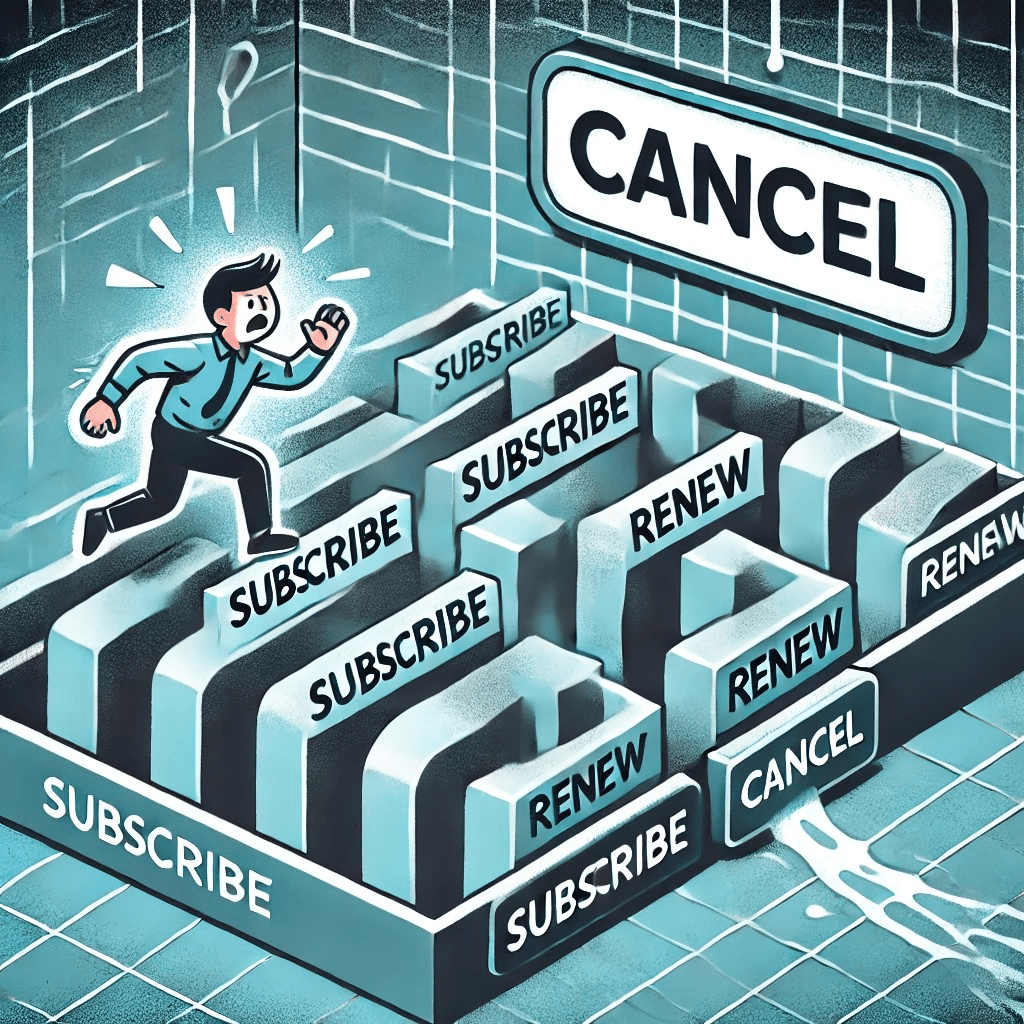
| Examining the subscription trap |
Warm-up question: Have you ever subscribed to a service that was hard to cancel? What was it like?
Listen: Link to audio [HERE]
Read:
A MARTÍNEZ, HOST:
The Federal Trade Commission has approved a regulation called the click-to-cancel rule. It’s aimed at companies that make it intentionally difficult for customers to cancel subscriptions, which you might have noticed are now a pretty big business model. Alexi Horowitz-Ghazi of our Planet Money team looked at why.
ALEXI HOROWITZ-GHAZI, BYLINE: For a long time, the subscription business model was kind of niche – think newspapers or milk delivery. But now everything from razor blades to car washes are available as a subscription. To figure out why, I reached out to Tien Tzuo, the founder and CEO of a subscription logistics company called Zuora.
TIEN TZUO: We’re a little bit invisible – right? – to you. You might not know that we exist, but we’re powering the money transactions behind anything from Zoom to The New York Times to General Motors, to power all sorts of subscription services.
HOROWITZ-GHAZI: Tien explains that our modern subscription-obsessed economy can be traced back to one Silicon Valley company in the late ’90s, where he was an early employee.
TIEN: Well, I think the company that people would point to is Salesforce.
HOROWITZ-GHAZI: Salesforce makes database software for other companies to keep track of sales and marketing. And up until that point, Tien says, the software industry was organized around selling individual goods, CDs with programs like Microsoft Word or Adobe Photoshop.
TIEN: Despite the fact that software was a digital product, it was very much sold on a unit basis.
HOROWITZ-GHAZI: The thing that Tien and his colleagues at Salesforce realized was that in the age of the internet, they could try a different model.
TIEN: Let’s create software that people don’t have to buy, that we run, that we operate, and you simply point your browser at our servers, and we’ll just take care of it for you.
HOROWITZ-GHAZI: Salesforce started offering their software as a service. Now, instead of buying your own copy of some program for a hefty sticker price, you can essentially rent it and spread the cost into smaller recurring payments every month. That made it affordable to more customers, and it gave Salesforce a more predictable stream of income. Within a few years, the company proved this model could be a billion-dollar business. Venture capitalists started investing more into startups that offered software as a service, and the model blew up with things like Netflix and Spotify.
At this point, does it feel like there’s a kind of pressure on almost any type of company if they’re trying to convince investors to back them to use a subscription model?
TIEN: I think I’d be hard-pressed to see a venture capitalist fund a company that does not have a strong recurring subscription model.
HOROWITZ-GHAZI: But the ubiquity of the subscription model has also come with a dark side. Over the past few years, consumer protection agencies like the Federal Trade Commission have received tens of thousands of complaints from customers about companies with opaque terms of service and cancellation processes that are nearly impossible.
SAM LEVINE: Subscription traps are a market failure.
HOROWITZ-GHAZI: Sam Levine is the head of consumer protection at the FTC. The agency has brought several high-profile lawsuits against companies that they see as the worst offenders. And earlier this month, they passed click-to-cancel, requiring companies to make it just as easy to cancel a service as it was to sign up, or risk a fine.
LEVINE: Yeah. You can trap people, and maybe it’ll earn you another 6.99 a month. But if you’re caught, you could be liable for civil penalties of more than $50,000 per violation. And that’s just basic deterrence theory.
HOROWITZ-GHAZI: Sam says the rule is slated to go into effect in about six months. In the meantime, he says, there are apps to track and cancel your subscriptions for you, but only if you’re willing to pay a monthly fee.
Alexi Horowitz-Ghazi, NPR News.
Vocabulary and Phrases:
- Niche: A small, specialized part of a market for a particular kind of product or service.
- Obsessed: Extremely focused on or interested in something.
- Trace back to: To find the origin or source of something.
- Sticker price: The full or listed price of something, often the initial or visible cost.
- Recurring: Happening repeatedly, such as monthly or annual payments.
- Hard-pressed: In a difficult situation, often finding something challenging.
- Ubiquity: The state of being everywhere or very common.
- Opaque: Not clear or transparent; difficult to understand.
- Deterrence: Measures taken to discourage or prevent an action.
- Slated: Scheduled or planned to happen at a certain time.
Comprehension Questions:
- What is the purpose of the new click-to-cancel rule approved by the FTC?
- How did the subscription model evolve from a niche market to something more common?
- Why did Salesforce move away from the traditional sticker price for their software?
- What issues have arisen with the ubiquity of subscription models, according to the FTC?
- What kind of deterrence does the FTC hope to achieve with the new rule?
Discussion Questions:
- Why do you think subscription services have become so popular across different industries?
- Do you find subscriptions for things like streaming or software more convenient, or do you think they’re just extra costs over time?
- How important is it to you to have an easy way to cancel a subscription? Have you ever felt trapped by one?
- What do you think about the FTC’s decision to regulate subscriptions? Will it help make things clearer for consumers?
- Do you think all companies should have transparent terms and cancellation options, or do you think it depends on the service?
 LanguageLeap