A recent study revealed that more than 3,000 chemicals found in food packaging are making their way into our bodies. From plastic containers to nonstick cookware, these chemicals leach into our food, especially when exposed to heat or certain types of food. While not all these chemicals have been fully studied for health effects, some have been linked to serious health issues like cancer and heart disease. This lesson explores the findings of the study, discusses the risks associated with food packaging, and explores ways individuals and regulators can minimize exposure.
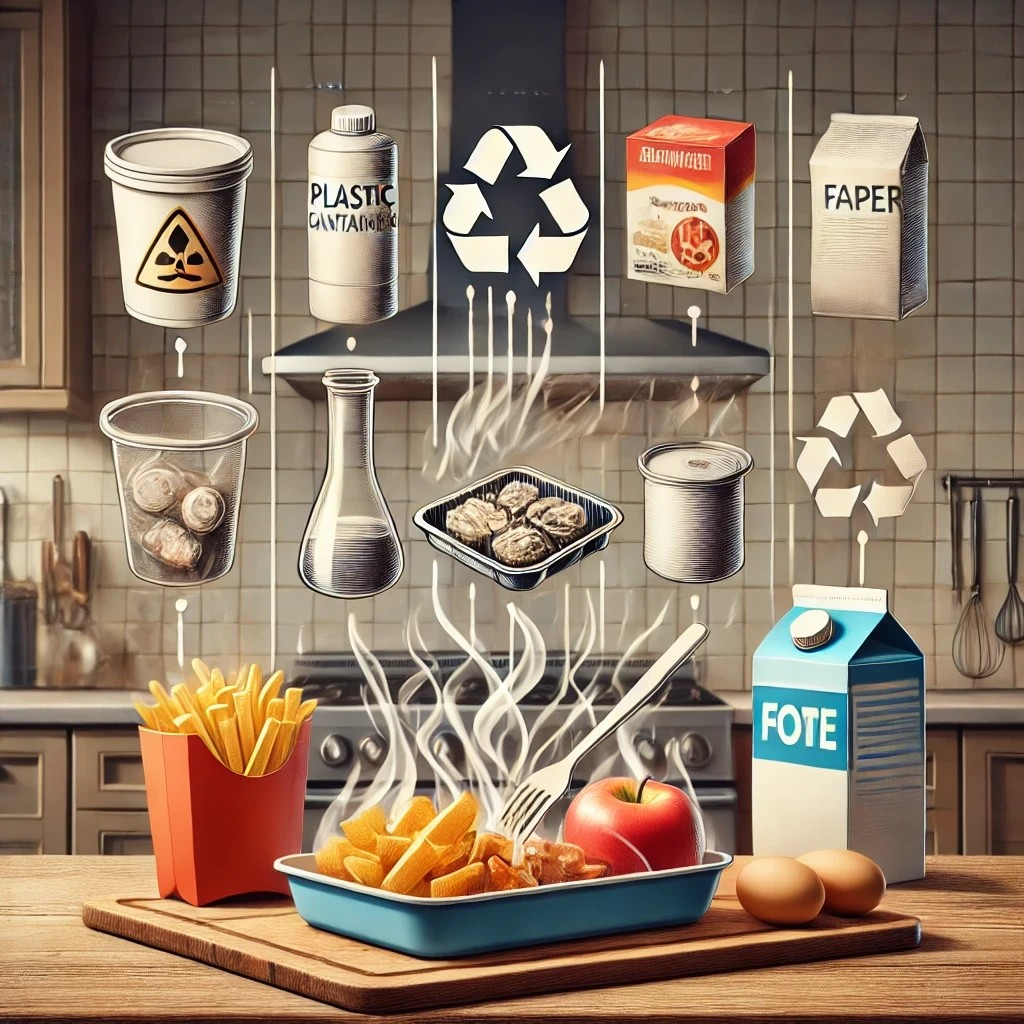
| Chemicals from food packaging leach into food — affecting people’s health |
Warm-Up Question: Have you ever thought about how food packaging might affect the food you eat? Do you think the materials used for packaging could impact your health?
Listen: Link to audio [HERE]
Read:
STEVE INSKEEP, HOST:
A study just found more than 3,000 chemicals in food packaging are in human bodies.
LEILA FADEL, HOST:
Wait, I eat Cheetos. Are you tell me the bag is bad for me, too?
INSKEEP: Yes. NPR’s Pien Huang reports.
PIEN HUANG, BYLINE: Chemicals from food packaging and food making are leaching into food.
JANE MUNCKE: It’s your plastic cooking utensil. It’s your nonstick frying pan. It’s your – I want to say chips, but in the U.S., you say fries – the paper that your fries come in, or the cardboard.
HUANG: Jane Muncke is a toxicologist, and managing director of the Food Packaging Forum in Switzerland. It’s a nonprofit research group that focuses on hazardous chemicals in food packaging. She co-authored a study, out this week, in the Journal of Exposure Science and Environmental Epidemiology.
MUNCKE: So we pulled together all of these data where people had measured food packaging chemicals in blood or in human urine, and so on and so forth, and there’s an overlap of 3,601 chemicals.
HUANG: Three thousand six hundred and one chemicals that are found in both food packaging and in humans. Muncke says one of the ways people get exposed is when the food and the packaging have a chemical reaction. You’ve probably seen it if you’ve ever stored tomato sauce in a plastic container.
MUNCKE: The container’s red, right? That’s because the molecules, like, give the sauce its red color. They have diffused into the plastic. And that happens the other way around, also, so chemicals from your plastic can diffuse into your foodstuff.
HUANG: She says that chemical leaching is hastened by heat, time, whether a food is fatty or acidic and how much of the food is touching the container. Now, this doesn’t mean that all 3,000 of these chemicals are definitely bad for you. Many haven’t been well-studied for health effects, but some are associated with health problems. Dr. Robert Sargis is an endocrinologist at the University of Illinois.
ROBERT SARGIS: Chemicals like phthalates, bisphenols, metals – I think there’s pretty robust evidence to suggest that there are adverse health effects.
HUANG: The study identified around 80 chemicals of high concern, related to health problems like cancers, developmental disorders and heart disease. But Sargis says these specific chemicals are hard to avoid.
SARGIS: The fact of the matter is we don’t know where this stuff is, and we don’t know 100% how we’re getting exposed to it.
HUANG: Like which containers and materials and uses are better or worse. In any case, these chemical effects accumulate over time. Leonardo Trasande is a pediatrician and researcher at New York University’s medical school. And he says studies show that some of these chemicals, like BPAs and phthalates, start clearing your body pretty quickly after you stop ingesting them.
LEONARDO TRASANDE: And if you sustain those interventions, you change hormone levels in weeks. You change your disease profile in months.
HUANG: Researchers say regulators could do more to help. They call for better labeling to help consumers choose, more research to understand the health effects, and restrictions on using the chemicals with known harms in food production and packaging. In the meantime, for individuals, they recommend not microwaving or dishwashing plastic food containers, and using more materials like stainless steel and glass, which are less likely to react chemically with food. Pien Huang, NPR News.
Vocabulary and Phrases:
- Leach into: To seep or pass gradually into something, often referring to chemicals entering food or liquids.
- Utensil: A tool or container, especially one used for cooking or eating.
- So on and so forth: A phrase used to indicate that a list continues in a similar way.
- Diffused: Spread out over a large area or among a large group of people.
- Hastened: To cause something to happen more quickly.
- Endocrinologist: A doctor who specializes in treating diseases related to hormones.
- Robust evidence: Strong, convincing proof or support for something.
- Adverse: Harmful or negative.
- Sustain: To support or maintain something over time.
- Interventions: Actions taken to improve a situation or prevent harm.
Comprehension Questions:
- What did the recent study find about chemicals in food packaging?
- What are some common food packaging materials or utensils that might leach into food?
- How did researchers gather information about the chemicals found in humans and food packaging?
- Why is it concerning that over 3,600 chemicals were found in both food packaging and humans?
- What might be the adverse effects of these chemicals on human health?
Discussion Questions
- Have you ever noticed a chemical reaction when storing food, like how tomato sauce leaves a stain in plastic containers? Why do you think this happens?
- How do you feel about chemicals from food packaging potentially leaching into the food you eat? Should more be done to prevent this?
- Why do you think it’s difficult to find robust evidence proving the long-term health effects of chemicals in food packaging?
- What kind of interventions do you think could help reduce the amount of chemicals that end up in our food from packaging?
- In what ways could the food industry make changes to sustain safer practices in packaging and reduce harmful chemicals?
 LanguageLeap