At the annual Ig Nobel Awards, scientists take a break from their serious research to celebrate the fun and unusual side of their work. From studies on the swimming ability of dead fish to research on plants mimicking plastic leaves, the Ig Nobels highlight discoveries that first make you laugh and then make you think. This lesson explores some of the award-winning research, revealing how humor can coexist with scientific inquiry and why embracing the lighter side of science is important.
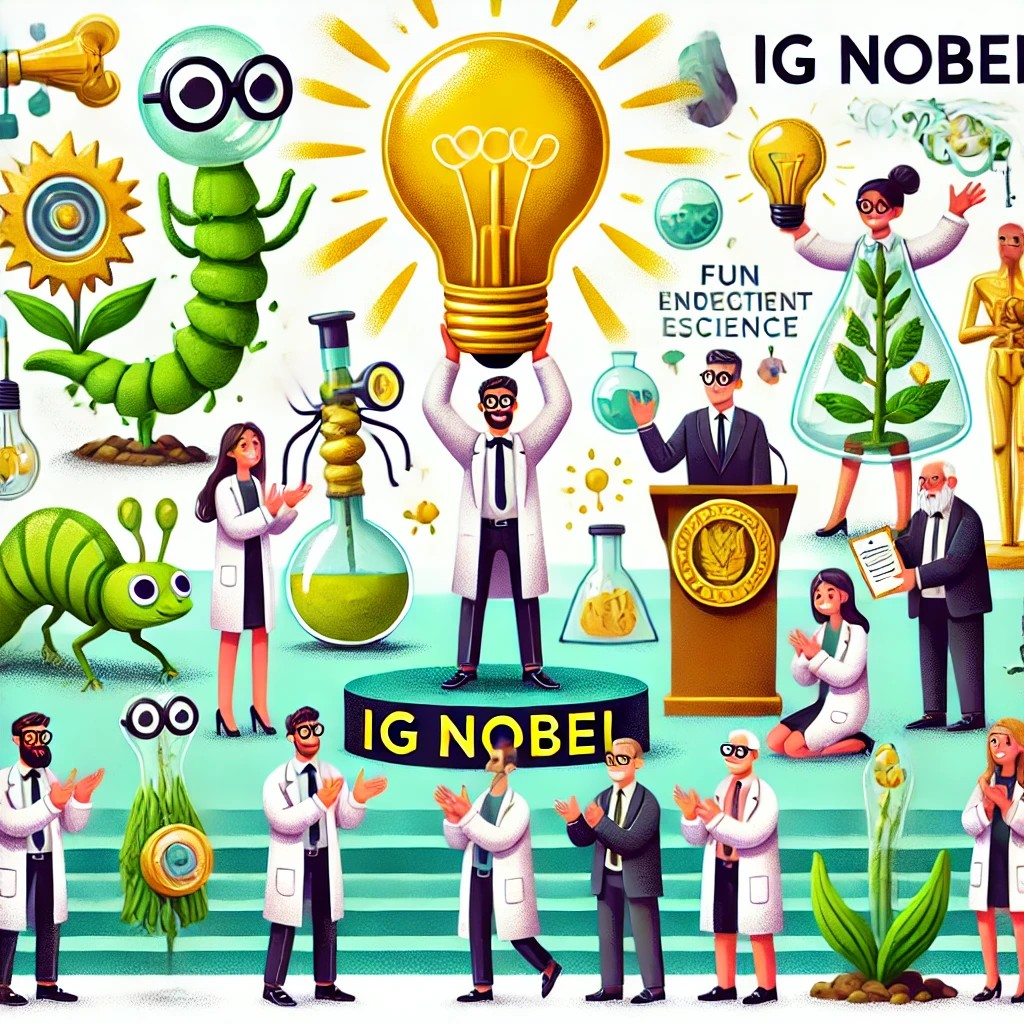
| Scientists celebrate the lighter side of their profession at Ig Nobel awards |
Warm-Up Question: Have you ever heard about funny or unusual science experiments?
Listen: Link to audio [HERE]
Read:
MICHEL MARTIN, HOST:
Last night in Cambridge, Mass., scientists celebrated the lighter side of their profession at the Ig Nobel award ceremony, which was broadcast on YouTube.
MARC ABRAHAMS: We honor some remarkable individuals and groups. Every Ig Nobel Prize winner has done something that first makes people laugh and then makes them think.
MARTIN: Real Nobel laureates awarded 10 Ig Nobel Prizes. Reporter Ari Daniel checked in with two of the winners.
ARI DANIEL, BYLINE: Felipe Yamashita has a somewhat alternative view of plants.
FELIPE YAMASHITA: I believe that the plant can see.
DANIEL: You heard that right. He believes plants can see.
YAMASHITA: I don’t know how they can see, but I’m pretty sure they can understand what’s going around.
DANIEL: Yamashita just finished his Ph.D. in botany at the University of Bonn. His thesis focused on a plant found in the temperate rainforests of southern Chile, a plant that he found grew to mimic the shape of plastic leaves placed alongside it.
YAMASHITA: Almost all leaves that were growing close to the plastic leaf copied the plastic leaf shape.
DANIEL: Yamashita thinks the real leaves sense the shape of the plastic leaves by detecting where they were letting light through and where they weren’t.
YAMASHITA: So the leaf grow one way, not the other way – one direction, not the other direction.
DANIEL: So seeing – kind of. Yamashita says it may function as a kind of camouflage to help the plant blend in with its neighbors, to reduce being munched on by some herbivore. His paper on the subject scored him an Ig Nobel Prize, an award honoring unusual science.
YAMASHITA: I feel my research fits really well on this prize because I receive a lot of critics about the paper.
DANIEL: Another Ig Nobel recipient is Saul Justin Newman at Oxford University.
SAUL JUSTIN NEWMAN: I was joking to my family, you know, every scientist dreams of the Nobel. But my dream had a typo, and I’m perfectly happy.
DANIEL: Newman won for his research showing that data related to some of the people who’ve lived the longest on the planet is riddled with errors.
NEWMAN: For example, the world’s oldest man has three birthdays, one of which seems to be a deliberate fraud. In Japan, 82% of the hundred-year-olds turned out to be alive on paper and dead in reality.
DANIEL: Newman admits, at first, it sounds kind of humorous. But he says there’s something pernicious going on.
NEWMAN: Picture your father dies at the age of 95. You’ve got no job, and their pension check turns up the week after they’re dead. All you have to do for that pension check to keep turning up in perpetuity is not register the death.
DANIEL: Newman says it’s easy to get away with, and he’s found a link between people who reach remarkable ages on paper and places in the world where there’s a hefty amount of pension fraud.
NEWMAN: It’s dissonant because all of these places don’t rank very highly on any other metric of survival.
DANIEL: Newman received his Ig Nobel award at the Massachusetts Institute of Technology. Other winners included a prize for the study of the swimming ability of dead trout, and another for demonstrating a technique for separating drunk worms from sober ones. The ceremony was MCed by Marc Abrahams, the founder and organizer of the Ig Nobels. He closed with these words.
ABRAHAMS: If you didn’t win an Ig Nobel Prize tonight – and especially if you did – better luck next year. Thank you.
DANIEL: For NPR News, I’m Ari Daniel.
Vocabulary and Phrases:
- The lighter side: Refers to a more humorous or less serious aspect of something.
- Thesis: A long piece of writing on a particular subject, often written for a university degree.
- Mimic: To imitate or copy the behavior, actions, or appearance of something.
- Detect: To discover or identify the presence of something.
- Camouflage: The act of hiding or disguising something to blend in with its surroundings.
- Typo: A small mistake in printed or written text, typically involving spelling.
- Riddled with (errors): Full of or containing many mistakes or problems.
- Deliberate: Done intentionally or on purpose.
- Pernicious: Having a harmful effect, especially in a gradual or subtle way.
- In perpetuity: Lasting forever or for an indefinite period.
- Get away with: To escape the consequences of doing something wrong.
- Dissonant: Lacking harmony; conflicting or inconsistent.
Comprehension Questions:
- What does the Ig Nobel Prize celebrate, according to the transcript?
- What was Felipe Yamashita’s research about, and how does it connect to the idea of plants being able to “see”?
- How did Saul Justin Newman’s research reveal that some of the oldest people’s data is riddled with errors?
- Why does Newman describe the fraud involving pensions as pernicious?
- How does Newman link long lifespans on paper with dissonant survival metrics in certain places?
Discussion Questions
- What do you think about the idea of celebrating the lighter side of science with awards like the Ig Nobel Prize? Does humor have a place in serious topics?
- Have you ever come across information that was riddled with errors or seemed off? How did you handle it?
- Why do you think some people get away with fraud or dishonesty in certain situations, like the pension fraud mentioned in the transcript?
- How do you think mimicking or camouflage might be useful in nature or everyday life? Can you think of examples?
 LanguageLeap